Loraine Keller
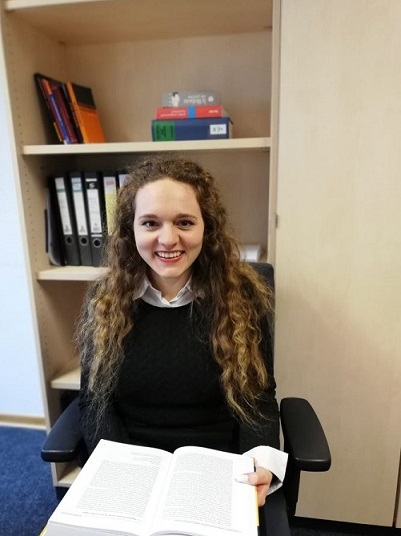
Portrait
Loraine Keller studied Romance Studies (French, Spanish) and Journalism at the Johannes Gutenberg University Mainz and the Université François Rabelais in Tours (France). After completing her master's degree, she worked for two years in the Department of Economics at Mainz University of Applied Sciences before going on to study Media Translation in Hildesheim, where she specialized in accessible Communications. During her master's degree, she worked at the Easy Language Research Center at the Institute for Translation Studies and Specialized Communication at the University of Hildesheim.
Since April 2020, Loraine Keller has been an associated participant in the doctoral program "Chronic Diseases and Health Literacy" (ChEG) at Hannover Medical School and part of the BK-Med (Barrier-free Medical Communication) research group at the Easy Language Research Unit in Hildesheim. Her research focuses on the acceptability of plain language Communications for different target groups.
Her doctoral project is supervised as an interface topic between translation and health science at the University of Hildesheim and the Hannover Medical School and focuses on comprehensibility-optimized medical communication for the target group of senior citizens.
Topic of the doctorate
Comprehensibility-optimized medical communication: Acceptability and acceptance of texts in simple and easy language
Background
Texts in external medical communication are often inappropriate in various ways (cf. Schindler 2019:660). Health information must therefore be prepared with the specific needs and requirements of individual target groups in mind. Only then can health literacy be developed as the ability to "find, understand and critically assess health-relevant information, relate it to one's own life situation and use it to maintain and promote health" (NAP Health Literacy 2018:12). However, in order to be able to understand, assess and use health-relevant information, "user-friendly preparation of information as well as language and text structure that is understandable to laypeople" (ibid. 42) are necessary.
The study focuses on the group of senior citizens (65+). This group is considered vulnerable in terms of health literacy and represents a rapidly growing group in terms of the proportion of different age groups in the population (ibid., Statista 2021). The pioneering study by Gutermuth (2019) shows that senior citizens have the best comprehension and retention rates for plain language texts in specialist legal communication. However, texts in plain language are perceived by this group in particular as potentially provocative, stigmatizing and generally not appropriate for them (ibid.). At the same time, this group requires more health information in their everyday lives than other recipient groups and also has a higher proportion of inadequate and problematic health literacy in Germany compared to Europe (Schaeffer et al. 2016:48). In view of the increased needs of this group, this is highly problematic, and research into comprehensibility-optimized and acceptable health information texts therefore represents a research desideratum of particular urgency.
Aim
The aim of the study is to investigate the sensitivities of the target group with regard to different text levels (standard language, simple and easy language) of health information in order to obtain empirical results on which elements in a (comprehensibility-optimized or standard) text make it particularly (in)acceptable. Qualitative methods will be used to evaluate the texts with regard to the criterion of user acceptance.
Facets of health literacy will also be examined qualitatively according to the model of Sørensen et al. 2012: How do respondents go about searching for or finding health information, which media do they use and which sources do they trust? How do they assess the information and sources they use? What is their general attitude towards health and how do they assess their own state of health?
Method
The test subjects are presented with three texts on a health information topic (presentation of the course, symptoms and treatment options for various illnesses or an overview of how painkillers work and what they can be taken for) in three different text versions (standard language, simple and easy language). After a short introduction, the three texts are read by each test person, followed by a block of questions in the form of an interview. The interview takes an average of around half an hour per test person.
Due to the pandemic-related restrictions and also in order to minimize the "interviewer interference factor", the interviews are not only conducted by the researcher herself, but also by trusted persons (e.g. relatives, nursing staff) of the interviewees.
The audio track of each interview is recorded using a recording device and then transcribed. The data will be analyzed qualitatively to answer the research questions (see above).
Publications
Ahrens, Sarah; Schulz, Rebecca; Kröger, Janina; Hernández Garrido, Sergio; Keller, Loraine & Rink, Isabel (eds.) (2022): Accessibility - Health Literacy - Health Information: Interdisciplinary Approaches to an Emerging Field of Communication. Berlin: Frank & Timme.
Ahrens, Sarah/Hernández Garrido, Sergio/Keller, Loraine/Kröger, Janina/Rink, Isabel/Schulz, Rebecca (2021): Medical communication in Easy and Plain Language: On understanding, retaining and accepting specialized medical communication in comprehensibility-enhanced formats. In: Jekat, Susanne J., Steffen Puhl, Luisa Carrer, and Alexa Lintner (eds.): Proceedings of the 3rd Swiss Conference on Barrier-free Communication (BfC 2020). Winterthur (online), June 29-July 4, 2020. Winterthur: ZHAW Zurich University of Applied Sciences, 29-38. DOI: 10.21256/zhaw-3001.
Keller, Loraine (2020): "Form is a difficult word!" - Barriers to the perception and understanding of specialist texts by recipients with disabilities using the example of the Deutsche Bahn passenger rights form. Hildesheim: University publishing house.
Keller, Loraine (2020): People with Cognitive Disabilities and their Difficulties with Specialized Interactive Texts. In: Hansen-Schirra, Silvia/Maaß, Christiane (eds.): Easy Language Research: Text and User Perspectives. Berlin: Frank & Timme, 57-66.
Lectures
Michele J, Ahrens S, Keller L, Posselt J (2022): Target group-oriented health literacy promotion among vulnerable groups - a discussion forum. Congress on Poverty and Health 2022, online, 24.03.2022.