High-throughput methods and stem cell technology support the search for CFTR modulators
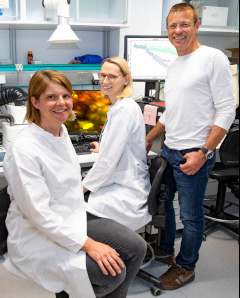
The genetic lung disease cystic fibrosis cannot yet be cured. Since November 2015, the first therapy with CFTR modulators (CFTR = cystic fibrosis transmembrane conductance regulator) has only been admitted in Germany for certain forms of mutation, which enable causal therapy of the defective CFTR ion channel that causes the disease. Scientists from Prof. Dr. Ulrich Martin and Dr. Ruth Olmer's working group at Hannover Medical School (MHH) have developed a method to identify further potential CFTR modulators using disease-specific induced pluripotent stem cells (iPSCs) in a high-throughput process.
Until now, the genetic lung disease cystic fibrosis has been considered incurable; for a long time, only symptomatic treatment was possible. With the first admission of a so-called CFTR modulator for patients with certain mutations of the CFTR gene, hopes are rising that a causal therapy will soon be found for more patients. More than 2,000 different mutations in the CFTR gene are responsible for different defects in the CFTR ion channels and therefore also the severity of the disease. It is therefore not possible to treat all patients with a single drug.
Prof. Dr. Ulrich Martin and Dr. Ruth Olmer, scientists at BREATH, the Hannover site of the German Center for Lung Research, and their colleagues have now developed a method to identify potential CFTR modulators in a high-throughput process. The modern method is based on the use of induced pluripotent stem cells (iPSCs), which are obtained by reprogramming human somatic cells. These cells can be multiplied almost indefinitely in the laboratory and then differentiated into a wide variety of cells. A small blood donation from the patient is sufficient to produce iPSCs with certain disease-specific mutations.
Dr. Sylvia Merkert and Dr. Madline Schubert used iPSCs with the CFTR gene mutation p.Phe508del for their new procedure. In the laboratory, a genetic fluorescence reporter was introduced into these cells, the fluorescence intensity of which correlates with the functionality of the CFTR ion channel. Since it is currently still very time-consuming to differentiate lung cells in large quantities, the iPS cells were instead differentiated into intestinal epithelial cells for high-throughput screening, which are faster and easier to produce. If these cells are treated with potentially effective substances, the activity of the channel can be measured in real time by changing the fluorescence signal, thus determining whether a substance is a potential drug. In this way, the BREATH researchers have already automatically examined over 42,500 different substances, of which around 20 were shown to be potentially effective on the activity of the CFTR ion channel. The results were published in the journal Stem Cell Reports.
"Our results show that disease-specific iPSCs are very well suited for automated drug screening for CFTR modulators," Prof. Ulrich Martin summarizes the significance of this work. "The use of patient cells in the first screening process is a major innovation compared to previous test systems based on tumor cell lines. In the next step, we will now work with our cooperation partners to further investigate the ten most promising substances in primary lung cells. Unfortunately, they may still be unsuitable as drugs. It may also be necessary to reduce toxic effects by chemically modifying the molecule," says Dr. Merkert.
In general, the patient's own induced pluripotent stem cells make it possible to simulate many clinical pictures, for example of the lungs, the heart or the vascular system, in the laboratory. "In future, we also want to use small, multicellular "organoids" to get even closer to the conditions in humans. Modern high-throughput methods in combination with stem cell technology will shorten the development time of new drugs in the future and also significantly reduce the number of animal experiments required," says Dr. Olmer, describing the further plans of her research group.
You can find the original publication here.
Text: BREATH / SM, AB