Research group Kefalakes / Sandmann
We conduct translational research in chronic hepatitis B virus (HBV) and hepatitis D virus (HDV) infection with an overall goal to improve the understanding of the pathogenesis of HDV infection and to develop novel approaches for its diagnosis, risk stratification, and antiviral therapy. To achieve this, we integrate cutting-edge immunological and virological techniques with the analysis of large, well-characterized clinical cohorts.
The hepatitis D virus is the only known satellite virus to infect humans. It causes the most severe form of chronic viral hepatitis and is associated with rapid progression of liver disease, frequently leading to liver cirrhosis and hepatocellular carcinoma. Despite substantial advances in recent years, the mechanisms contributing to viral control, HDV-associated liver disease, treatment response and clinical outcome remain incompletely understood.
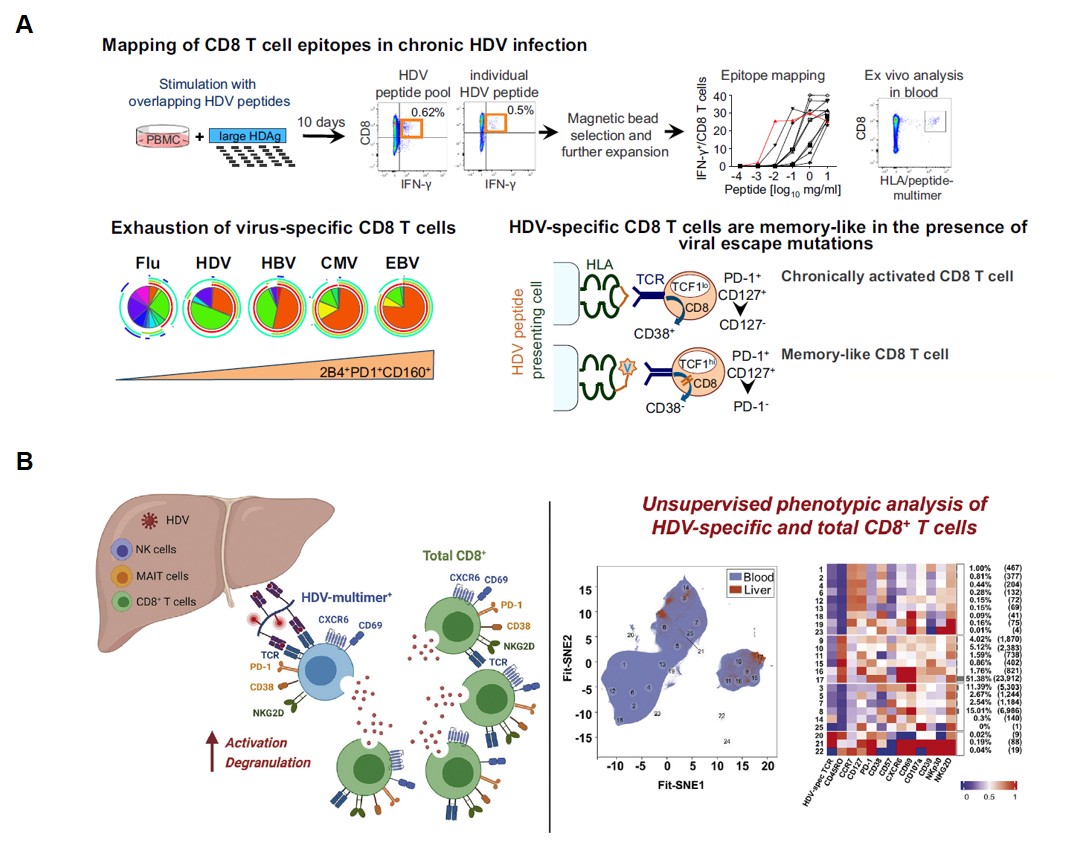
A major focus of our research is the characterization of antiviral immune responses during chronic HDV infection. We investigate the complex interactions between the virus and the host immune system and their role in viral control vs. persistence, and immune-mediated liver disease.
To address these questions, we employ state-of-the-art technologies and systems immunology, including single-cell and spatial transcriptomics, high-dimensional spectral flow cytometry, and a broad range of molecular, immunological, and virological techniques. These datasets are integrated using advanced bioinformatic approaches and linked to detailed clinical phenotypes.
Our work has substantially advanced the understanding of cellular immune responses in chronic HDV infection. We identified HDV-specific CD8⁺ T-cell epitopes and characterized the functional properties of HDV-specific CD8⁺ T cells. We demonstrated that the majority of these cells are not terminally exhausted but instead display a memory-like phenotype in the presence of viral escape mutations. In contrast, T cells retaining antiviral effector functions exhibit chronic activation and an increased susceptibility to apoptosis.
Furthermore, we demonstrated that the intrahepatic microenvironment profoundly shapes the phenotype of CD8⁺ T cells. Liver-resident CD8⁺ T cells display a tissue-resident phenotype with high expression of innate activation markers such as NKG2D. These findings suggest that antigen-independent ("bystander") activation of CD8⁺ T cells contributes to the immunopathogenesis of chronic HDV infection.
Our clinical research focuses on improving the diagnosis, risk stratification, and treatment of patients with chronic HDV infection. We analyze comprehensive clinical datasets and biobank samples from national and international patient cohorts and integrate these data with virological and immunological analyses.
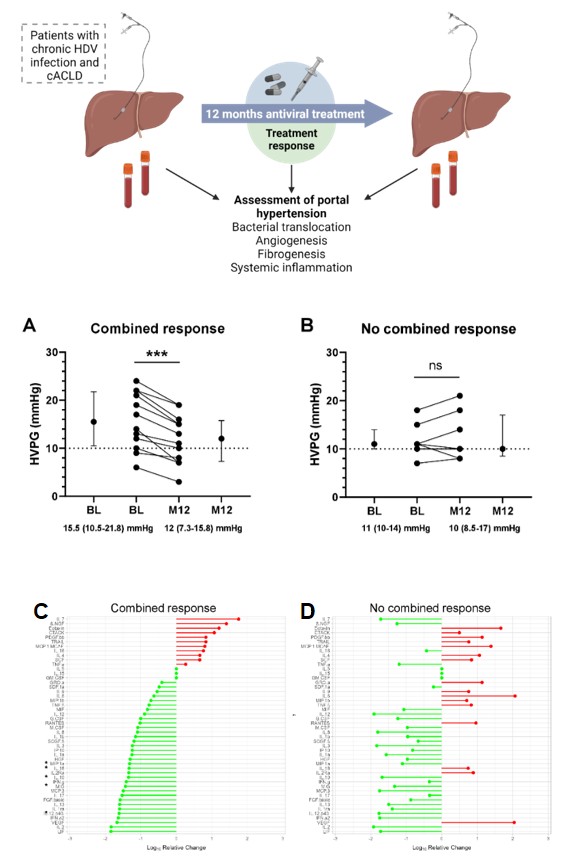
A major objective is the identification and validation of clinical parameters and novel biomarkers predicting disease progression and treatment response. We investigate virological markers, non-invasive methods for assessing liver disease—including transient elastography—and hemodynamic parameters of portal hypertension. Our studies have demonstrated that novel virological biomarkers can predict treatment response and that non-invasive methods provide reliable risk stratification in patients with chronic HDV infection. In addition, we investigate the effects of antiviral therapy on advanced liver disease and portal hypertension in close collaboration with the AG Maasoumy.
The close integration of clinical research with immunological and virological investigations forms the foundation of our research program. By combining molecular and cellular analyses with detailed clinical phenotyping, we identify mechanisms associated with viral control or persistence, disease progression, and treatment response. Our overall goal is to translate these findings into improved diagnostic tools, personalized therapeutic strategies, and better clinical management for patients with chronic HDV infection.
Our research is supported by the German Research Foundation (DFG), the Cluster of Excellence RESIST, the German Center for Infection Research (DZIF), the Horizon Europe research program and internal funding mechanisms of Hannover Medical School.
Further information
Our research group
Dr. med. Helenie Kefalakes
Clinical Department of Gastroenterology, Hepatology, Infectiology and Endocrinology
Hannover Medical School OE 6810
Carl-Neuberg-Str. 1
30625 Hannover
Phone +49 511 532-83742
kefalakes.helenie@mh-hannover.de

PD Dr. med. Lisa Sandmann
Clinical Department of Gastroenterology, Hepatology, Infectiology and Endocrinology
Hannover Medical School OE 6810
Carl-Neuberg-Str. 1
30625 Hannover
Phone +49 511 532-3850
- Rahaf Albarghash, MSc (PhD student, HBRS Infection Biology)
- Shruti Chowdhury, MSc (PhD student, HBRS Infection Biology)
- Ali Ehsani, MSc (PhD student, BIOMEDAS)
- Reem Hoblos, MSc (PhD student, HBRS Infection Biology)
- Vrinda S. Nair, MSc (PhD student, HBRS Infection Biology)
- Estéban Schlimme, MSc (PhD student, HBRS Infection Biology)
- Mara Lissek, TA
- Merle Greiß, cand. med.
- Anna Hahn, cand. med. (KlinStrucMed)
- Robin Iker, cand. med. (StrucMed)
- Manfred Anim, PhD
- Carina Jacobsen, PhD (current position: group leader, DSMZ)
- Katja Steppich, PhD (current position: project manager, HepNet Study House)