Exposure assessment of methods used in animal experiments
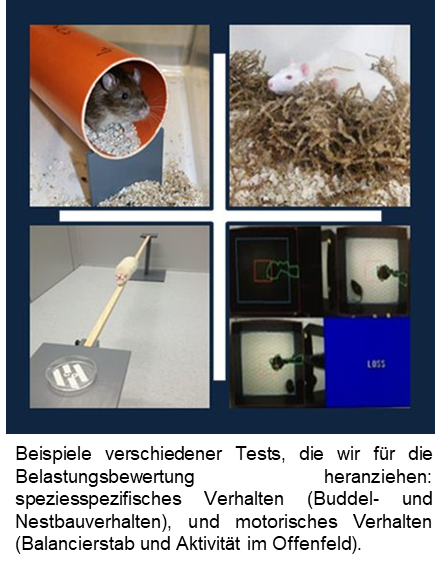
The assessment of exposure in animal testing is a central component of European and German legislation. However, the legally required, graduated assessment is made more difficult by the fact that there are not enough scientifically sound and quantifiable parameters available for the assessment of exposure. As part of a multicenter research project funded by the DFG (severity-assessment.de), suitable parameters and methods are being identified and tested on established animal models in order to create the basis for a scientifically sound and scalable assessment of the burden on laboratory animals in animal experiments. These are then compared across working groups and models.
In our working group, we develop evaluation schemes to assess the burden of intracranial interventions in established rat models of neurological diseases. This includes surgical interventions as well as the tests used in our laboratories to assess motor and cognitive functions, electrophysiological stimulation in the context of deep brain stimulation (DBS), neuronal recordings and the definition of human endpoints in brain tumors. For stress assessment, we combine classic clinical scores with analyses of species-specific spontaneous behavior. In addition, behavioral examinations in the area of motor function and the associative-limbic system as well as telemetric measurements of cardiac activity and movement behavior are used.
These examinations have already enabled us to create a gradation of the stress caused by intracranial interventions of varying complexity, systemic injections, behavioral tests and animal care measures. In addition, we have developed an algorithm based on individual weight progression that allows us to reliably determine the humane endpoint in a rat model with a brain tumor before the onset of severe stress.
This data will be used to optimize the postoperative pain protocol and to improve behavioral studies and housing conditions. Group housing in large, well-equipped cages with running wheels is also currently being tested.
Helgers SOA, Talbot SR, Riedesel AK, Wassermann L, Wu Z, Krauss JK, Häger C, Bleich A, Schwabe K. Body weight algorithm predicts human endpoint in an intracranial rat glioma model. Sci Rep. 2020 Jun 2;10(1):9020. DOI: 10.1038/s41598-020-65783-7
Lewejohann L, Schwabe K, Häger C, Jirkof P. Impulses for animal welfare outside the experiment. Lab Anim. 2020 Apr;54(2):150-158. DOI: 10.1177/0023677219891754
Talbot SR, Biernot S, Bleich A, van Dijk RM, Ernst L, Häger C, Helgers SOA, Koegel B, Koska I, Kuhla A, Miljanovic N, Müller-Graff FT, Schwabe K, Tolba R, Vollmar B, Weegh N, Wölk T, Wolf F, Wree A, Zieglowski L, Potschka H, Zechner D. Defining body-weight reduction as a humane endpoint: a critical appraisal. Lab Anim. 2020 Feb;54(1):99-110. DOI: 10.1177/0023677219883319
Schwabe K, Boldt L, Bleich A, van Dijk RM, Helgers SOA, Häger C, Nowakowska M, Riedesel AK, Schönhoff K, Struve B, Wittek J, Potschka H. Nest-building performance in rats: impact of vendor, experience, and sex. Lab Anim. 2020 Feb;54(1):17-25. DOI: 10.1177/0023677219862004
Wassermann L, Helgers SOA, Riedesel AK, Talbot SR, Bleich A, Schwabe K, Häger C. Monitoring of Heart Rate and Activity Using Telemetry Allows Grading of Experimental Procedures Used in Neuroscientific Rat Models. Front Neurosci. 2020 Dec 17;14:587760. DOI: 10.3389/fnins.2020.587760
Collaborations
Prof. Dr. Andre Bleich, Dr. Christine Häger, Prof. Marion Bankstahl (Institute of Laboratory Animal Science and Central Animal Laboratory, MHH)
Prof. Dr. René Tolba (Interdisciplinary Center for Clinical Research, University Hospital Aachen)
Prof. Dr. Heidrun Potschka (Institute of Pharmacology, Toxicology and Pharmacy, LMU Munich)
Prof. Dr. Ute Lindauer (Translational Neurosurgery and Neurobiology, University Hospital Aachen)
Prof. Dr. Brigitte Vollmar, Prof. Dietmar Zenker (Institute for Exp. Surgery, Rostock University Medical Center)
Prof. Dr. Lars Lewejohann (Institute for Animal Welfare, Animal Behavior and Laboratory Animal Science, Free University of Berlin)
Funding
DFG Research Unit 2591 - SCHW1176/7-1/2/3