Information on the ward
Welcome to our website
Our Nursing is based on the MHH mission statement and the nursing concept of Hannover Medical School. It is planned, carried out and evaluated in a patient-oriented manner, taking into account the psychosocial situation. We are responsible for a certain number of patients within the framework of reference care.
Ward 74 has 21 beds, which are divided into three units units (74a-c).
Our nursing team consists of full-time and part-time registered nurses (some with additional qualifications such as specialist training in anesthesia and intensive care). Our team is supported by our respiratory therapists, artificial heart coordinators and wound managers. Participation in internal and external training is an integral part of our Human Resources. HTTG's Clinical Department offers its employees its own training program to ensure a high standard of safety and care. We guarantee continuous care by working in a three-shift system in order to restore the well-being and health of our patients through interdisciplinary cooperation.
As a patient at the HTTG Clinical Department, you will receive temporary care on our ward after an operation.
We look after patients before and after cardiac surgery, such as coronary bypasses or heart valve operations, as well as patients after surgery on the large vessels (aorta). Patients following a heart, lung or heart-lung transplant and the implantation of an artificial heart are also cared for by our interdisciplinary team.
In addition, we can also bridge the organ function of the heart and lungs at short notice using special procedures (ECMO therapy). This requires a high standard of monitoring. For this purpose, we have extensive medical technology facilities or Institutions that enable intensive monitoring of patients' organ functions and intensive treatment of functional disorders (especially after operations and transplants).
We are supported in the necessary daily data processing by an IT system tailored to our work processes. This enables the complete recording of patient-related and care-relevant data (haemodynamic monitoring, balancing including online fluid management, laboratory data, etc.). This makes it easier for us to provide complex nursing care, which, in addition to basic care including wound care, mobilization and ventilation weaning, essentially consists of monitoring measures, laboratory checks and the administration of prescribed medication. It is crucial for the course of the patient's condition to react to changes in a timely and appropriate manner. The intensive care knowledge and experience of our nursing staff contribute to this.
Your relative is in our intensive care unit. This is probably a very worrying situation for you.
We would like to provide you with the following information to help you better understand the situation your relative is in.
For some patients, breathing must be supported by a ventilator. This device is connected to the patient via tubes. Air flows in and out via the breathing tube, which is inserted into the windpipe through the mouth or nose. Inserting the tube is called intubation, removing it is called extubation. If the patient needs the help of the ventilator for a longer period of time, a tracheotomy may be performed. As long as the tube is in place, the patient cannot speak, drink or eat. Depending on the patient's situation and the medication used, you may find your relative in an artificial deep sleep, dazed or awake. The awake patient has the opportunity to express themselves through signs and gestures or in response to specific questions. When the tube is removed and the patient is sufficiently awake, they can speak again.
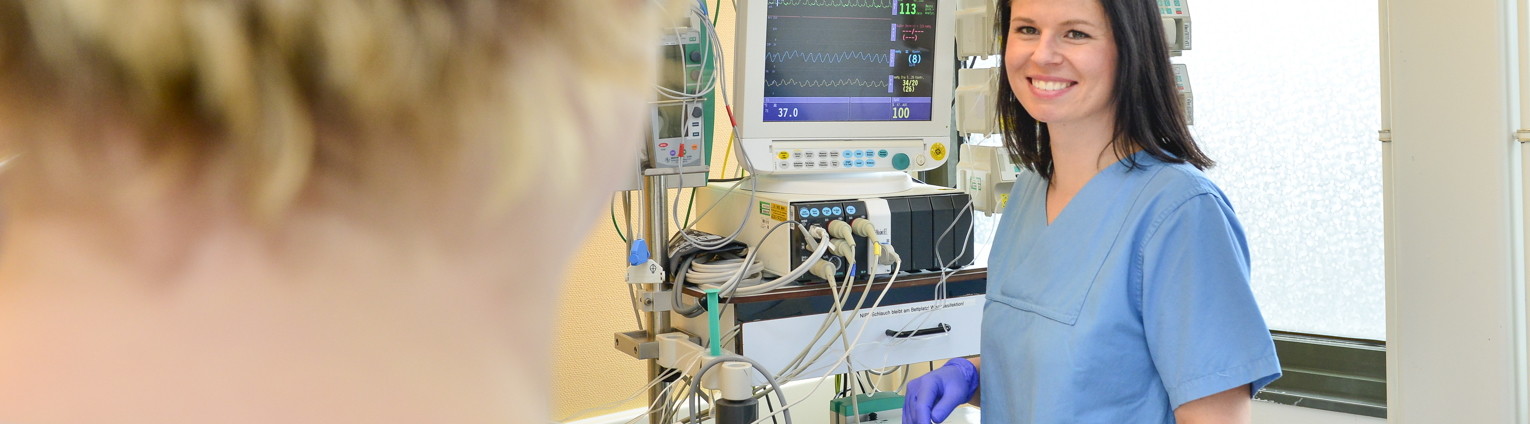
The patient is connected to monitors for constant monitoring of heart function, blood pressure, body temperature, blood oxygen levels and other important bodily functions. The data is recorded via sensors (electrodes) attached to the body and connected to the monitoring devices via cables. The measured values can be read off in the form of curves or figures on the corresponding screens. Almost all devices in the intensive care unit react to even the smallest changes with audible and visible signals. This does not usually mean acute danger. However, the alarms draw our attention to a particular situation and help us to act in good time in an emergency.
Thin plastic tubes (venous catheters) inserted into a blood vessel ensure the necessary supply of medication, fluids and nutrients. As long as the patient is unable to eat and drink normally, nutrition is provided either via a tube inserted through the nose into the stomach (gastric tube) or via the venous catheter. Body fluids, such as gastric juice or urine, are drained through a gastric tube or bladder catheter. After an operation, tubes(drains) are sometimes placed in the wound area to drain secretions and blood so that wound healing is not impaired. These fluids are collected in collection bags or bottles attached to the edge of the bed. Special mattresses on the patient beds are designed to prevent the development of pressure sores (decubiti). Sometimes elaborate special beds are also used for special positioning.
Sometimes a patient has to be isolated because regular bacteriological tests reveal bacteria that are resistant to a large number of antibiotics, i.e. against which these antibiotics are no longer effective. These bacteria are therefore referred to as multi-resistant. If multi-resistant bacteria are detected in patients, it may be necessary to take special hygiene measures to prevent the transmission of these bacteria to other patients. A sign on the room door will inform you of this and the nursing staff will help you to behave appropriately.
We ask you to disinfect your hands regularly. You will find disinfectant dispensers in the visitors' room and in front of each patient room.
Our intensive care unit has regulated work processes. We try to maintain the day-night rhythm for the patient. Doctors examine the patient, determine the therapy and carry out the necessary treatments. They are supported by the nursing staff, who monitor the patient, carry out certain therapeutic measures and record the course of treatment. The nursing staff also support the patient with personal hygiene, mobilization and food intake. Various tasks are also carried out alternately by nursing staff and physicians. However, this routine can be interrupted by acute events. This then requires a change in the work routine and can temporarily give the impression of restlessness.
If necessary, please bring the patient's glasses, dentures or hearing aids with you. You are also welcome to bring your relative hygiene items such as a razor, toothbrush, deodorant or skin lotion. Other personal items and food only after consultation with the nursing staff.
If you have any questions, please do not hesitate to call us. For data protection reasons, we are only allowed to provide information to direct relatives. We would ask you to coordinate within the family so that only one person calls and asks for information and then passes it on.
We will inform you immediately if there are any serious changes in your relative's condition.
- You enter the MHH through the main entrance (building K6) and walk through the shopping street to elevator node_B.
- There, please turn right and continue to elevator node_E.
- Take the passenger elevator to floor 7.
You will then find the entrance to the intensive care area on the left-hand side.
Dear visitors,
Visiting an intensive care unit is often not a pleasant experience, but we will do our best to accommodate your needs as far as possible.
Please use the hands-free telephone with us. You will find the telephone in front of the entrance to the intensive care unit. Please do not enter the intensive care unit until you have registered by telephone and have been requested to do so by the nursing staff. Depending on the situation, we will direct you to your relatives or ask you to come to our visitors' room for a short time.
To ensure that the ward runs smoothly, we ask you to keep to the following times: between 14:00 and 19:30.
We ask for your understanding that even during the specified visiting times, there may be waiting times due to medical and nursing measures. waiting times until we can accompany you to the patients. In this case, please always sit in the waiting room. The nurse in charge will ask you to come in as soon as possible.
Personal contact with the patient through your visits is an important part of recovery. Visits are determined by the patient's ability to cope with stress and their treatment situation. On the day of the operation, the anesthesia may last into the evening hours, so please arrange your visit with us.
In the interests of your relative and other patients, we ask you to make arrangements within the family and ensure that no more than two relatives visit at the same time.
The Visiting children and adolescents in an intensive care unit is problematic. Please contact us in advance!
Please do not leave any personal belongings unattended and always take your valuables with you to the ward.
Flowers and plants are not permitted in the intensive care unit for reasons of hygiene.