Duodenal atresia
Duodenal atresia is a congenital disease in which the duodenum is not passable. This disease occurs either due to the absence of a part of the intestine (true "atresia") or due to a membrane that protrudes into the duodenum like a windsock. In most children, the disease is already detected during pregnancy during check-ups.
Duodenal atresia can only be treated by surgery. This involves either opening the intestine and severing the membrane or stitching the two parts of the duodenum together (duodenoduodenostomy). If no other diseases are present, the individual prognosis for the patient is very good. No subsequent operations or restrictions to daily life are to be expected.
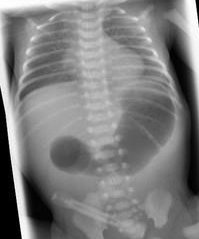
First, an X-ray of the abdomen is taken in the Clinical Department. As the stomach and intestinal tract of the newborn fills with air after birth, two air bubbles form in the stomach and duodenum, which is known as a double bubble. As newborns with duodenal atresia vomit after drinking, a thin silicone tube ("feeding tube") is inserted through their nose. This drains the secretions (saliva, gastric juice, small intestinal secretions), which cannot flow into the rest of the small intestine due to the malformation of the duodenum, to the outside.
The operation is internationally standardized. The part of the duodenum that lies in front of the atresia and is therefore also overstretched is connected to the very narrow part behind the missing section of intestine. The pediatric surgeon surgically adjusts the different widths of the two parts of the intestine. The operation can be performed openly via an abdominal incision or via laparoscopy (minimally invasive). The pediatric surgeon will explain the advantages and disadvantages of both procedures to you before the operation.
Open surgery :
In the open (conventional) surgical technique, the pediatric surgeon makes an incision a few centimeters across the upper abdomen. The abdominal organs are then examined for further malformations. The two parts of the duodenum are exposed. The upper part is incised transversely, the lower part longitudinally. The pediatric surgeon then sutures the two parts together. This connection is called an anastomosis or, in the case of duodenal atresia, a duodenoduodenostomy. The suture is in the shape of a diamond and is made of absorbable material. The stitches do not need to be removed later. Scarring depends on the individual's disposition. As the incision takes into account the so-called cleavage lines of the skin, the scars are often less visible later than expected.
Minimally invasive surgery:
In this minimally invasive surgical technique, the pediatric surgeon makes a small incision in the navel through which he guides a thin tube (trocar) into the abdominal cavity. Air is blown into the abdominal cavity through the trocar and a camera is inserted (laparoscopy). This allows the entire abdomen to be inspected. The operation follows the same principle as the open procedure, except that three additional working channels (trocars) are inserted into the abdomen instead of the upper abdominal cross-section. The two parts of the duodenum are exposed and sutured together as in the open procedure. As there is no skin incision in the minimally invasive procedure, the cosmetic result is better than with the open procedure.
However, not all children can undergo minimally invasive surgery. The surgical technique depends on factors such as birth weight or other malformations (such as heart defects). The pediatric surgeon may also have to switch to the open surgical technique for technical reasons, for example if the overview during laparoscopy is inadequate.
Children with duodenal atresia have to stay in hospital for about 7-10 days after the operation. During this time, the child and mother are cared for by our pediatric nurses and medical team on the infant ward. In the first few days after the operation, your child will not be fed by mouth or via a feeding tube, but intravenously via a drip. The feeding tube will also be left in the child's stomach for a few days after the operation. This is necessary in order to drain the secretions (saliva, gastric juice, small intestinal secretions) that cannot yet pass easily through the small intestine due to temporary swelling of the duodenum and the general sluggishness of the small intestine after the abdominal operation.
A few days after the operation, your child can be fed by mouth. However, it is not possible to predict how long it will take for the bowel to function normally. Every child takes its own time. If your child drinks the food completely and gains weight steadily, he or she is healthy and can be discharged home.
Children with duodenal atresia have to stay in hospital for about 7-10 days after the operation. During this time, the child and mother are cared for by our pediatric nurses and medical team on the infant ward. In the first few days after the operation, your child will not be fed by mouth or via a feeding tube, but intravenously via a drip. The feeding tube will be left in the child's stomach for a few days after the operation. This is necessary in order to drain the secretions (saliva, gastric juice, small intestinal secretions) that cannot yet pass easily through the small intestine due to temporary swelling of the duodenum and the general sluggishness of the small intestine after the abdominal operation.
A few days after the operation, your child can be fed by mouth. However, it is not possible to predict how long it will take for the bowel to function normally. Every child takes its own time. If your child drinks the food completely and gains weight steadily, he or she is healthy and can be discharged home.