Esophageal atresia
If a baby is born with oesophageal atresia, nothing can pass from the mouth into the stomach, neither food nor saliva, which is swallowed unconsciously all the time. However, these newborns very often also have another problem: a connection between the trachea and oesophagus, a "tracheoesophageal fistula" (trachea - windpipe; fistula - tube in Latin). In most cases, this connection is to the lower stump of the esophagus and gastric juice can therefore enter the lungs. This then leads to breathing problems or pneumonia. Conversely, the stomach can also be inflated with air via this connection, which in turn causes abdominal discomfort.
Once an oesophageal atresia has been diagnosed, a complex operation is required. The type of surgical procedure depends on the distance between the upper part of the oesophagus and the lower part. If this distance is short, both parts of the oesophagus can be directly connected with just one operation. If the distance is long, more complex therapies are required.
To make a diagnosis, a small plastic tube is inserted into the esophagus via the mouth and a springy resistance is encountered. An X-ray of the chest shows the air filling of the upper part of the esophagus, which ends blindly (so-called blind sac). Further down you may see an air filling of the intestine as an indication of a lower fistula (connection between the esophagus and trachea).
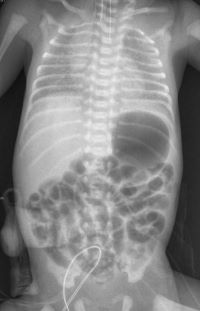
In many cases, esophageal atresia is combined with other concomitant malformations. The most common of these are malformations of the heart. Other typical malformations are those of the arms and legs, vertebral body anomalies, malformations of the kidneys or malformations of other parts of the intestine. These malformations must therefore be searched for using ultrasound and X-rays in the first few hours after admission to hospital. An ultrasound of the heart (echocardiogram or "echo") must also be carried out for surgical planning in order to determine heart function and the position of the aorta
The type of esophageal atresia determines the surgical method and the distance between the upper part of the esophagus and the lower part is of decisive importance. The distance between the ends of the esophagus is based on the projection onto the spine. If the distance between the two ends of the esophagus is less than 5-6 vertebrae, both parts of the esophagus can usually be joined together ("end-to-end anastomosis").
Short esophageal atresia with lower tracheoesophageal fistula (type 3b):
This is the most common form of esophageal atresia (90%), there is a short distance between both parts of the esophagus and also a fistula between the esophagus and trachea. As the distance is short, both parts of the esophagus can be connected with just one operation, which is usually performed in the days shortly after birth.
Provided there are no contraindications (e.g. severe heart defect or extremely premature birth with a weight < 1500-2000g), we prefer to offer this form of atresia as a minimally invasive procedure (thoracoscopic).
Thoracoscopic surgery:
In the thoracoscopic (minimally invasive) surgical technique, the pediatric surgeon makes three or four small incisions (approx. 2-3 mm) above the right-sided rib cage, through which thin tubes (trocars) are inserted into the chest cavity. Air is also blown into the chest cavity through one of the trocars and a camera is inserted (thoracoscopy). This allows the entire right-sided chest to be inspected. The operation follows the same principle as the open procedure. The fistula, i.e. the connection between the trachea and oesophagus, is closed so that no fluid from the stomach/lower oesophagus can enter the trachea. In the further course of the operation, the ends of the esophagus are then sutured together using extremely fine stitches. As the minimally invasive procedure eliminates the extensive skin incision above the right rib cage, the cosmetic result is better than with the open procedure.
In individual cases, a small drainage tube (so-called thoracic drainage or pleural drainage) is placed in the pleural cavity (the space between the surface of the lung and the pleura) in order to maintain or restore the physiological negative pressure. Sometimes a controlled suction is also applied, which serves to convey wound secretions or air out of the pleural cavity. The suture is made of absorbable material. The stitches do not need to be removed later.
However, not all children can undergo minimally invasive surgery. The surgical technique depends on factors such as birth weight or other malformations (such as heart defects). The pediatric surgeon may also have to switch to an open surgical technique for technical reasons, for example if there is insufficient visibility during a thoracoscopy.
Open surgery:
A skin incision is made over the right side of the rib cage to gain access to the chest. This incision is usually made between the fourth and fifth ribs. We use this access to reach the fistula directly. The first step is to close the fistula, i.e. the connection between the trachea and oesophagus, so that no fluid from the stomach/lower oesophagus can enter the trachea. In the further course of the operation, the ends of the esophagus are sutured together with extremely fine stitches. At the end of the operation, the chest is closed again. In some cases, a small drainage tube (so-called thoracic drainage or pleural drainage) is placed in the pleural cavity (the space between the surface of the lungs and the pleura) in order to maintain or restore the negative pressure that normally exists in the chest. Sometimes a controlled suction is also applied, which serves to pump wound secretions or air out of the pleural cavity. The suture is made of absorbable material. The stitches do not need to be removed later. Scarring depends on the individual disposition.
Elongated esophageal atresia without fistula (type 2):
Around 5% of children have long-distance esophageal atresia in which both parts of the esophagus cannot be connected immediately ("end-to-end anastomosis"). Apart from the lack of gastric distension, the clinical picture of long-stretch atresia is similar to that of short-stretch esophageal atresia with esophagotracheal fistula. There are several options for operating on these children.
Within the first 24-48 hours of life, a conventional (open surgery) or laparoscopic (minimally invasive) assisted gastrostomy (a surgically created opening through the abdominal wall into the stomach) is performed to introduce enteral nutrition. A direct connection between the upper esophagus and the skin of the neck ("collared esophagostomy") may also be created. The advantage of this solution is that it stimulates food intake via the mouth and the swallowing process. This shortens the eating training that is often necessary for months after the definitive reconstruction of the esophageal passage.
The definitive reconstruction of the esophagus usually takes place after 8-12 weeks or an approximate body weight of 5 kg. If the distance between the two ends of the esophagus is less than 4-6 vertebral bodies, we operate by opening the right side of the chest and connecting the two parts of the esophagus directly to each other ("end-to-end anastomosis"). The technique is the same as for reconstruction shortly after birth. If it is not possible to connect the two parts of the esophagus, esophageal replacement procedures using the stomach, large intestine or small intestine are used.
We will be happy to inform you about the different options and methods. You can then decide at your leisure which method you would like to opt for. There is therefore no need to rush this decision.
Newborns with esophageal atresia have to stay in hospital for about 14 days after the operation. During this time, the child and mother are cared for by our pediatric nurses and medical team. In the first few days after the operation, your child will not yet be fed by mouth, but via the stomach tube inserted during the operation. In individual cases, the child may also be fed intravenously, i.e. via a drip. The feeding tube will be left in the child's stomach for a few days after the operation for feeding purposes.
A few days after the operation, your child can be fed by mouth. However, it is not possible to predict how long it will take for the oesophagus to function normally. Every child takes its own time. If your child drinks the food completely and gains weight steadily, the feeding tube will be removed and you can be discharged home.
Follow-up treatment is usually necessary for several years, for which regular check-ups are scheduled in our gastroenterology consultation. Our Clinical Department works closely with the parents' initiative KEKS e.v. http://www.keks.org/. Every patient receives a specially developed follow-up book (similar to the yellow check-up booklet) for standardized and thorough follow-up care, in which all upcoming check-ups can be planned and managed.
Typical long-term problems include tracheomalacia*, gastroesophageal reflux disease °° or narrowing (stenosis) of the esophageal suture. The lethality (mortality) of esophageal atresia depends on concomitant malformations and birth weight. It is less than 5 % with a birth weight over 1500 g and without major heart defects.
* Tracheomalacia (Latin for "soft windpipe") is a condition characterized by a slackening of the windpipe (trachea). This is caused by a lack of stability of the cartilage clasps in the trachea, which leads to a collapse of the trachea, typically during the inhalation phase.
Gastroesophageal reflux disease with reflux esophagitis refers to a disease of the esophagus caused by an abnormally long reflux of gastric acid.