Mia Gillner discovered whether research was the right path for her during her Voluntary Scientific Year at the MHH. The application process will begin shortly.
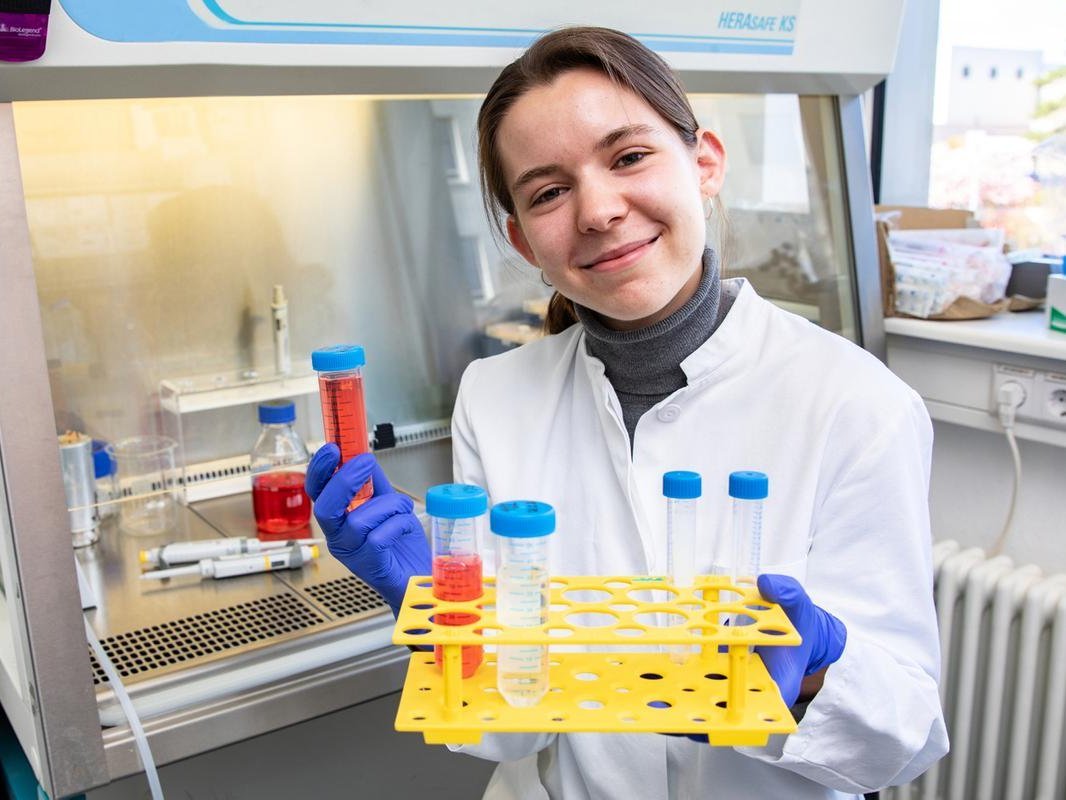
Mia Gillner discovered her passion for lab work during her voluntary year and is now studying medicine in Dresden. Copyright: Karin Kaiser/MHH
Even as a high school student, Mia Gillner wanted to gain experience in clinical work. That’s why she completed a high school internship at the Braunschweig Municipal Hospital. At the same time, her interest in mathematics, computer science, natural sciences, and technology—the STEM subjects—grew. Would biomedical research be the right fit for her? The high school graduate found out during a Voluntary Scientific Year (FWJ) last year at the Hannover Medical School (MHH). Now she wants to encourage other high school students to take a voluntary year in science.
At the Leibniz Laboratories for Biotechnology and Artificial Organs (LEBAO), the basic research division of the Clinical Department of Cardiac, Thoracic, Transplantation, and Vascular Surgery, Mia Gillner worked with a research team focused on stem cell research and the reprogramming of somatic cells, conducting research into, among other things, personalized cell and gene therapies for heart and lung diseases. In this context, Gillner took on the task of investigating various cell- and cycle-specific senescence markers—molecular indicators used to identify aged cells that can no longer divide—in induced smooth muscle cells derived from a reprogrammed stem cell line.
The background: Although the cell cultures are considered biologically young, they exhibit premature signs of aging. The FWJ participant conducted molecular biology experiments with the goal of determining the cells’ properties and establishing cell cultures with high proliferation potential. “I expected that during my FWJ I would realize I’d rather work in the Clinical Department, but research and lab work fascinate me much more than I would have expected,” says Mia Gillner. “I love asking questions and digging into things until I understand them in detail. That’s exactly what I was able to do in the lab.”
She realized that the way work is done in the lab simply suits her personality well. The FWJ provided her with valuable experience and also helped her grow personally. “It had a lasting impact on me, because my desire remains the same: I’d like to go into research,” she says. While she was still working in the lab, she submitted an application for medical school and, thanks to her volunteer work and a strong score on the Test for Medical Study Programs (TMS), was accepted to a programme in Dresden.
The FWJ should be better known
She herself had come across the opportunity to do an FWJ rather by chance. At the IdeenExpo two years ago, she discovered the MHH booth and spoke there with a biologist who told her about the Voluntary Scientific Year at the MHH. “I was immediately enthusiastic about the idea and wanted to use it to find out whether I could imagine a future in research.” Mia Gillner submitted an application and found exactly the right research project for her interests at LEBAO. “I’m very grateful to be able to work here with so many nice colleagues. I can ask questions anytime—everyone is very helpful.” Now she wants to raise awareness about the Voluntary Scientific Year: “It’s such a shame that so few people know about it, because it offers so many opportunities.”
FIKUS scholarship enables participation
To ensure that as many high school students as possible can participate in the FWJ, the MHH has been offering additional scholarships since 2024 for applicants who are financially or culturally disadvantaged. The FIKUS scholarship includes, among other things, an increase in the allowance, access to affordable housing near campus, an additional mentoring program to prepare for college, and extra counseling services. To be eligible for the program, applicants must be financially or culturally disadvantaged, have a particular interest in medicine, and demonstrate exceptional academic performance relevant to a scientific degree program.
The voluntary scientific year (FWJ)
During the FWJ, young people work full-time for one year on a research project of their choice. They are part of a research team and conduct research on stem cells, gene therapies, and vaccines, or gain new insights in quantum physics, laser research, or materials science. The MHH coordinates the FWJ; there are also many other interesting placement opportunities outside the university, such as at Leibniz University Hannover, the Laser Zentrum Hannover e.V., Fraunhofer ITEM, the University of Music, Drama, and Media, the University of Veterinary Medicine Hannover, as well as at the Helmholtz Center for Infection Research and the Physikalisch-Technische Bundesanstalt in Braunschweig. The application period for the 2027–2028 academic year will begin shortly and run through the end of January 2027.
Three digital information sessions:
Friday, November 27, 2026, at 5:00 p.m.
Friday, December 18, 2026, at 5:45 p.m.
Thursday, January 14, 2027, at 5:00 p.m.
SERVICE
Formore information, click here.
Link to the application portal:
https://www.mhh.de/bewerbung-fwj
Text: Bettina Dunker