MHH research team has investigated how the immune system responds to vaccines adapted to the JN.1 virus variant.
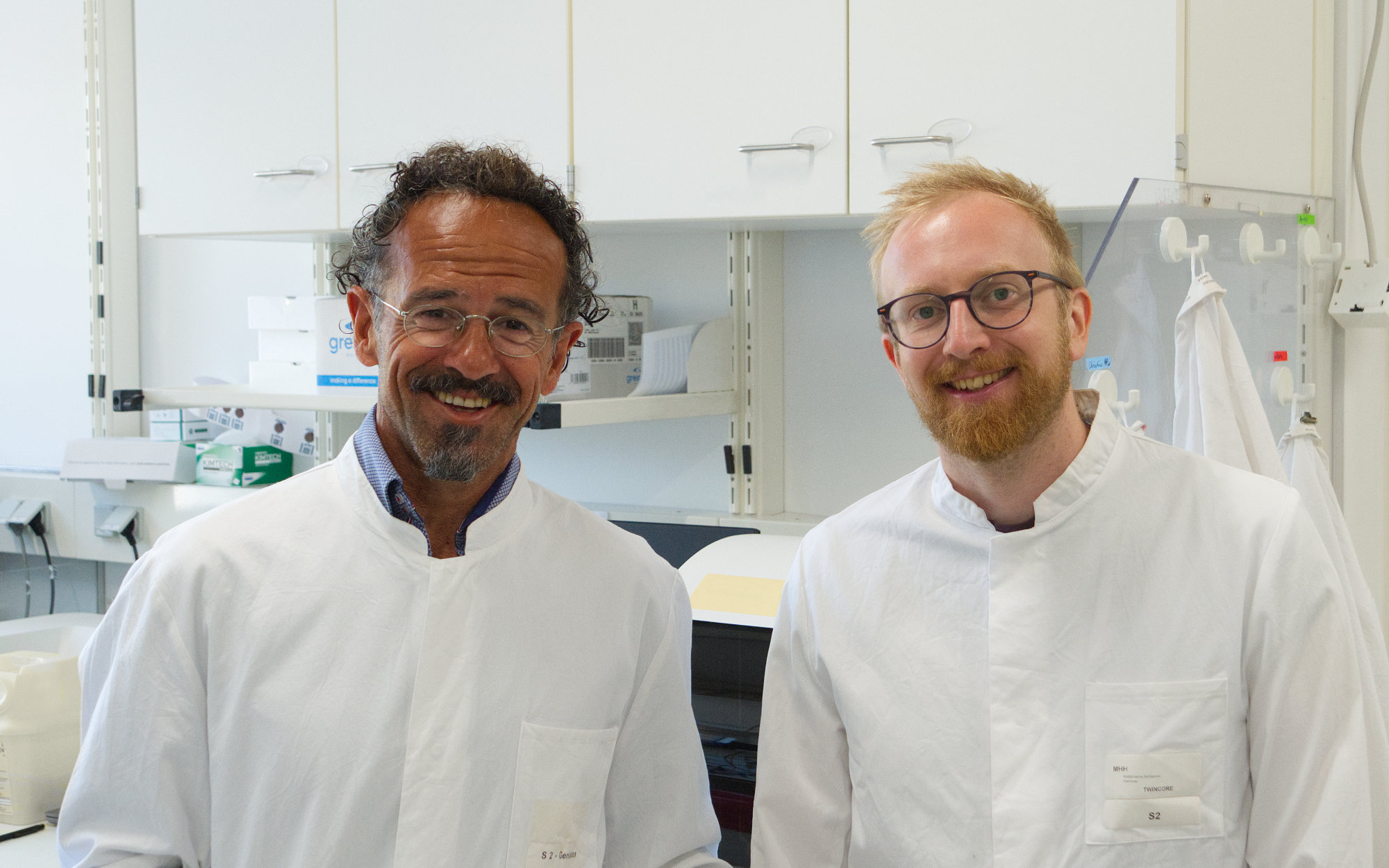
They investigated the booster effect on the immune system: The study’s lead authors, Dr. Metodi Stankov (left) and Dr. Matthias Bruhn. Copyright: TWINCORE/Grabowski
The SARS-CoV-2 coronavirus is constantly evolving. As a result of these ongoing mutations, vaccines become less effective and must be regularly adapted. In 2025, this was the case with the JN.1 variant. Until now, however, it was unclear how the immune system reacts to new virus variants. Are primarily pre-existing memory B cells reactivated, or are new naive B cells also activated on a larger scale? This question is particularly relevant for individuals whose immune response has already been shaped by previous vaccinations and infections. A research team led by Prof. Dr. Georg Behrens, senior physician at the Clinical Department of Rheumatology and Immunology at Hannover Medical School (MHH), and Prof. Dr. Ulrich Kalinke, director of the Institute of Experimental Infection Research at TWINCORE, has now investigated, in collaboration with the German Primate Center in Göttingen, how the immune system responds to adapted vaccines. The results were published in *Nature Communications*.
Booster increases antibody binding
The interdisciplinary research team, comprising experts in medicine and the natural sciences, examined the antibody and B-memory-cell responses in a group of pre-immunized individuals. These individuals had already received a dose of an mRNA vaccine tailored to the so-called JN.1 variant of the coronavirus. “Following the booster vaccination, we observed increased antibody binding and improved neutralization of JN.1 and subsequent virus variants,” says Dr. Metodi Stankov, a research associate in Prof. Behrens’s Immunity in Infections, Vaccination, Inflammation, and Immunodeficiency research group and one of the study’s two first authors. Initially, the researchers found only memory B cells that recognized either exclusively the earlier virus variant Wu01 or both Wu01 and JN.1. “In contrast, B cells specific only to JN.1 increased only slowly, peaking 21 days after vaccination,” says Dr. Matthias Bruhn, a postdoctoral fellow at the Institute of Experimental Infection Research and also a co-first author of the article.
Maturation process improves binding to the virus
Subsequent single-cell RNA sequencing of the antigen-specific memory B cells and functional analyses of the corresponding monoclonal antibodies revealed that so-called somatic hypermutation drives specialization toward improved binding to JN.1 and more effective neutralization. Somatic hypermutation is a natural maturation process of the immune system. It involves targeted changes in the gene segments of antibodies responsible for antigen binding. Through the subsequent selection of antibodies with particularly strong binding affinity, the immune system can specifically refine its defense against already known pathogens.
A better understanding of vaccine responses
Based on these results, the researchers conclude that, following a booster vaccination, it is primarily pre-existing memory B cells that adapt to the new viral variant. The activation of naive B cells, on the other hand, does not appear to be the dominant mechanism. “The JN.1-adapted booster vaccination is associated with the adaptation of an existing memory B-cell repertoire to JN.1, as well as with improved neutralization of circulating and antigenically closely related viral variants,” explains Prof. Kalinke. “This study is a first step toward better understanding how the adaptation of vaccines to new virus variants influences the immune response,” says Prof. Behrens. “With the methods available today, we can track much more precisely how adapted vaccines regulate immune responses.”
The work was funded by, among others, the RESIST Cluster of Excellence and the German Centre for Infection Research (DZIF).
The original paper, “JN.1-adapted vaccination is associated with readjustment of ancestral memory B cells towards neutralisation within the JN.1 antigenic space”, can be found here.
Text: Administrative Unit for Communications