There is a shortage of donor organs. Pig organs could offer a solution. An MHH team is conducting research on this in a new project on xenotransplantation.
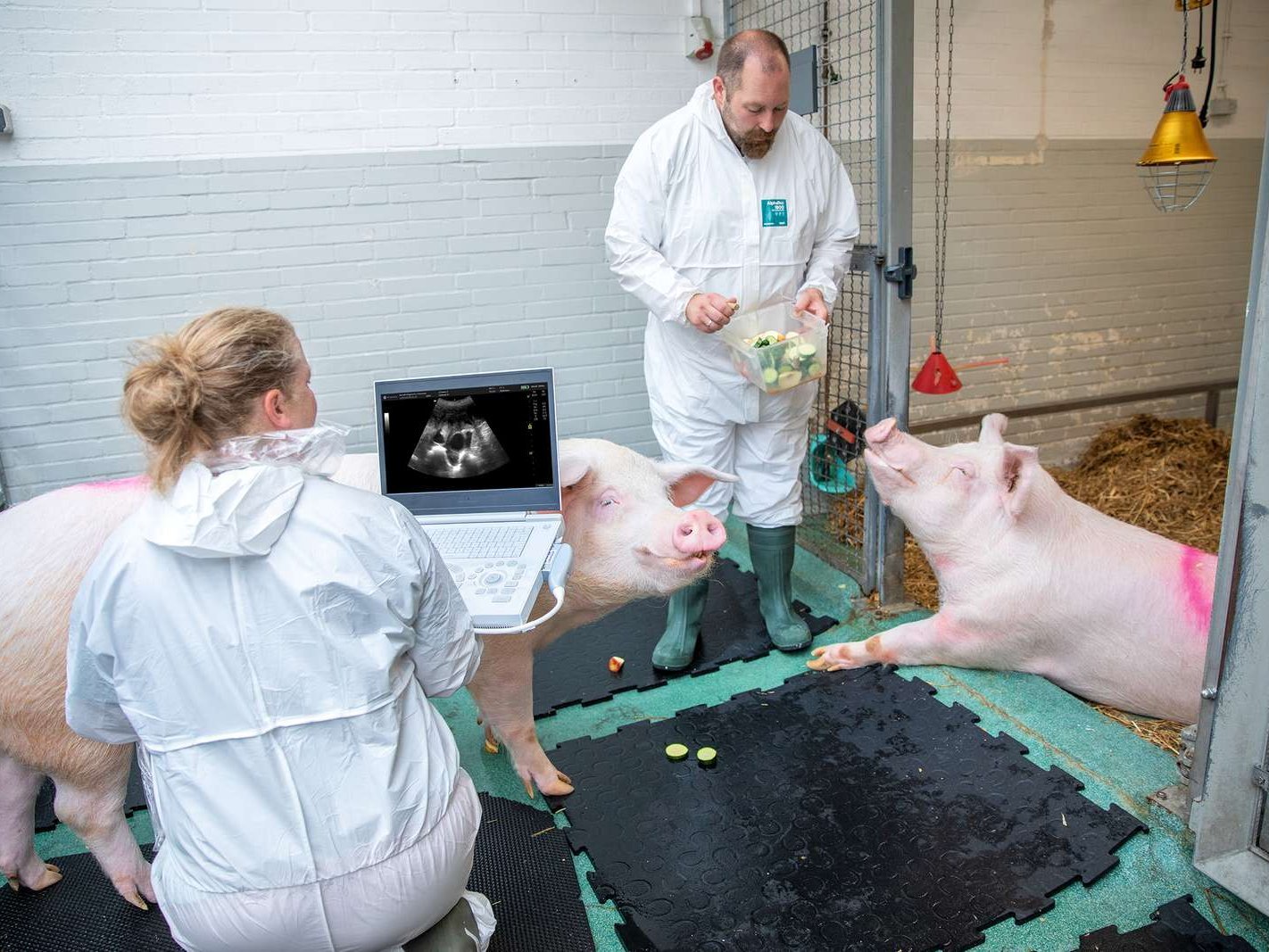
Offspring are important for pig breeding. Sows are regularly examined by ultrasound to determine whether they are pregnant. Copyright: Karin Kaiser/MHH

The XeNid project team. Copyright: Bettina Bandel / MHH
When an organ is no longer functioning and other treatments are no longer effective, an organ transplant is necessary. It saves many lives every year. At the Hannover Medical School (MHH), Germany’s largest Transplant Centre, 300 to 400 organs are transplanted annually—primarily kidneys, lungs, livers, and hearts. However, the demand for donor organs far exceeds the supply. In Germany, approximately 8,200 people are currently waiting for a donor organ, with about 1,000 of them in Hanover alone.
“The shortage of suitable donor organs is one of our greatest clinical challenges,” says Prof. Dr. Moritz Schmelzle, director of the MHH Transplant Centre. “We see it as our most urgent task to advance innovations in transplant medicine that could counteract this shortage.” The use of pig organs from genetically modified donor animals is considered a promising solution. Such an organ transplant from an animal to a human is called xenotransplantation. An interdisciplinary team at the MHH is now working on the new project “Xenotransplantation in Lower Saxony” (XeNid) with the goal of introducing xenotransplantation as a therapeutic option into everyday clinical practice. The state of Lower Saxony and the Volkswagen Foundation are supporting the four-year project with approximately four million euros as part of the “zukunft.niedersachsen” program.
Pig Organs as temporary replacements
“We want to establish resources, methods, and concepts so that genetically modified pig organs can temporarily replace human organs until a human organ becomes available,” says Prof. Dr. André Bleich, director of the MHH Institute of Laboratory Animal Science and the MHH Central Animal Laboratory. He is coordinating the project together with associate professor PD Dr. Philipp Felgendreff of the MHH Clinical Department of General, Visceral and Transplant Surgery.
The team has set itself the goal of laying the groundwork to provide new treatment options for patients with organ failure who have no chance of receiving a life-saving transplant. For example, the team aims to develop liver dialysis using genetically modified pig livers for people with acute liver failure. In addition, the team aims to improve the transplantation of pig heart valves seeded with human cells to prevent chronic rejection reactions. The researchers also hope to make progress in the field of lung transplantation. Patients and their representatives are being involved in discussions regarding the study design, ethical considerations, and the interpretation of the results.
Goal: Xenotransplantation in everyday clinical practice
For xenotransplantation to become part of routine clinical practice, many questions must be answered—ranging from the breeding of suitable animals to the control of the recipient’s immune response and the actual transplantation procedure. Pigs are particularly well-suited as organ donors because their organs share many biological characteristics with human organs. However, to prevent rejection by the human immune system, the animals must be genetically modified. “We hope that xenotransplantation will become a viable treatment option for people who urgently need a life-saving organ and are running out of time due to the shortage of human donor organs. The XeNid project is an important step toward providing these patients with a potential treatment option,” says PD Dr. Felgendreff.
In Germany, xenotransplantation of whole organs is not yet performed on patients. In the U.S., the first clinical applications are taking place in exceptional cases, as so-called individual experimental treatments for patients who have no chance of receiving a human donor organ without a xenotransplant. Since February 2025, two U.S. biotech companies have been conducting clinical trials involving humans who are receiving kidney transplants from genetically modified pigs.
SERVICE
You can finda video on this topic (“Xenotransplantation—Medicine of the Future?”) here.
Text: Bettina Bandel