The MHH plus foundation is awarding Dr. Janna Heide and Prof. Dr. Hartmut Goldschmidt the Zimmermann Prize and Medal.
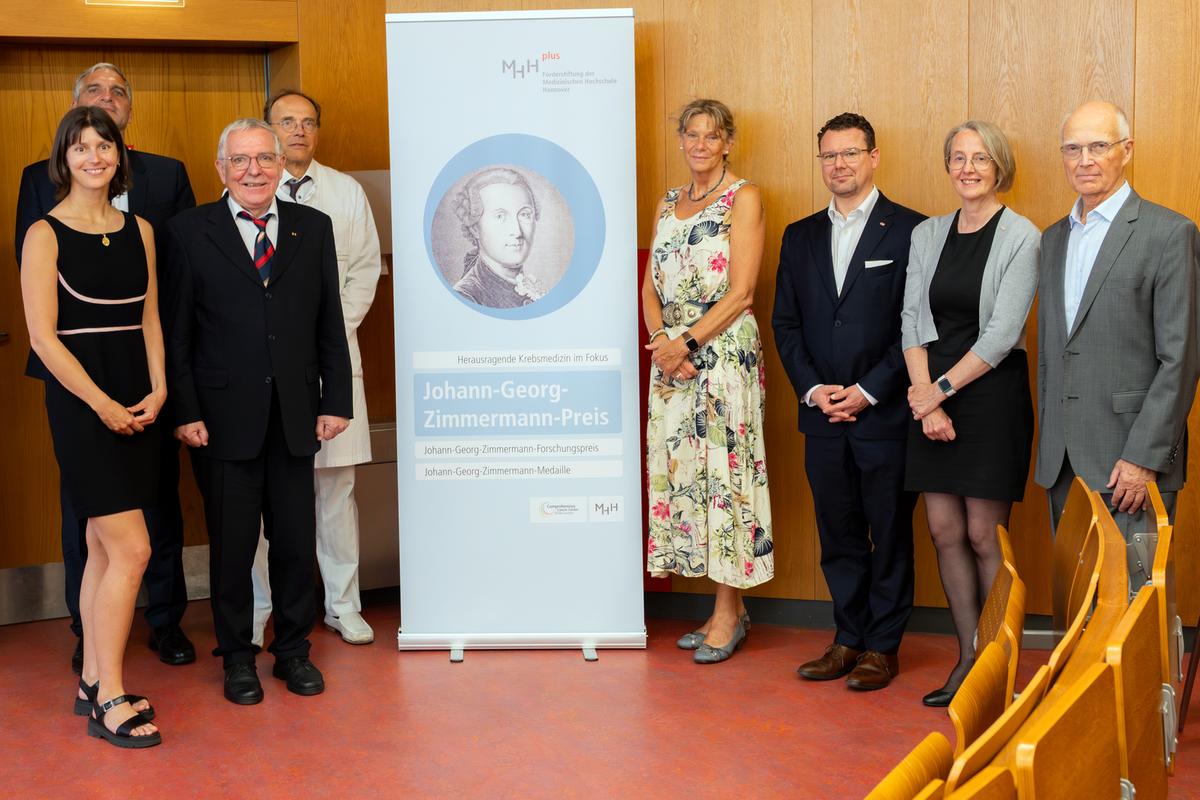
The group photo shows (from left): Research Award winner Dr. Janna Heide (UKE), her laudator Prof. Dr. Ulf Panzer (UKE), medal recipient Prof. Dr. Hartmut Goldschmidt, Board of Trustees member Prof. Dr. Hillemanns, MHH President Prof. Dr. Denise Hilfiker-Kleiner, laudator Prof. Dr. Florian Heidel, Board of Trustees Chair Prof. Dr. Hildegard Büning, and Prof. Dr. Siegfried Piepenbrock, Deputy Chair of the Foundation’s Board of Trustees. Copyright: Annika Morchner/MHH
The Johann-Georg-Zimmermann Research Prize and the Johann-Georg-Zimmermann Medal are among the most prestigious awards in the field of cancer research in Germany. Last Wednesday, the prizes were presented at the Hannover Medical School (MHH) by President Prof. Dr. Denise Hilfiker-Kleiner: “I warmly congratulate the award recipients on this honor. Their work impressively demonstrates how excellent research finds its way into clinical application and opens up new treatment options for patients,” the President emphasized at the award ceremony.
Award for myeloma experts
This year, Prof. Dr. Hartmut Goldschmidt was honored with the Johann-Georg-Zimmermann Medal. The hematologist and oncologist heads the GMMG (GermanSpeaking Myeloma Multicenter Group) study group at the Clinical Department of Hematology, Oncology, and Rheumatology at Heidelberg University Hospital and at the National Center for Tumor Diseases in Heidelberg (NCT). He is internationally recognized as a leading expert in the field of multiple myeloma.
“Multiple myeloma is a malignant disease of the bone marrow and belongs to the group of blood cancers. In this disease, pathologically altered plasma cells proliferate in the bone marrow. These cells of the immune system are normally responsible for the production of antibodies, but they become malignant in multiple myeloma,” explained Professor Goldschmidt.
A particular focus of Professor Goldschmidt’s work is the close integration of clinical research and patient care. For many years, he has played a key role in the development and conduct of numerous clinical trials on multiple myeloma. These efforts center on the systematic evaluation of new therapeutic concepts and the further development of treatment strategies.
“I am very pleased to receive this special award. For me, it also represents recognition of the long-standing and excellent collaboration within myeloma research and our joint efforts to advance new treatment approaches for this disease,” said Goldschmidt. Under his leadership, the GMMG has developed into one of the most important networks for clinical myeloma research in the German-speaking world. It is characterized by numerous national and international collaborations as well as a broad portfolio of studies covering all stages of the disease.
Award for researcher paving the way for more targeted cancer therapies
Dr. Janna Heide of the University Medical Center Hamburg-Eppendorf (UKE) received the Johann-Georg-Zimmermann Research Prize, which comes with a prize of 10,000 euros. The physician is conducting research on new active substances that specifically target biological processes in the connective tissue surrounding the tumor, thereby opening up new treatment options for cancer.
She was honored for her work on the development of an NNMT inhibitor as a potential new therapeutic approach for tumors associated with ovarian, breast, and colorectal cancer. NNMT stands for nicotinamide N-methyltransferase, an enzyme involved in cellular metabolism that may be hyperactive in the connective tissue cells of tumors. An inhibitor is a compound that specifically blocks the activity of this enzyme.
“Research into such target structures is an important step toward opening up new treatment options for various types of cancer. I am particularly interested in how fundamental biological mechanisms can be translated into concrete therapeutic approaches. This award motivates me to further advance research into the mechanisms of tumor development, with the long-term goal of developing more targeted treatment options for patients,” said Dr. Heide.
About the Johann-Georg-Zimmermann Prize
The Johann-Georg-Zimmermann Prize was first awarded in 1973 and is now one of Germany’s most prestigious awards in the field of cancer research. To equally promote and recognize both early-career researchers and long-standing commitment, the award is divided into two categories: The “ ” Research Prize honors current scientific work by early-career researchers (up to age 40) and is endowed with 10,000 euros. The “ ” Medal, endowed with 2,500 euros, is awarded to an individual who has rendered outstanding service to the fight against cancer. The Johann-Georg-Zimmermann Prize is funded by the MHH plus Foundation and presented in collaboration with the Comprehensive Cancer Center Lower Saxony (CCC-N).
As of this year, Prof. Dr. Hildegard Büning serves as chair of the Board of Trustees for the Johann-Georg-Zimmermann Prize. “For decades, the Johann-Georg-Zimmermann Prize has stood for scientific excellence and the promotion of innovative cancer research. This serves as the foundation for the development of innovative therapeutic approaches to improve patient care. It is impressive to see how the award recipients have contributed to this—and continue to do so—through their scientific contributions and extraordinary dedication. I am delighted to be able to support this important work on the Board of Trustees,” explained Professor Büning.
New this year was the Johann-Georg-Zimmermann Exchange Hub: Before the award ceremony, six MHH doctoral students discussed career questions with Dr. Janna Heide over lunch—ranging from study abroad experiences to career prospects at university hospitals or in the pharmaceutical industry, as well as how to deal with setbacks or perceived detours in one’s career path. The event, initiated and moderated by Professor Büning, was very well received and is planned to be repeated at the next awards ceremony if possible.
Text: Jana Illmer-Krüger