For the eighth time, the MHH has received the “Family-Friendly University” certification—in recognition of its long-standing commitment to family-friendly working and studying conditions.

For the eighth time, the MHH has received the “Family-Friendly University” certification. Picture: Pixabay
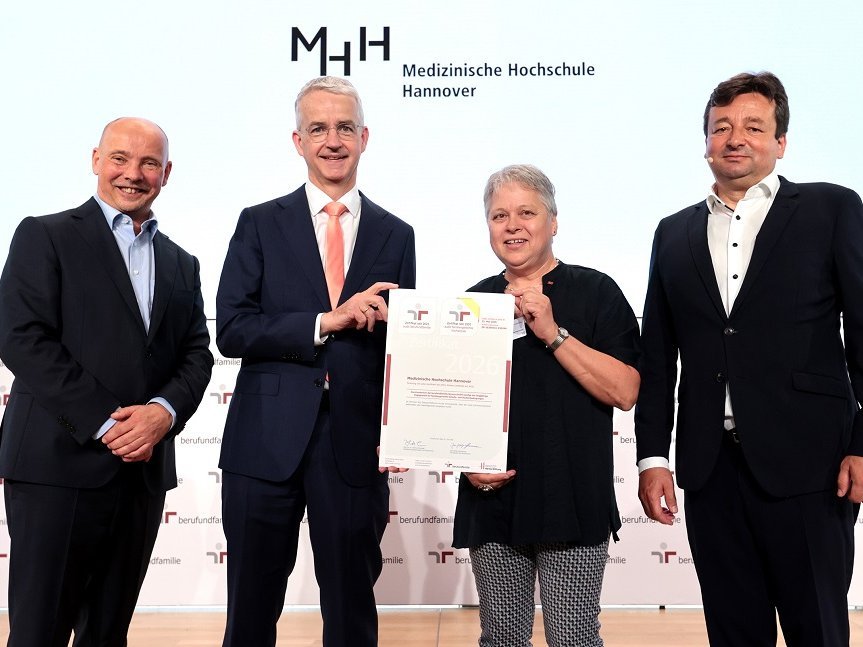
Professor Helmut Schneider, Board of Trustees of berufundfamilie; MHH Vice President Professor Frank Lammert; Kerstin Bugow, MHH Office for Gender Equality; and Oliver Schmitz, managing director of berufundfamilie. Copyright: Pressefoto Berlin
Since 2005, the Hannover Medical School (MHH) has been certified under the “Family-Friendly University Audit” program administered by berufundfamilie Service GmbH. Now, for the second time, the MHH has received the certificate not only for the areas of research and teaching but also for the area of patient care. The quality seal was presented in Berlin to MHH Vice President Prof. Dr. Frank Lammert and the audit coordinator, Kerstin Bugow. It is valid for three years.
Working conditions must be continuously adapted
The audit focuses on work-life balance and is part of the MHH’s “Future Initiative.” The high standards achieved over the past 21 years—ranging from the expansion of childcare to flexible work schedules and new leadership models—are integral to the university’s profile. “Family-friendly structures play a key role in determining whether new employees join and stay, and whether students can successfully complete their studies or training. The university aims to secure and expand its position as an excellent research center, a high-performing university hospital, and an attractive training institution and employer,” explained MHH Vice President Prof. Dr. Frank Lammert. This requires, for example, the continuous adaptation of working conditions: The MHH’s new leadership models, such as job sharing and dual leadership, are being expanded. Flexible work schedules—ranging from part-time and flex time to remote work and a variety of shift models in Nursing—are being implemented.
Attractive programs enhance work-life balance
The MHH offers 404 full-day childcare spots and a wide range of flexible childcare options for emergencies and during all school breaks. In addition, there are diverse information and counseling services on work-life balance topics for students and employees in research and the Clinical Department. Nursing family members is also a priority for the MHH’s Family Services: The range of workshops has been significantly expanded, and the MHH is exploring whether it can offer day care spots for employees’ family members. “Demographic change means that family members in need of care must be given even greater attention when it comes to balancing work and family life. I know this firsthand: I cared for my mother for many years,” emphasizes Susanne Klyk, the MHH’s Equal Opportunities Officer.
Text: Simone Corpus