92 digital simulation units for dentistry: The MHH offers students one of the most modern learning environments in Germany.
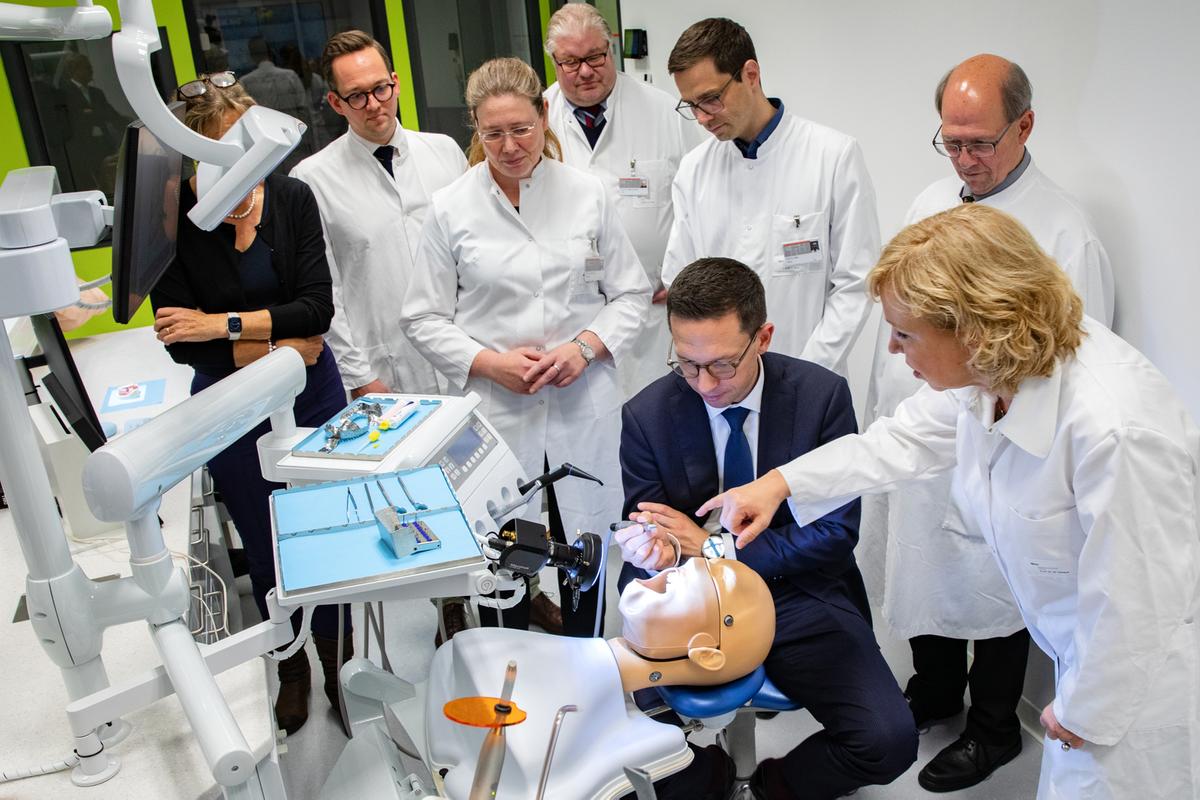
Minister Falko Mohrs took the official opening to heart and sat down at one of the state-of-the-art phantom units himself—guided here by Prof. Dr. Meike Stiesch. Copyright: Karin Kaiser/MHH
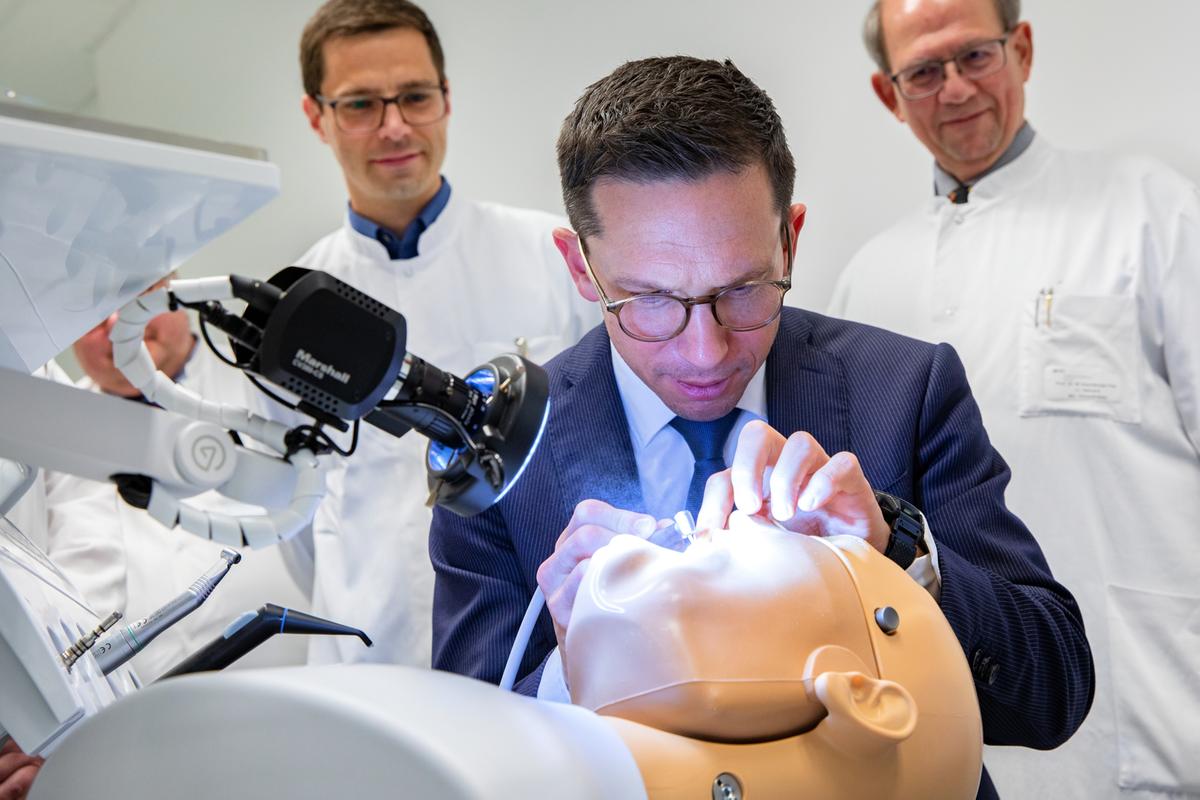
Minister Falko Mohrs took the official opening ceremony literally and sat down at one of the state-of-the-art phantom units himself—here he is working under the watchful eyes of Prof. Dr. Felix Kunz (left) and Prof. Dr. Michael Eisenburger. Copyright: Karin Kaiser/MHH
Before dental students treat patients, they practice on models. To this end, the Hannover Medical School (MHH) now has a total of 92 digital simulation units available in two state-of-the-art simulation rooms. With these facilities, the MHH’s Centre for Dentistry, Oral Medicine, and Maxillofacial Medicine offers one of the most advanced learning environments for dentistry education in Germany.
“In dentistry in particular, excellent training stems from the interplay of scientific knowledge and practical experience. That is exactly what the new simulation rooms at the MHH’s Department of Dentistry, Oral and Maxillofacial Medicine are for: students gain more space for hands-on practice, and faculty members have modern facilities for high-quality teaching,” said Lower Saxony’s Minister of Science, Falko Mohrs. “As a state, we are investing more than 13 million euros here to ensure that the dentists of tomorrow are optimally prepared for their responsible roles.”
The new simulation labs were completed while the university remained in operation. To mark the completion of the one-and-a-half-year construction project, Minister Mohrs visited the MHH today and officially opened the second state-of-the-art simulation lab; the first had already been completed in August 2025. “We are very pleased that, with the completion of this construction project, we can provide our students with state-of-the-art learning and working conditions,” explains MHH President Prof. Dr. Denise Hilfiker-Kleiner. “In the new simulation rooms, students can practice complex treatment procedures under realistic conditions before taking on responsibility for patients. In doing so, we are not only enhancing the quality of our dentistry education but also making an important contribution to patient safety. At the same time, this investment demonstrates the importance placed on innovative and practice-oriented teaching at the MHH.”
Realistic practice on phantom heads
Using the digital simulation units—known as phantom heads—future dentists learn all the essential skills. The simulation rooms are primarily used by the Clinical Department of Conservative Dentistry, Periodontology, and Preventive Dentistry (ZKO) and the Clinical Department of Dental Prosthetics and Biomedical Materials (ZPW). “They offer excellent opportunities for teaching, including the simultaneous transmission of demonstrations via microscope and camera to all workstations,” emphasizes Prof. Dr. Nadine Schlüter, managing director of the Centre for Dentistry, Oral and Maxillofacial Medicine and Director of the ZKO. “In addition, during special simulation sessions, students have the opportunity to simulate individual patient cases as virtual dentistry treatments based on intraoral scans, thereby gaining even greater confidence for the actual treatment. This allows students to learn a large portion of dentistry procedures in a resource-efficient manner, including even highly complex treatments such as root canal therapy.”
From digital scan to finished dental prosthesis
“To ensure optimal teaching, all phantom units are connected to one another via an educational network. This allows images and instructional content from various camera angles and different computer workstations to be transmitted directly to the monitors of the individual units,” explains Prof. Dr. Meike Stiesch, Director of the ZPW and Dean of Research and Transfer at MHH. “Using the phantom heads, students learn to prepare teeth for crowns or bridges. They then digitally capture the prepared teeth using intraoral scanners. Based on this data, they design the dental prosthesis on the computer (CAD—computer-aided design) and subsequently manufacture it using a milling process (CAM—computer-aided manufacturing). Finally, students can place the restoration they designed and fabricated themselves directly onto the phantom head. In this way, they learn the entire digital workflow of modern prosthetic dentistry—from preparation to the finished dental prosthesis.”
New curriculum, new requirements
The previous simulation lab or phantom course room for students in dentistry had been in use at MHH since 1993. In addition to the need for renovation resulting from its long service life, the construction project became more urgent due to the new Dental Licensing Regulations (ZApprO). These regulations stipulate that the degree program must be divided into three phases instead of the previous two. The consequences: more instruction in small groups, increased examination workload due to changed exam formats and a revised composition of examination committees, as well as—in particular—changed student-to-instructor ratios in classroom instruction, with fewer students per instructor. Therefore, it was urgent to expand the capacity of the phantom course rooms.
First major construction project under our own management
“The participating Clinical Departments, as partners of the project team, supported the planning process from the very beginning in a very close, constructive, and highly committed manner,” explains architect Lutz Jürgens, who served as project manager within the MHH’s Building Construction Project Management department. “In early 2023, with the establishment of Devision VI Construction Management, the MHH assumed responsibility as the project owner for the MHH property from the State Construction Management of Lower Saxony. The renovation and expansion of the phantom lecture hall capacities is the MHH’s first major project as the project owner. The project was completed on schedule and within budget.”
Text: Bettina Dunker