The Hannover Heart Rhythm Center (HHC) establishes safe working conditions for employees during pregnancy. A study addresses fears regarding radiation risks.
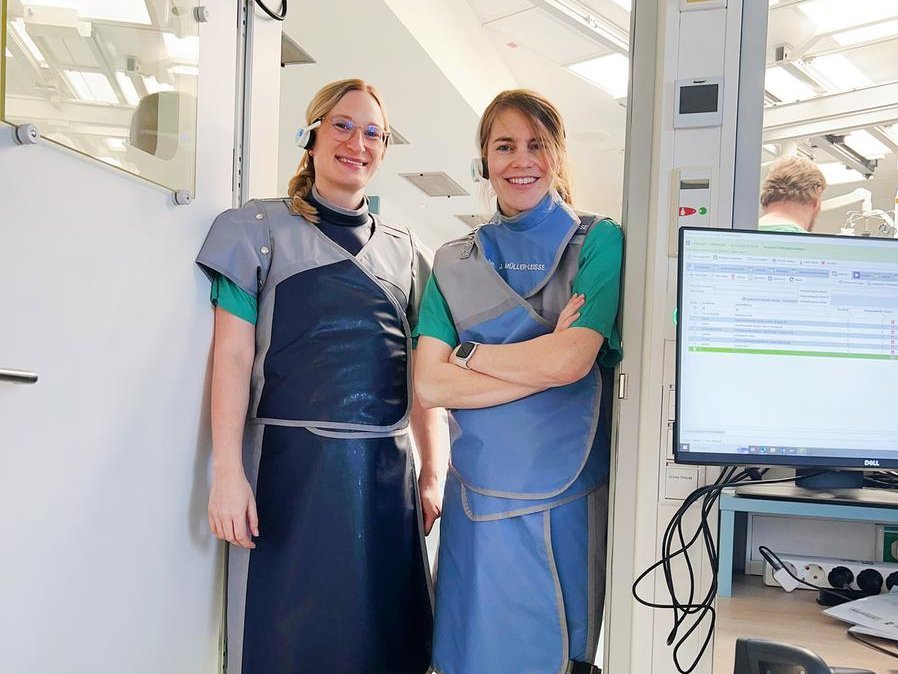
Worked in the cardiac catheterization lab until going on maternity leave: Dr. Henrike Hillmann (left) and PD Dr. Johanna Müller-Leisse Copyright: Johanna Müller-Leisse/MHH
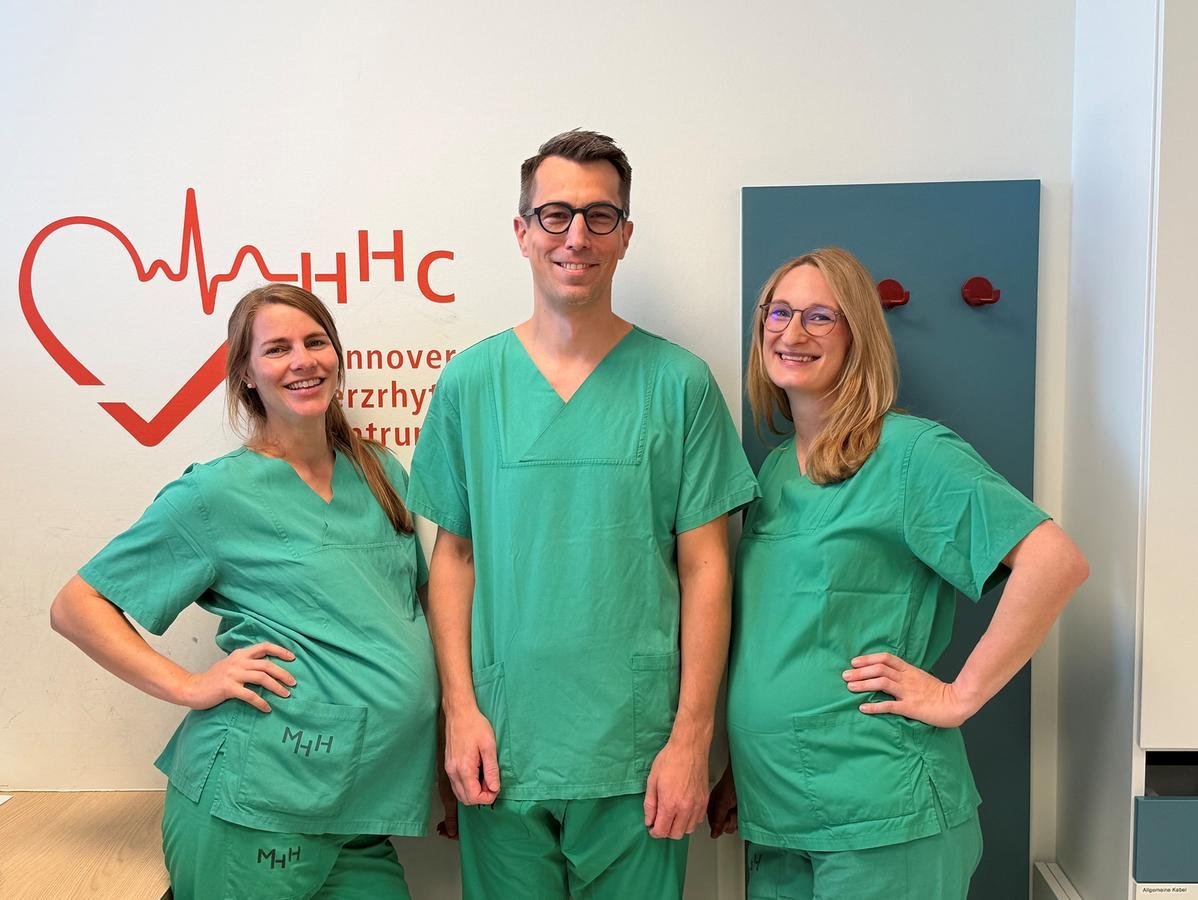
Schafften gemeinsam neue Strukturen für schwangere Ärztinnen: PD Dr. Johanna Müller-Leisse, Prof. Dr. David Duncker und Dr. Henrike Hillmann (von links) Copyright: David Duncker/MHH
When physicians are expecting a child, blanket work restrictions are often imposed on certain activities, such as surgeries and examinations involving X-rays. This restriction often results in a career setback. “For many female colleagues, this is a major issue. They enjoy their profession, simply want to continue their current work, or don’t want to have to interrupt their specialty training,” explains Prof. Dr. David Duncker, director of the Hannover Heart Rhythm Center (HHC). As one of the few cardiology training centers in Germany, the HHC has established structures that allow female physicians to continue practicing their profession as usual even during pregnancy. The HHC is part of the Clinical Department of Cardiology and Angiology at Hannover Medical School (MHH).
Additional protective measures
The Hannover Heart Rhythm Center offers the full range of treatments for patients with cardiac arrhythmias. This includes invasive procedures such as catheter ablations and the implantation of pacemakers and defibrillators. These procedures are performed under X-ray guidance in the cardiac catheterization laboratory. “According to current recommendations from professional societies, pregnant physicians are permitted to continue performing invasive procedures under certain conditions and on a voluntary basis,” explains Prof. Duncker. To ensure safe working conditions for pregnant physicians, additional protective measures have been established at the HHC for pregnant women performing invasive procedures: These include the use of two-piece X-ray aprons, sterile radiation shielding drapes, and an electronic real-time dosimeter to monitor radiation exposure during the procedure. To protect against infections, all patients are tested for HIV and hepatitis B. In addition, the entire team supports their pregnant colleagues. Everyone is informed and aware of the situation—if necessary, someone with at least equivalent qualifications will step in.
Safety and support from the team
Two female physicians have already had positive experiences with the new protocols. Both continued to work as usual in the cardiac catheterization lab during their respective pregnancies—one in 2023 and the other this year. Associate Professor (PD Dr.) Dr. Johanna Müller-Leisse was able to gain even more experience and has since completed her habilitation; Dr. Henrike Hillmann was able to complete her residency and specialization. For both of them, the electronic live dosimeter was particularly important. “The device is worn directly on the lower abdomen at the level of the uterus, underneath the radiation protection apron. It showed me that I wasn’t exposed to radiation there. That gave me a great sense of security,” says Dr. Hillmann in retrospect. The two cardiologists also greatly appreciate the support from the team.
Study: radiation dose to the uterus is negligible
The risk of radiation exposure is a concern for many pregnant female physicians. For this reason, a team at the HHC conducted an observational study to examine this issue in depth. The aim of the study was to monitor a pregnant female physician performing invasive procedures in the cardiac catheterization lab. Over a period of 80 weeks—equivalent to the duration of two pregnancies—an electronic personal dosimeter was worn under the X-ray protective apron at the level of the uterus during all procedures performed in the catheterization lab. The device measured the total radiation potentially delivered to the uterus during the examinations over this period. During the first 40 weeks, 320 procedures were recorded, and during the second 40 weeks, 368 procedures were recorded. The results are reassuring. “The average cumulative radiation exposure to the uterus is 0.037 millisieverts over the entire duration of a pregnancy,” explains PD Dr. Müller-Leisse, the study’s first author. “This dose is well below the permitted European limit of one millisievert and, in my view, is entirely acceptable.” By way of comparison: radiation exposure during a round-trip transatlantic flight amounts to about 0.1 millisievert.
Topic generates great interest
The study was published in the journal *Circulation*. “We hope that the data from our study can help women decide whether or not they wish to continue their interventional work during pregnancy,” says PD Dr. Müller-Leisse. Professor Duncker places great importance on equal opportunity within the team. For the past two years, the HHC has held the maternity protection seal “Pregnant? Here, they can continue their medical work appropriately” from the German Association of Female Physicians. The new structures at the HHC and the study are also attracting a great deal of attention at other Clinical Departments in Germany and Europe. “Our model is proving effective and may help other facilities or institutions find new ways to continue employing pregnant physicians as well,” says the director of the HHC.
Text: Tina Götting