MHH team investigates the mechanism of cancer-induced cachexia and identifies a protein that stimulates skeletal muscle-specific genes.
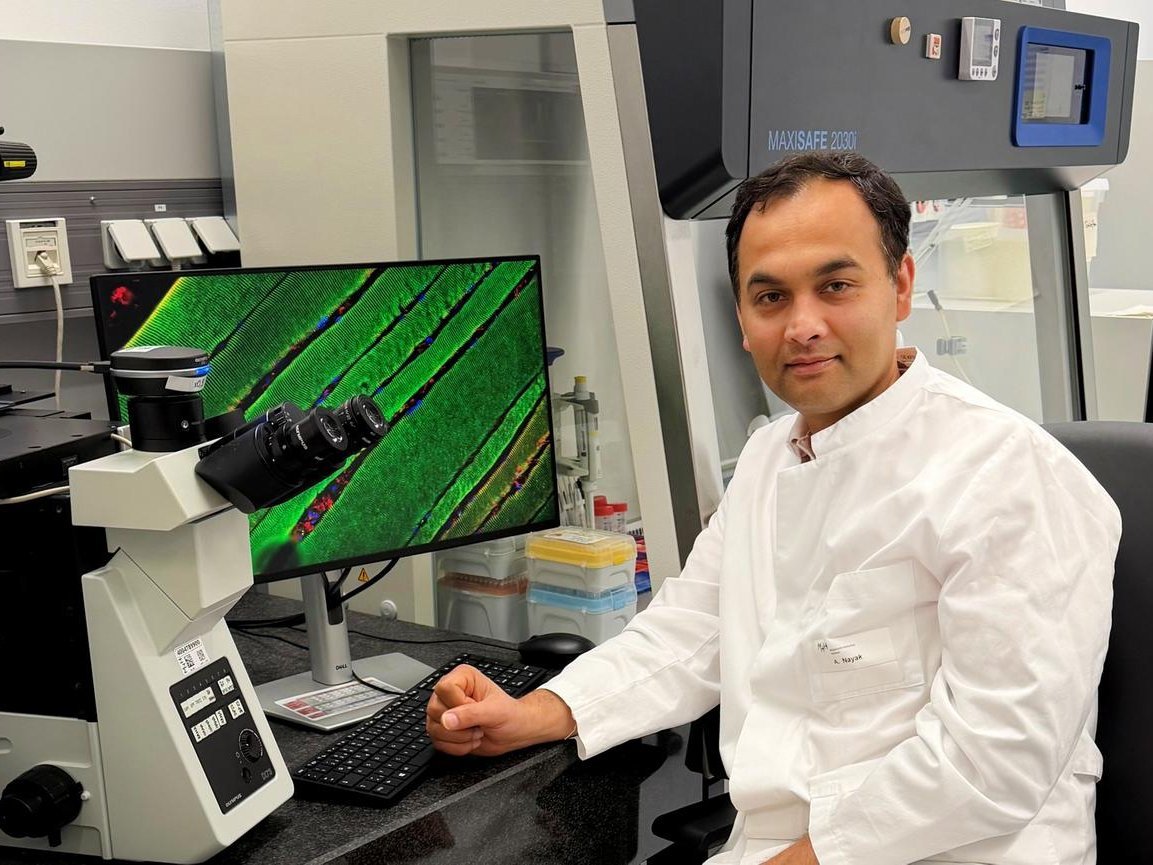
Has discovered a mechanism by which cancer causes muscle wasting: Dr. Arnab Nayak, associate professor. Copyright: Edgar Becker/MHH
Cachexia is one of the severe forms of muscle wasting in humans. It affects up to 80 percent of cancer patients. It is caused by cancer cytokines—pro-inflammatory signaling molecules—that the tumor cells themselves release. Depending on the type of cancer, cancer-induced cachexia (CIC) accounts for 30 to 50 percent of all cancer-related deaths worldwide and is therefore also referred to as the “final disease.” There is no curative treatment. To find an effective treatment approach, a research team led by associate professor (PD) Dr. Arnab Nayak, a scientist at the Institute of Molecular and Cell Physiology at Hannover Medical School (MHH), is investigating the previously unknown processes associated with CIC. With his research group “Chromatin and SUMO Physiology,” he has already shown that cancer cytokines directly interfere with the metabolism of muscle cells and actively remodel them. In addition, they cause the muscle to release less calcium, which impairs muscle contraction—that is, the active tightening of the muscle. In his latest study, the molecular biologist now describes the underlying mechanism and presents a potential future approach for a causal treatment. The results have been published in the journal “Cell Death Discovery.”
Oxidative stress promotes muscle wasting
“Research usually focuses on the primary disease—cancer—while the significance of the secondary condition, CIC, is underestimated,” says PD Dr. Nayak. “Yet the significant loss of muscle mass causes a dysregulation of metabolic processes throughout the entire body and therefore often leads to death even before the actual tumor disease does.” Current therapies tend to focus on alleviating symptoms. For example, dietary supplements, as well as endurance and strength training, are used in an attempt to halt muscle wasting. The molecular biologist, however, is focusing on the causes of cachexia and is examining the so-called SUMO (small ubiquitin-like modifier) signaling pathway. In this process, known as SUMOylation, the SUMO protein is attached to other proteins to alter their function. SUMO proteins play an important role in the stress response by modifying various enzymes. “Since cachexia is associated with oxidative stress—that is, the imbalance between aggressive oxygen species and protective antioxidants—we investigated a possible link between SUMOs and CIC.”
Paradox: gene silencer activates skeletal muscle genes
In a mouse model and in cell culture, the research team demonstrated that CIC triggered increased SUMOylation of certain proteins in skeletal muscle cells, leading to disrupted calcium homeostasis, disorganization of the sarcomeres—the smallest functional units of the muscle—and impaired muscle contraction. At the same time, the researchers discovered something unexpected: They found that a protein called L3mbtl2 (Lethal(3)malignant brain tumor-like protein 2) activated a large number of muscle-specific genes. Normally, L3mbtl2 binds to DNA as an epigenetic repressor protein and, acting as a kind of molecular guard, ensures that the genes at that location cannot be transcribed. “Paradoxically, however, we observed that L3mbtl2 acts as an activator for a large group of muscle-specific genes that regulate sarcomere structure and calcium homeostasis,” says PD Dr. Nayak. Increased SUMOylation of L3mbtl2 in CIC disrupted its binding to DNA, leading to downregulation of these genes and, ultimately, to cachexia.
Mutation in the SUMO-conjugation site
Since increased SUMOylation of L3mbtl2 was the underlying cause of CIC, the researchers modified the protein’s SUMO conjugation site. This genetic intervention partially corrected the cachexia. Thus, the study holds the potential for the development of new therapeutic strategies to alleviate CIC. “Modulating the SUMOylation process could serve as a potential future approach to improving cachexia—a condition for which there are currently no effective therapies,” emphasizes the molecular biologist.
SERVICE
The original publication, “Reorientation of the SUMOylation landscape and altered L3mbtl2-mediated transcriptional activity in cancer-associated muscle contractile dysfunction,” can be found here.
Information on the Nayak research group “Chromatin and SUMO Physiology” can be found here.
Text: Kirsten Pötzke