At MHH, 300 children learned when the Christoph 4 rescue helicopter is deployed and how the crew works.
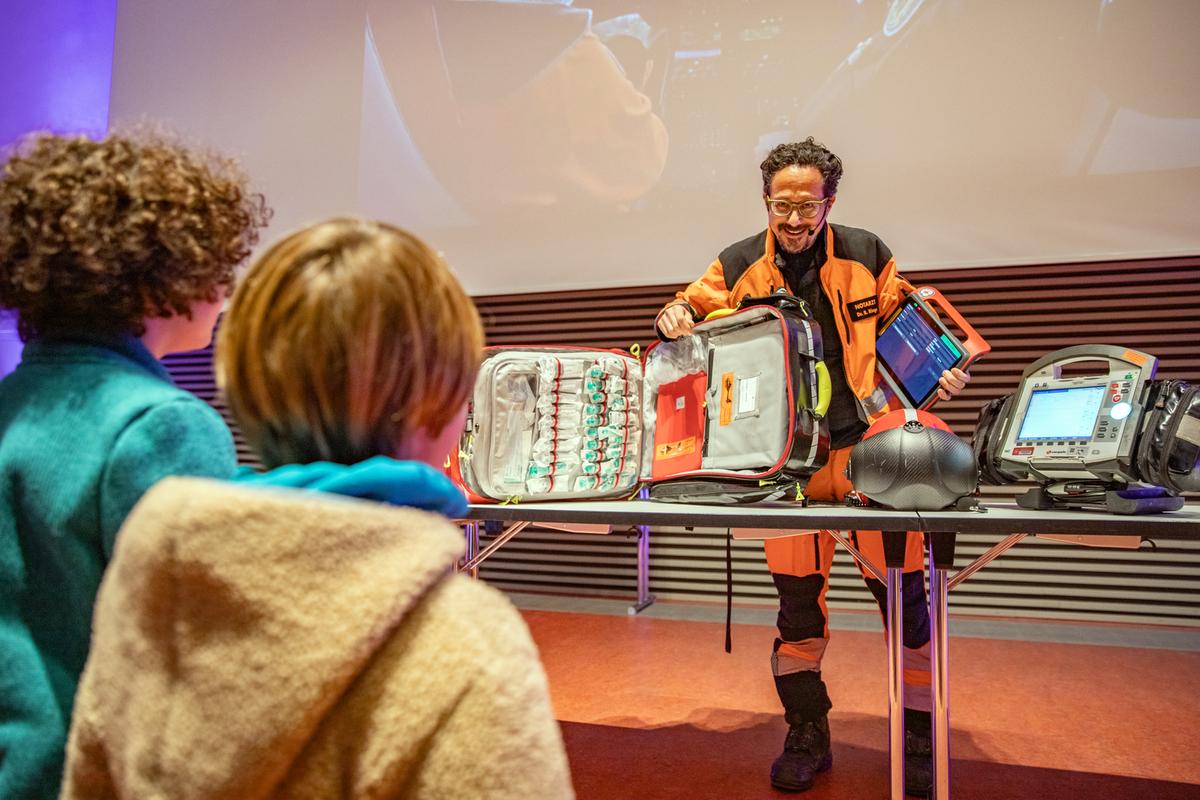
Emergency medicine physician Dr. Bastian Ringe shows young guests at the KinderUniHannover what’s inside an emergency backpack. Copyright: Karin Kaiser/MHH
Why is the Christoph 4 rescue helicopter orange? How fast can it fly? And who is on the crew? Around 300 curious girls and boys got answers to these and many other questions during a lecture at the KinderUniHannover (KUH) at the Hannover Medical School (MHH). Under the title “The Rescuers in Orange—When Does Emergency Medical Help Come from the Air?”, Dr. Bastian Ringe took the young audience on an exciting journey of discovery in the nearly full Lecture Hall F. The experienced emergency and disaster medicine specialist from the Christoph 4 rescue helicopter vividly explained when the helicopter is dispatched and how rescue crews assist people in distress from the air.
To the scene at top speed
Right from the start, the children were able to experience the rescue helicopter from a very special perspective: A video shown on a large screen depicted what the rescue team sees during a flight. “No matter where we have to go, we’re always the fastest. We can fly our helicopter at speeds of up to 288 kilometers per hour,” Dr. Ringe reported. After all, every minute counts following an accident—sometimes just a few minutes can mean the difference between life and death.
The children also learned that the rescue helicopter is on duty from sunrise to sunset. It’s needed, for example, when a serious accident occurs in which people’s lives are at risk, when roads are blocked, or when the accident site is far away. There’s also a special reason for the helicopter’s eye-catching color: “The color orange is particularly easy to see, and besides, orange is the color of civil defense,” explained Dr. Ringe.
A flying intensive care unit
The 8- to 12-year-olds also learned who flies on the rescue helicopter: The crew includes a pilot, a paramedic, and an emergency physician. Together, they bring medical care directly to the scene. To do this, the helicopter is equipped like a small intensive care unit and stocked with a wide range of medical supplies.
The children were able to explore what this looks like up close. Dr. Ringe had brought along an emergency backpack, a monitor, and a helmet—which all crew members wear during the flight. Things got especially exciting when the young students were allowed to get hands-on: They were able to put on the emergency backpack, which weighs about 20 kilograms, and try on the helmet.
There was also plenty to learn beyond the individual rescue helicopter: Germany has twelve civil defense helicopters. “The children were incredibly interested and curious. It gave me great pleasure to introduce them to our work,” said Dr. Ringe. He added that school classes interested in a tour are welcome to contact him by email at christoph4@mh-hannover.de.
Next children’s university lecture: the wonderful world of mathematics
The inter-university lecture series of the KinderUniHannover (KUH) for 8- to 12-year-olds continues on Tuesday, November 17, 2026, at 5:15 p.m., at Leibniz University Hannover, with the topic: “More Than Just Arithmetic! The Wonderful World of Mathematics.”
Text: Bettina Bandel