The University of Hildesheim and MHH want to work together to find out how physical activity affects children with leukemia.
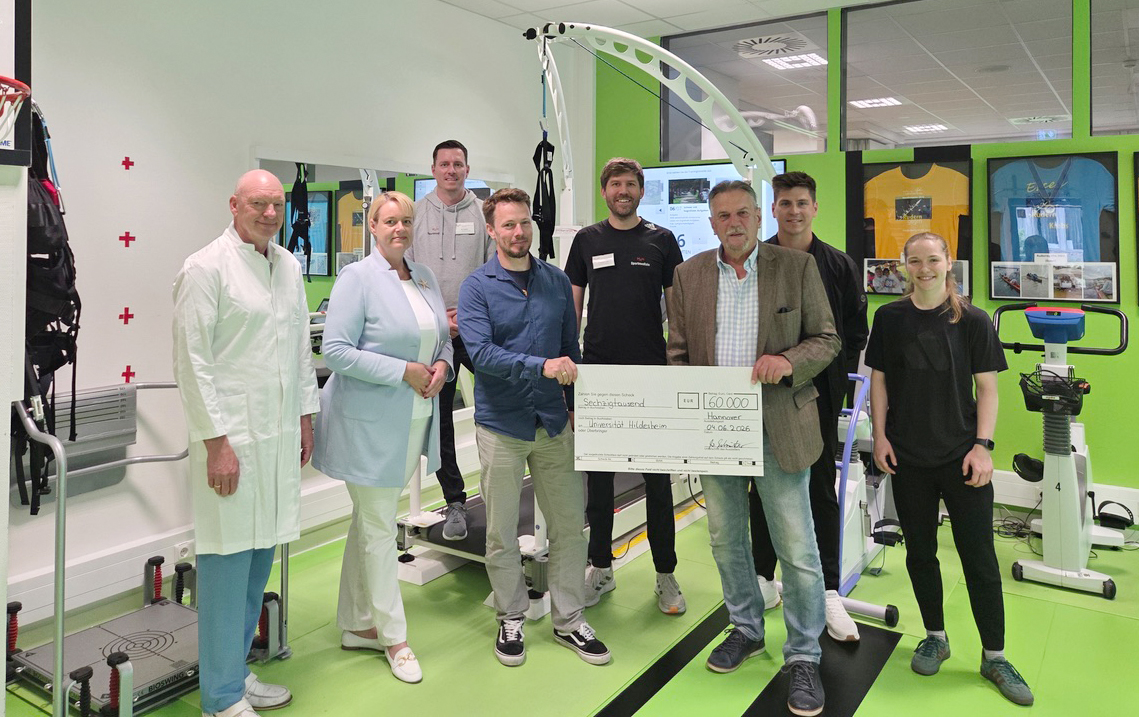
Project with strong partners (from left): Uwe Tegtbur, Anke Mayer, Mirko Buzdon, Nico Kurpiers, Thorben Sundermeier, Wolfgang Schröter, Edward-Philipp Pieper, Lia Bernewitz. Copyright: Project Team/University of Hildesheim
How does exercise affect children during and after cancer treatment? A new joint project between the University of Hildesheim and the Hannover Medical School (MHH) is investigating this question. The focus is on a sports science companion study to the nationwide leukemia study, in which data from children with acute lymphoblastic leukemia (ALL)—one of the most common childhood cancers—is being collected and analyzed.
The project is led by Prof. Dr. Nicolas Kurpiers, a sports scientist at the University of Hildesheim. “We know that exercise is good for you, but what are the specific effects? We want to examine the role physical activity plays and how it can influence the course of the disease—for example, in terms of pain medication use, length of hospital stay, activity levels, and mental well-being,” explains Kurpiers.
Co-initiator Prof. Dr. Martin Stanulla, a pediatric oncologist at MHH and coordinator of the scientific activities in the large-scale leukemia study, adds: “If exercise could demonstrably improve the lives of children with leukemia in the long term, this would have enormous significance for our treatment strategies. The goal of our research is therefore to determine whether physical activity can make a measurable contribution to reducing treatment side effects, improving quality of life, and achieving better long-term treatment outcomes.”
To this end, the project is taking a retrospective approach and utilizing the vast amount of data that is already available but has not yet been analyzed: Nationwide data dating back to the year 2000 is being analyzed. In addition, the study will include documented hospital stays, pain medication use, and a questionnaire in which participants can document their activity levels and quality of life before, during, and after treatment. Professor Kurpiers says: “This will allow us to expect data from 2,000 to 3,000 children.”
Project with strong partners
The project is financially supported by the Robert Tonn Foundation and the Association for Children with Cancer in Hanover (Verein für krebskranke Kinder Hannover e.V.). “We are very pleased to be able to provide significant support as a partner right from the start of this research project. From our perspective, there is great potential here that can help to sustainably improve the treatment and quality of life for children with cancer,” says Wolfgang Schröter, Chairman of the Board of the Robert Tonn Foundation. Also involved are sports scientists who are contributing their practical experience from working with children and adolescents with cancer.
Focus on international research
Building on the first phase of the project, which is now getting underway, the research is to be expanded in the long term—including internationally and prospectively, that is, with an eye toward the future. “With a larger dataset and intervention studies, we can investigate even more precisely which primary forms of physical activity—such as strength or endurance—are particularly effective, to what extent, and at what intensity,” emphasizes Professor Kurpiers. “It is interesting, for example, to investigate whether strength and endurance training have different effects on the immune system.” Based on this, exercise recommendations could then be developed for use in prevention and rehabilitation—to improve the treatment and well-being of the children.
Text: Ineke Nithack/University of Hildesheim
Further information on the project “Winter and Water Sports in the Rehabilitation of Children with Cancer” is available here. The project can be supported through donations; full details are available here.