MHH researchers have developed an app for women with hereditary breast and ovarian cancer. A study is now testing its effectiveness.
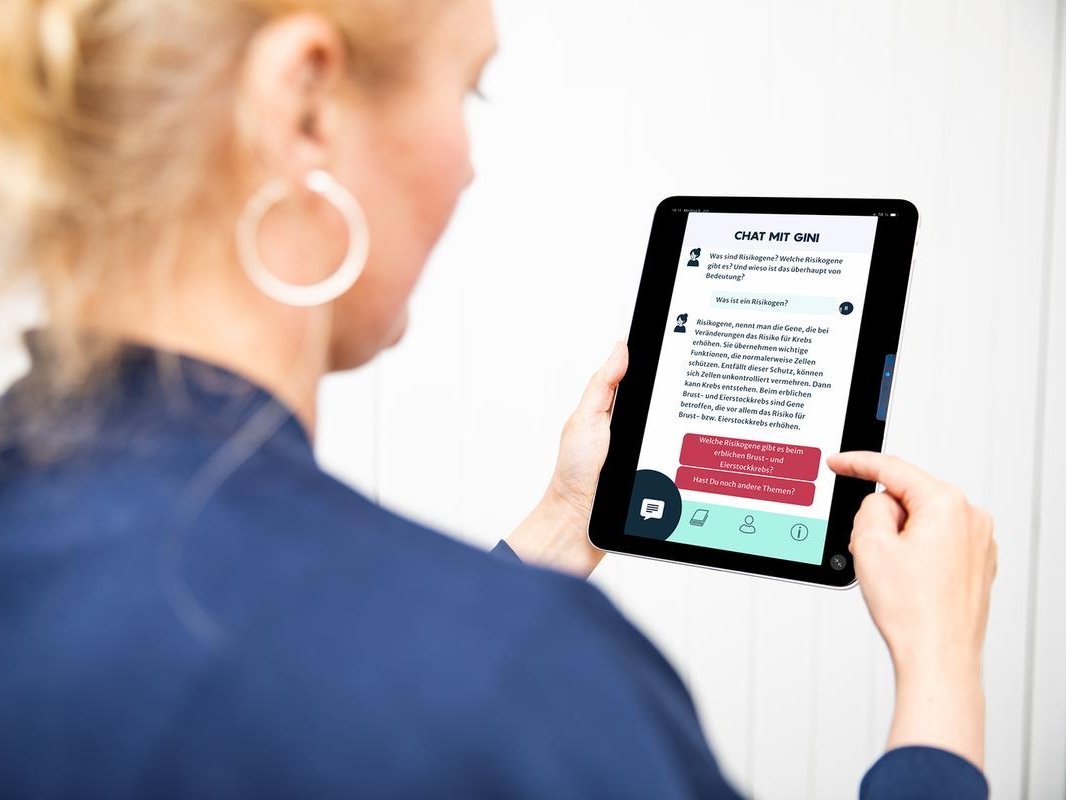
The GenE³ app helps Mss with questions about familial breast and ovarian cancer. Copyright: Karin Kaiser/MHH
Hereditary factors—so-called cancer predispositions—play a role in about five to ten percent of breast cancer cases and in up to 25 percent of ovarian cancer cases. Those affected can seek genetic counseling as an important basis for medical decisions. In the process, patients often have to process complex information regarding genetic risks, screening options, and treatment options. This can sometimes result in significant psychological stress. Furthermore, not all questions can be answered, or some may not arise until after the counseling session.
A research team at Hannover Medical School (MHH) led by Dr. Beate Vajen, Head of Clinical Administration at the Institute of Human Genetics, along with Dr. Dominik Wolff and Dr. Thomas Kupka, both scientists at the Peter L. Reichertz Institute of Medical Informatics, now aims to solve this problem with an application they have developed. The GenE³ app—Genetic Disorders Explained Simply—uses a digital assistant to answer questions and provide clear information tailored to each user’s individual life situation. The app is designed to help patients better understand the content of genetic counseling and make informed, independent decisions. The researchers now aim to scientifically demonstrate the app’s effectiveness. German Cancer Aid is supporting the project with approximately 290,000 euros. The two-year study is scheduled to begin in September 2026.
Information overload and anxiety take a toll
Cancer predispositions increase the risk of developing cancer over the course of a lifetime and can be passed on to one’s own children. In Germany, therefore, anyone who suspects a familial cancer predisposition or cancer is entitled to genetic counseling. “In our outpatient clinic, we counsel Ms.s on familial breast and ovarian cancer,” says Dr. Vajen. However, after the consultation—and especially after receiving a positive test result—many women feel overwhelmed by the flood of information, and further questions arise afterward. “Most Ms. go home and search online, which rarely leads to helpful answers and only intensifies their fears.”
Improving health literacy
The GenE³ app, developed at MHH, is designed to bridge this gap. It offers personalized, scientifically verified information in plain language via a chatbot. “Our app has already been rated very highly by patients in an initial study,” notes Dr. Vajen. “In the current study, we now want to examine, using a sample of 240 patients, whether using the app actually improves patients’ health literacy without simultaneously causing additional psychosocial stress.” In addition, in collaboration with the Clinical Department of Psychosomatics and Psychotherapy, levels of anxiety and depression, as well as emotional and mental strain, are being assessed.
Personalized support
The GenE³ app informs patients about topics that are particularly important to them in their current situation and are tailored to their individual needs. The app provides a knowledgeable digital conversation partner who understands their situation, responds to it, and can thus offer individualized support. To this end, users first enter information about themselves—such as age, details about children and their desire to have children, and their own diagnosis. “Questions and answers based on medical expertise are then selected from an AI server,” explains Dr. Kupka. “This allows the app to draw conclusions about both the selection of topics and other characteristics of the patients.” In addition, the researchers have developed an AI that arranges the topics in a logical order based on their individual importance to the patients.
Further applications possible
“Digital applications offer great potential for supporting patients even outside of the consultation, for example, if further questions arise at home or if they simply want to review the information again at their leisure,” says Dr. Vajen. “However, GenE³ is purely an informational companion app that does not make decisions and does not replace medical counseling or therapy,” the scientist emphasizes. If the researchers can demonstrate its effectiveness, further applications will become possible. “The app is scalable, meaning it can be flexibly adapted to changing requirements and used for other diseases in the future,” notes medical informatics expert Dr. Wolff. Given the limited availability of genetic counseling in Germany, the GenE³ app demonstrates the potential of digital health applications to provide cancer patients with comprehensive, quality-assured information.
SERVICE:
Further information can be found here.
Text: Kirsten Pötzke