Thanks to a donation from the Kinderherz Hannover association, six apartments are now available for internationals
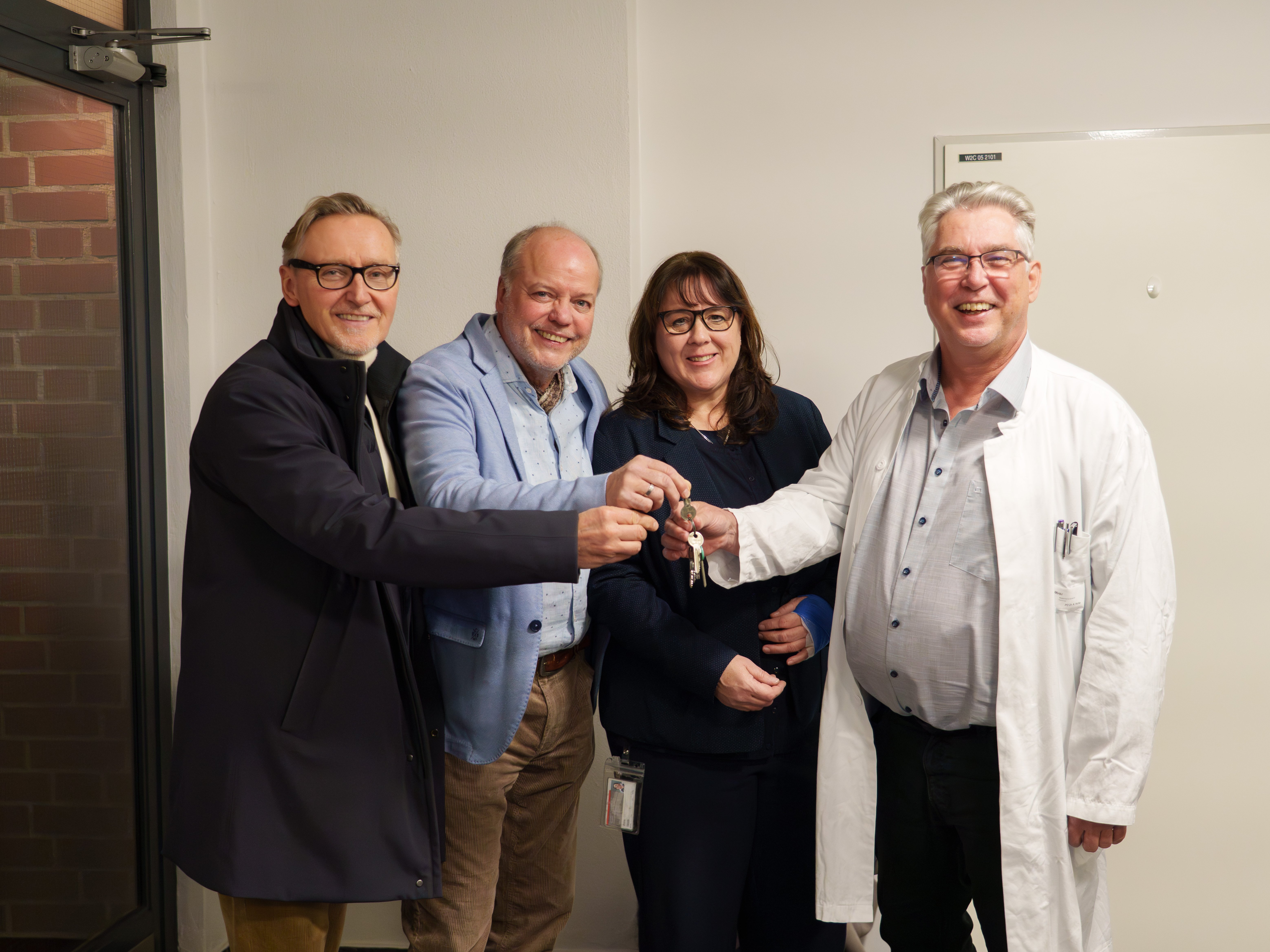
Holding the keys ready for the first residents: master carpenter and room planner Ralf Helmrich, Hanns Werner Staude, Petra Heyde and PD Dr. Alexander Horke. Copyright: Anna Junge/medJUNGE
Going to a foreign country as a worker, learning a new language, going through professional recognition - and not finding an apartment? This is what happens to many nurses from abroad. In view of the shortage of nursing staff, they play a central role in the healthcare system. Pediatric cardiac medicine is also severely affected by the shortage of nurses. The MHH has now made progress in this area: six formerly disused one-bedroom apartments have been refurbished on campus. They are intended to provide accommodation for international nursing staff during their professional recognition.
Finding accommodation is always a problem
"Internationalization in research, teaching and healthcare and patient care is a central element of MHH's future strategy," emphasizes MHH Vice President Prof. Dr. Frank Lammert. Currently, up to 100 people a year start their careers in Nursing and Surgery at the MHH, flanked by international programs. Most of them have already completed nursing training in their home country, but still have to undergo professional recognition and pass a language test in Germany. Until then, they work as nursing assistants on various wards. "Finding accommodation for the new colleagues is always a big problem, as we only have access to a small contingent from the Studentenwerk Hannover and the free housing market," explains Director of Nursing Claudia Bredthauer.
The new one-bedroom apartments were made habitable again thanks to a cooperation between the Kinderherz Hannover association, the Children's Heart Surgery Department and the Nursing Integration Management. Following partial refurbishment, they now have an entrance area with a kitchenette, a bathroom and a small balcony. Basic furniture is also available. The whole project was financed by a donation of 60,000 euros from the Kinderherz Hannover association. "It is simply important to give the internationals a roof over their heads," says Hanns Werner Staude, first chairman of the association. "I am delighted that we have managed to do this so well together." Associate professor Dr. Alexander Horke, Head of Congenital Heart Surgery, couldn't agree more. After all, international nurses also work in pediatric cardiac medicine. "We should definitely support them in gaining a foothold here. The generous donation is a great help," emphasizes the surgeon.
Three questions for ...
Petra Heyde, Integration Officer Nursing
Which countries do the internationals come from?
Heyde: Many come from the former Balkan states, Tunisia and Iran. Last year, we also managed to recruit Nursing staff from South and Central America, India and Egypt for the first time.
Recruiting new colleagues is sometimes very difficult. Why is that?
Heyde: Germany is not the number one emigration destination for these specialists, some of whom are very well trained. Other countries, such as Canada, the UK and the Scandinavian countries, are more attractive for many. We are in global competition, so recruiting experienced nursing staff is challenging.
How can you and your colleague help the new recruits get started in Hanover?
Heyde: We advise and support them in all matters relating to their "new life" in Germany, help with professional recognition and visa procedures, offer special language support and intensive practical training on the wards. And, of course, we also help them find accommodation.
Text and interview: Tina Götting