One Health project examines the effects of pollutants and stress on the immune system and the microbiome in pregnant women, children, and adolescents.
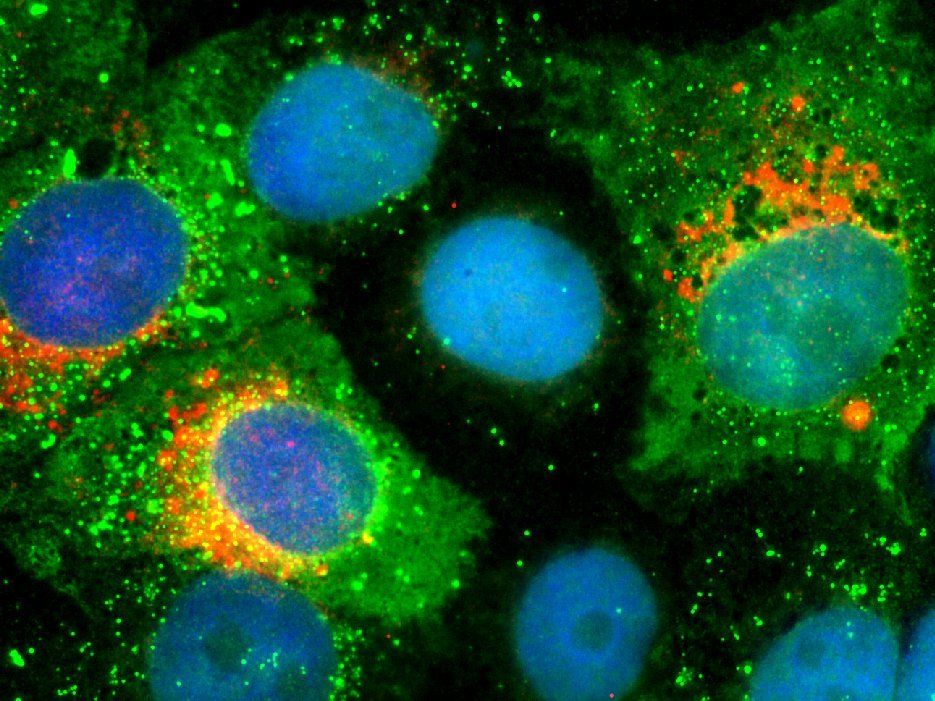
The EMVIC project also focuses on coronaviruses. The microscope image shows kidney epithelial cells infected with SARS-CoV-2. The cell nuclei are stained blue. In cells infected with the virus, the coronaviruses’ nucleocapsid protein glows green. The spike protein is stained red. Copyright: HZI/Marco van Ham
Environmental factors such as chemical pollutants, psychosocial stressors, antibiotics, and an unhealthy diet influence the human immune system and microbiome. They can contribute to an increased risk of infection, reduced immune resilience, and altered vaccine responses. To date, there has been little research into how these factors affect viral immune responses in pregnant women, children, and adolescents. The EMVIC project, in which Hannover Medical School is participating, aims to close this gap. It is coordinated by the Helmholtz Centre for Environmental Research (UFZ) and will begin on July 1. Other participants include the University of Leipzig and the Helmholtz Centre for Infection Research (HZI).
Contaminants such as per- and polyfluoroalkyl substances (PFAS), phthalates, and bisphenol A can generally weaken the immune response—including the response to vaccinations—and increase susceptibility to infections. Stress factors such as social inequality, unfavorable living conditions, psychosocial stress, or climate change also have a negative impact on the functioning of the immune system. At the same time, environmental pollution, antibiotics, and an unhealthy diet have negative consequences for the microbiome—that is, the totality of microorganisms in the human body.
To date, these processes have rarely been studied together over extended periods of time in vulnerable population groups. “Although pregnant women, children, and adolescents are at the center of One Health considerations, they are often underrepresented in research,” says Dr. Gunda Herberth of the UFZ, coordinator of the three-year EMVIC project. One Health means that the health of the environment, animals, and humans is considered as a unified whole. This project focuses on the relationship between the environment and humans. It brings together expertise from the fields of environmental exposure, virology, immunology, microbiome science, and epidemiology. The project is funded by the Federal Ministry of Research, Technology, and Space (BMFTR) through the One Health Platform funding program with approximately 1.2 million euros. The MHH will receive 295,000 euros of this amount.
Analysis of the gut microbiome in adolescents
The goal of the MHH’s subproject is to characterize the gut microbiome in adolescence. “We are examining the entire genetic information of the gut microbial community and correlating it with psychosocial and socioeconomic factors. In particular, we are analyzing the relationship between the gut microbiome and the vaccination status and infections of the study participants,” says Dr. Marius Vital, associate professor atthe MHH Institute for Microbiology and Hospital Hygiene.
EMVIC (Early-Life Environmental Exposures, Microbiome, and Immune Development: A One Health Perspective on Viral Infections in Children) focuses on three important pathogens that are highly relevant to public health and the immune system: measles virus, the Epstein-Barr virus (EBV), and SARS-CoV-2 (coronavirus). Measles and SARS-CoV-2 cause acute infections for which vaccines are available. However, altered immune responses to vaccination and long-term post-vaccination outcomes have not yet been sufficiently studied. There is currently no approved vaccine against the Epstein-Barr virus. After the initial infection, it remains in the body for life, usually in a dormant state within the B cells of the immune system. EBV is associated with various diseases, including certain lymphomas and other tumors, as well as autoimmune diseases.
How the gut microbiome influences immune responses
Experimental and epidemiological studies also show that gut bacteria and their metabolic products can influence the immune response to measles and SARS-CoV-2. The effect on EBV, however, has not yet been sufficiently investigated. At the same time, environmental factors such as chemical exposure can directly influence the microbiome. “However, the interactions between environmental influences, the structure and functions of the microbiome, viral infections, and immune responses are still largely misunderstood,” says Dr. Herberth.
For their analysis, the researchers are using the LiNA (Lifestyle and Environmental Factors and Their Influence on Newborns’ Allergy Risk) mother-child cohort established at the UFZ. LiNA provides detailed long-term data collected annually from several hundred mother-child pairs, from pregnancy through adolescence. It investigates how environmental factors such as chemicals, lifestyle, and air pollutants during pregnancy and early childhood shape the development of the immune system and the risk of allergies. “We intend to combine and expand this data with data from the EMVIC project on viral infections, immune responses, the composition and function of the microbiota, and vaccinations in childhood and adolescence,” says Dr. Herberth, who also leads the LiNA study. The goal is to create a dataset that will be available in the future for One Health research projects.
The project’s goal is to provide a scientific foundation for recommendations on prevention, vaccination strategies, and environmental health assessments, thereby supporting evidence-based decision-making in the field of public health. For example, the results could serve as the basis for recommendations on vaccination strategies for groups at risk of a reduced or altered immune response due to environmental or psychosocial factors. In addition, findings on how chemical exposure affects the immune resilience of children and adolescents could be incorporated into health regulations issued by the Federal Environment Agency or the Federal Institute for Risk Assessment.
Text: Helmholtz-Zentrum für Umweltforschung GmbH - UFZ