In our cells, lysosomes are responsible for waste disposal. MHH researchers have discovered how this molecular machinery works.
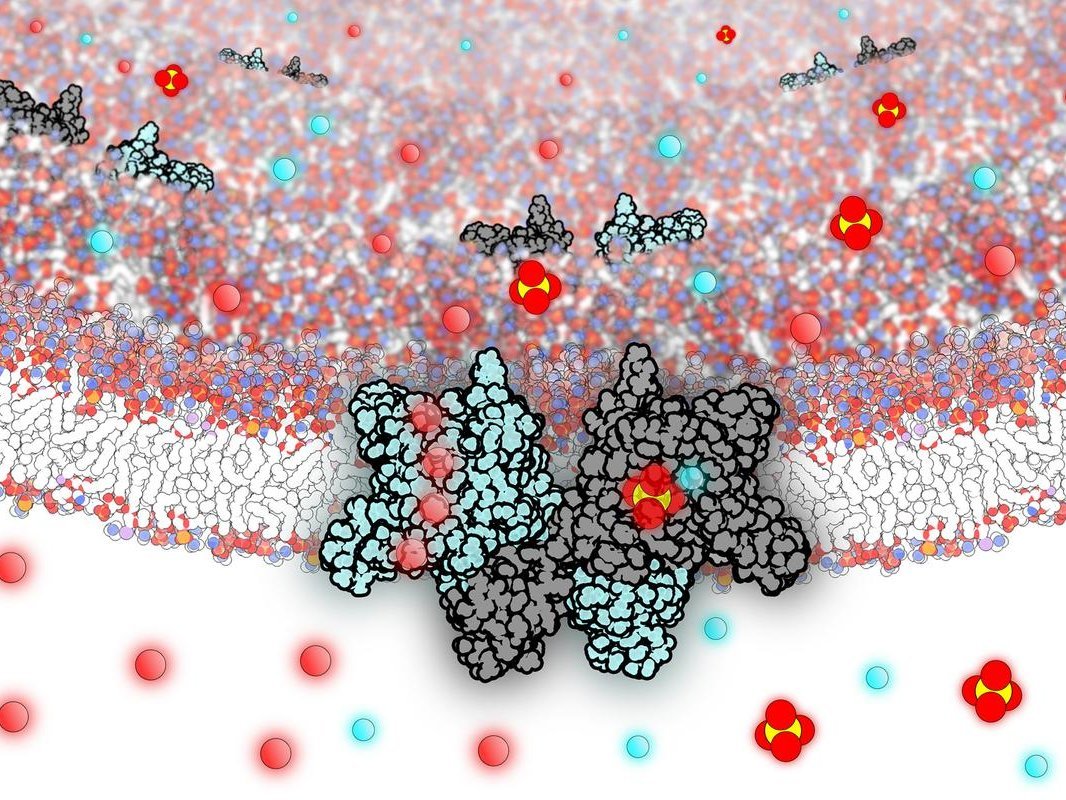
The molecular diagram illustrates the dual function: To ensure smooth protein degradation, the SLC26A11 protein acts as a transporter to remove sulfate waste and as a channel to expel the resulting chloride from the lysosome into the cell interior. Copyright: Institute of Neurophysiology / MHH
Cleaning up is essential in our daily lives—and this also applies to human cells. They have their own garbage collection system that tracks down old cell components, foreign bodies such as bacteria, and waste products inside them and encloses them in a kind of garbage bag. But nature is not wasteful, so cellular waste is not simply discarded but broken down into its building blocks and recycled. The task of these “recycling centers” is carried out by structures called lysosomes. Among other things, they break down proteins, producing sulfate—a chemical compound of sulfur and oxygen—as a byproduct. However, the sulfate must also be removed from the lysosomes. If it accumulates unchecked, it impairs the function of the enzymes involved. Such disruptions can lead to a group of disorders known as lysosomal storage diseases. These include, for example, Sanfilippo syndrome, a fatal neurological disorder.
Despite its significance, the molecular machinery underlying these mechanisms has been largely unknown until now. A research team led by Prof. Dr. Jan-Philipp Machtens, Director of the Institute of Neurophysiology at Hannover Medical School (MHH), in collaboration with Forschungszentrum Jülich and the Max Planck Institute for Molecular Cell Biology and Genetics in Dresden, has now elucidated this pathway. The researchers discovered that a specific enzyme in the lysosomal membrane is responsible for the export of excess sulfate from the lysosomes. The study has been published in the journal *Nature Communications*.
Lysosomes function as the “stomach of the cell”
Lysosomes are large, acidic organelles inside the cell. An organelle is a specialized, compartmentalized area within a cell that performs a specific task—similar to our organs. Lysosomes serve as the final destination for proteins that have reached the end of their lifespan. They are sometimes referred to as the “stomach of the cell” and, like the stomach, have an acidic environment inside. Like the stomach, they digest whatever they enclose—material from outside the cell or from within the cell itself, such as proteins, carbohydrates, fatty acids, and nucleic acids. These are broken down by enzymes, and the resulting components are transported through the lysosomal membrane into the cell interior, where they are then recycled. “We were able to demonstrate that a membrane protein called SLC26A11 acts as the transporter responsible for regulating the sulfate concentration,” says Professor Machtens. The general presence of SLC26A11—particularly in kidney and brain cells—was already known. However, its exact location and function had remained unclear until now. “In our study, we have now elucidated the function of SLC26A11 in lysosomes,” explains the neurophysiologist.
The enzyme’s dual function is crucial
In their investigations, the researchers found that SLC26A11 has a dual function. On the one hand, as a transporter, it actively exports the sulfate produced during protein degradation from the lysosomes—always together with a positively charged hydrogen atom and in exchange for a negatively charged chlorine atom, also known as a chloride ion. This transport coupling provides the energy necessary for efficient sulfate export from the acidic lysosome. However, this would in turn lead to an accumulation of chloride there. Therefore, SLC26A11 has a second function as a chloride channel, which transports the accumulating chloride ions back out. “The dual function of SLC26A11 as a sulfate transporter and chloride channel is crucial for lysosomes to fulfill their role in protein degradation and for cells to efficiently dispose of this protein waste,” emphasizes the neurophysiologist. These findings could open the door to new approaches for innovative therapeutics that target not only lysosomal storage disorders but also other neurological diseases associated with impaired chloride regulation in lysosomes.
Text: Kirsten Pötzke
SERVICE:
The original paper, “SLC26A11 is an atypical solute carrier with dual transport-channel function mediating lysosomal sulfate transport,” can be found here.