From medicine to natural sciences to public health: doctoral students celebrate their graduation - two of them receive the doctoral prize.
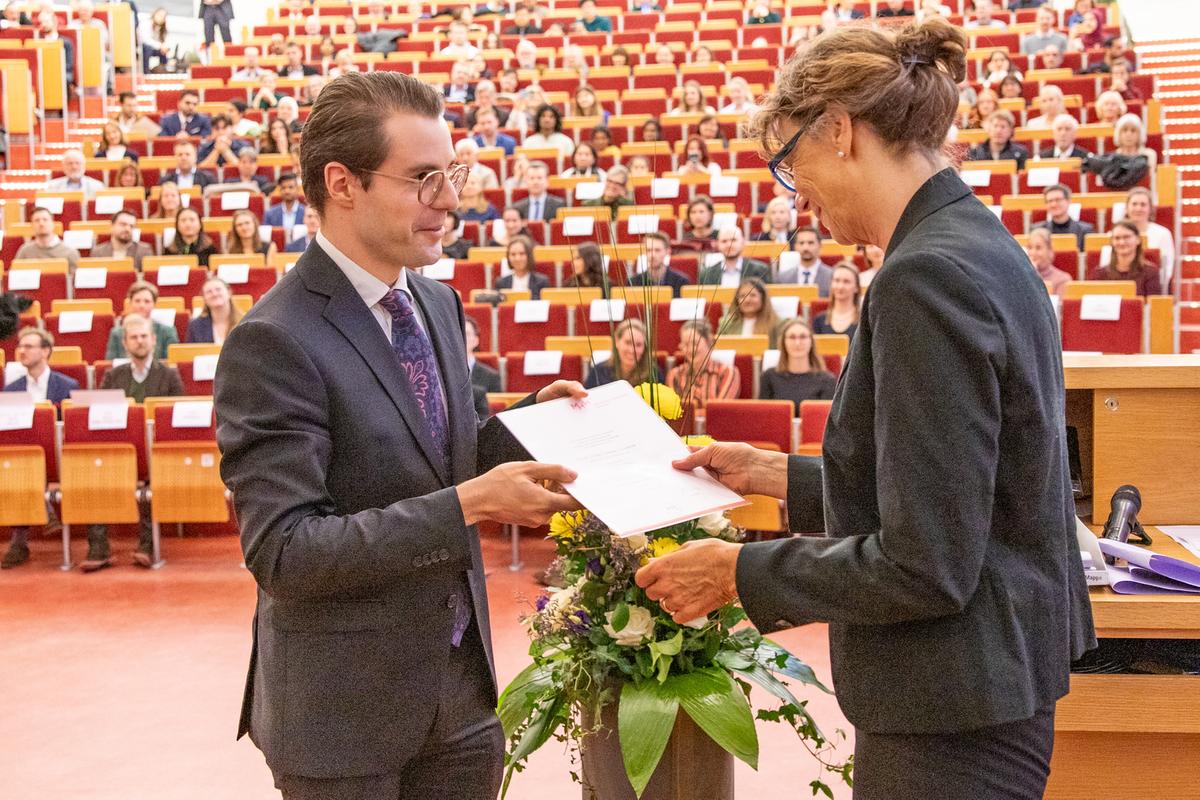
MHH President Professor Hilfiker-Kleiner presented the doctoral certificates in person. Copyright: Karin Kaiser / MHH
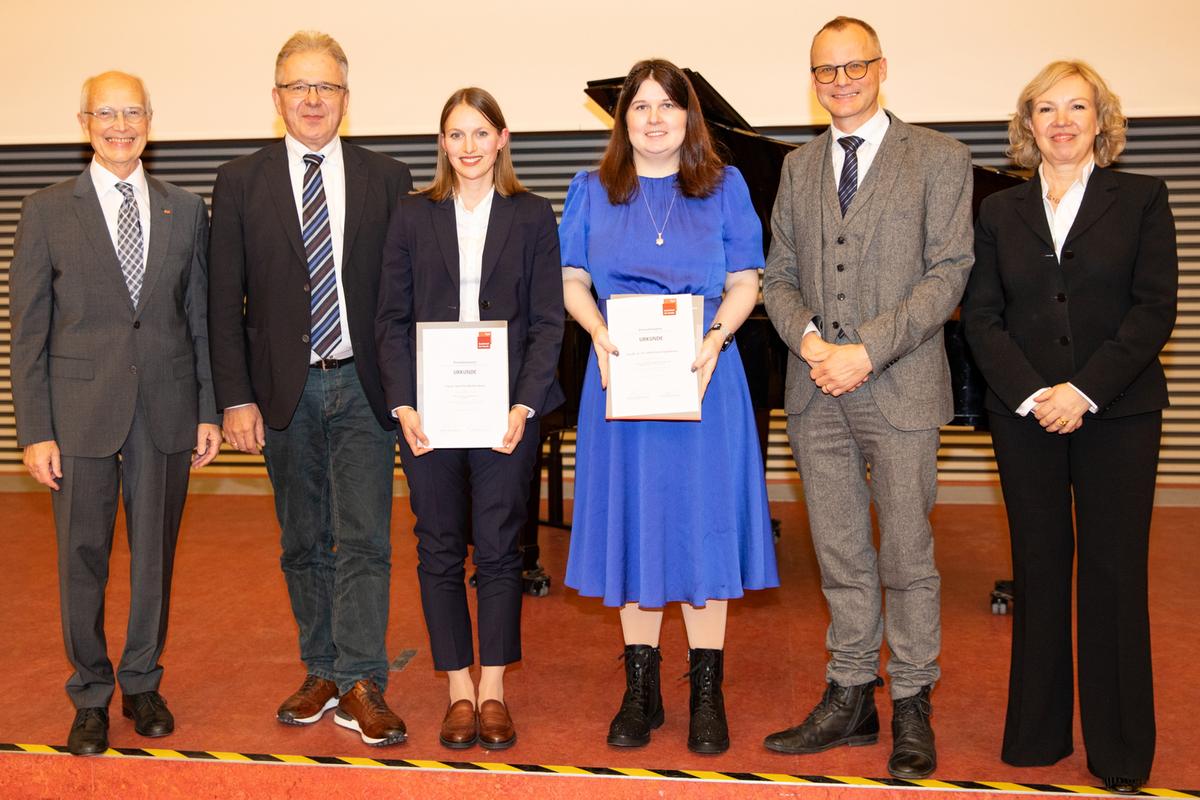
Honoring the two doctoral award winners Dr. Dr. med. Elisa Marlene Henze (3rd from left) and Dr. rer. nat. Sophie Anna Engelskircher (4th from left): Professor Piepenbrock, Professor Förster, Professor Wedemeyer and Professor Stiesch. Copyright: Karin Kaiser / MHH
120 women and men are now allowed to use the title of physician in their name. Hannover Medical School (MHH) awarded them their doctoral certificates last Friday. All subjects at the university were represented at the award ceremony. Among the 73 PhD students and 47 doctoral candidates were 54 medical physicians, 36 medical scientists, five dentistry students, two dentists, twelve natural scientists, two human biologists and two public health doctoral students. A total of eight PhD students graduated with distinction.
MHH President Prof. Dr. Denise Hilfiker-Kleiner welcomed the doctoral candidates and their families and friends to the graduation ceremony at the university. "Today you are celebrating another milestone in your life. With your work, you have not only demonstrated scientific ability and perseverance, but also created something unique that enriches our scientific world. Today, you represent all of MHH's disciplines and at the same time show how diverse our scientific community is." The MHH President then called all the doctoral candidates to the stage in small groups, congratulated them and presented them with their doctoral certificates.
Two doctoral candidates received the doctoral prizes of 2,500 euros each from the Gesellschaft der Freunde der MHH e.V. The prizes for outstanding doctoral theses were presented by Prof. Dr. Siegfried Piepenbrock, Chairman of the Gesellschaft der Freunde der MHH e.V., together with Dean of Research Prof. Dr. Meike Stiesch. The award winners are Dr. rer. nat. Sophie Anna Engelskircher and Dr. med. Elisa Marlene Henze. Dr. Engelskircher works in the MHH Clinical Department of Gastroenterology, Hepatology, Infectious Diseases and Endocrinology. Dr. Henze works in the MHH Clinical Department of Haematology, Haemostaseology, Oncology and Stem Cell Transplantation.
New findings on cell changes following hepaptitis C infection
Dr. rer. nat. Sophie Anna Engelskircher wrote her doctoral thesis at the MHH Clinical Department of Gastroenterology, Hepatology, Infectious Diseases and Endocrinology under Clinical Director Prof. Dr. Heiner Wedemeyer. Here she researched the effects of hepatitis C on the immune system and possible late effects such as liver cancer (HCC). In her outstanding dissertation entitled "Long-Hep-C: Persistent changes in the immune cell signatures after cure of hepatitis C?", Dr. Engelskircher used modern multi-color flow cytometry to analyse how certain immune cell groups, the natural killer cells (NK cells) and unconventional T cells (UTCs), behave during a hepatitis C infection and for several years after cure with modern drugs.
It was found that hepatitis C led to significant cell changes, both in terms of activation markers and depletion characteristics. Many of these changes did not completely normalize after healing. Even four to six years after successful therapy, NK cells and UTCs still showed typical traces of the previous infection. After treatment, new changes also developed that were not detectable before the start of therapy. A certain subgroup of UTCs, the so-called MAIT cells, was also significantly reduced in people with hepatitis C - and remained permanently reduced even after recovery. A certain NK cell population, namely TIM-3hi-CD38+ NK cells, was particularly significant. These cells were frequently found in people with hepatitis C, but were largely absent in healthy control subjects. Patients who later developed liver cancer after being cured showed consistently high levels of this cell population. In people without subsequent tumor development, however, these cells decreased after healing. Functional tests confirmed that these NK cells are highly cytotoxic.
The PhD student came to the conclusion that a cure of hepatitis C does not mean that the immune system returns to its original state. The infection leaves a long-term "immune fingerprint". In particular, certain NK cell patterns could help to identify people with an increased risk of developing liver carcinoma at an early stage in the future.
Link to the publication (first authorship): https://journals.lww.com/hep/fulltext/2024/07000/impending_hcc_diagnosis_in_patients_with_cirrhosis.21.aspx
Important contribution to a more detailed understanding of the viral entry routes of herpes viruses
Dr. med. Elisa Marlene Henze received her doctorate with a thesis on the "Role of MCK2 in the pathogenicity of MCMV". The dissertation was written at the MHH Institute of Immunology under the supervision of Institute Director Prof. Dr. Reinhold Förster.
The cytomegalovirus (CMV) belongs to the herpes viruses and is a widespread pathogen that causes a high disease burden. In order to prevent the consequences of a CMV infection with the help of antiviral drugs and vaccinations, precise knowledge of the viral entry tools is required.
In her doctoral thesis, Dr. Henze was able to show that the virus MCMV, also known as "mouse cytomegalovirus", only infects certain immune cells well when it produces the chemokine MCK2. However, this process is not the same for all cell types. For example, connective tissue cells (fibroblasts) can be infected without MCK2. By closely examining the cell surface, the researcher was able to find out that the MHC-Ia molecules play an important role in the infection. She also discovered that genetic differences in the MHC complex can influence susceptibility to infection. Experiments in mice that do not express MHC-Ia have shown that this impedes viral spread from the lungs to the salivary glands.
Overall, this work contributes to a more detailed understanding of the mechanisms of primary MCMV infection in terms of cell entry, infection of different tissues and dissemination in the body.
Link to the publication: MCK2-mediated MCMV infection of macrophages and virus dissemination to the salivary gland depends on MHC class I molecules: Cell Reports
Text: Bettina Dunker