MHH researchers are developing a customisable glaucoma implant. It is designed to significantly reduce the risk of scarring and blindness.
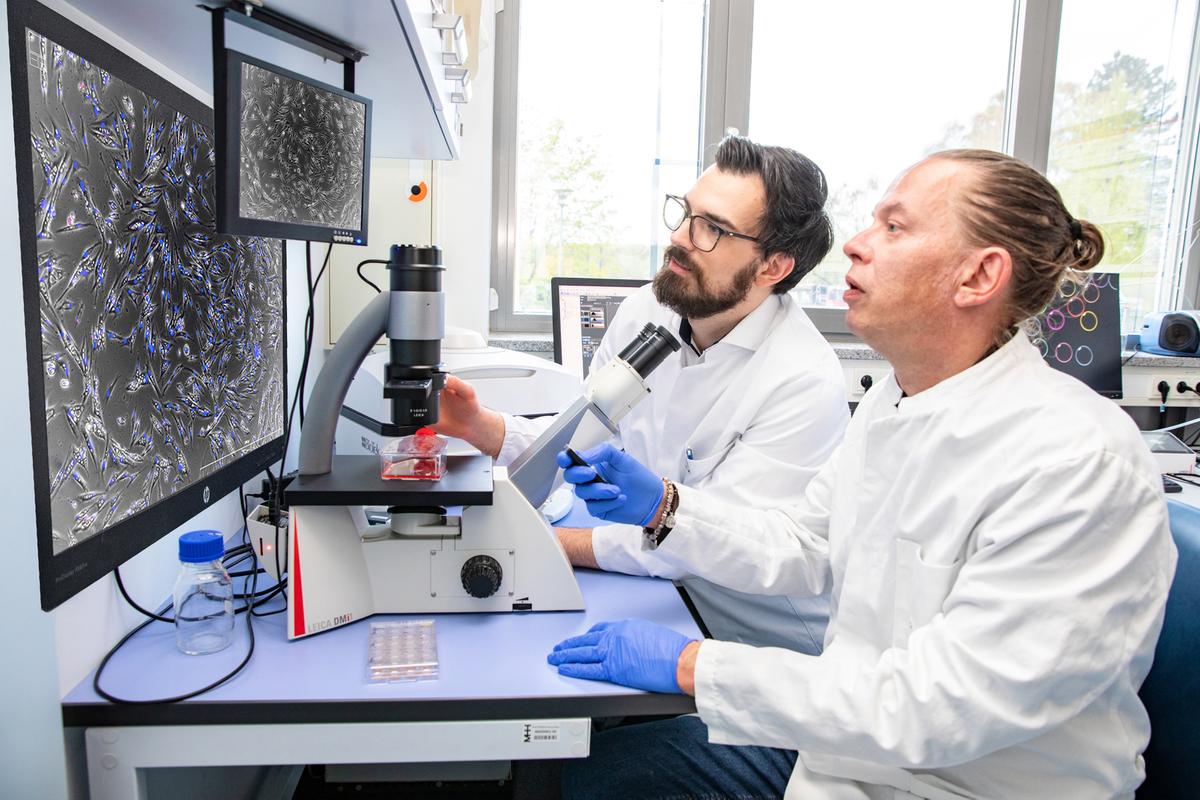
Developing a novel, individually controllable implant for glaucoma: Dr. Maximilian Binter (left) and Dr. Heiko Fuchs. Copyright: Karin Kaiser/MHH

Glaucoma is one of the most common causes of blindness worldwide. It is estimated that around 76 million people are affected. To prevent further damage to the optic nerve, treatment aims to lower intraocular pressure. This is achieved either using special eye drops, laser treatments or surgical procedures that create a connection between the space under the conjunctiva and the interior of the eye. However, these operations often have side effects and require follow-up surgery. Common complications include scarring processes, known in technical terms as fibrosis. These can cause the artificial connection to close up again. A research consortium led by the Department of Ophthalmology at Hannover Medical School (MHH) is now working on a novel glaucoma implant designed to individually regulate intraocular pressure whilst simultaneously preventing the development of fibrosis. The “Antifibrotic Glaucoma Implant (Glaucoma AF)” project is being carried out in cooperation with Hanover University of Applied Sciences and Arts, the Institute of Metal Forming Technology and Metal Forming Machinery, and the Institute of Quantum Optics at Leibniz University Hannover, and is being funded by the European Regional Development Fund (ERDF) with around 1.8 million euros over three years.
Inhibiting unwanted scar tissue formation
The gold standard among surgical glaucoma treatments is filtering trabeculectomy. This procedure creates an additional drainage pathway through which aqueous humour is drained beneath the conjunctiva. There, a so-called drainage cushion forms, from which the fluid is absorbed by the body via the surrounding tissue. Alternatively, a stent or an artificial valve in the eye can also ensure that the fluid is drained. The problem with all these procedures is the so-called Tenon’s fibroblasts. These specialised connective tissue cells, which form a protective layer of the eye, are responsible for rapid – but in this case undesirable – wound healing. As the main cause of scarring, they can jeopardise the success of pressure-reducing eye surgery. To inhibit fibrosis, most patients are given mitomycin C. This anti-tumour drug, known from cancer treatment, is intended to prevent the surgically created drainage pathway from closing up again. “The disadvantage of this chemotherapeutic cytotoxin is that it attacks not only the Tenon’s fibroblasts, but also the conjunctiva and the protective sclera of the eye,” explains ophthalmologist Dr Maximilian Binter.
Integrated control mechanism
The project is based on a basic implant that has already been developed, featuring a valve that can still be opened even after the operation. The primary aim is to prevent intraocular pressure from dropping too sharply following the procedure. The current project aims to further develop this control mechanism so that, in future, intraocular pressure can be adjusted gradually and individually to suit the needs of each patient. This should make pressure adjustment more personalised and easier to control in the long term. A coating with anti-fibrotic agents is also planned. To this end, the researchers are now looking for an alternative to mitomycin C to prevent the development of fibrosis and the resulting reduction in effectiveness or even failure of the implant, without damaging other parts of the eye.
Search for an eye-friendly fibrosis inhibitor
“We have established cell cultures from various cell types in the eye and are now testing several drugs—some of which are already approved for other cancers—at different dosages in live-cell analyses,” says Dr Heiko Fuchs, head of the MHH Ophthalmology Research Laboratory. The biologist hopes that among these there is an active ingredient that primarily keeps Tenon’s fibroblasts in check without weakening the eye tissue. The advantage: if such an active ingredient is found, the drug would not need to undergo a completely new approval process, but its authorisation would simply need to be extended to include its use for glaucoma in the eye. This is significantly faster and more cost-effective.
Implant designed to release active ingredient in a controlled manner
“It would be fantastic if we could discover a selectively effective drug,” says Dr Fuchs. “This could then probably be applied to other conditions where abnormal wound-healing processes trigger fibrosis.” The eye-friendly fibrosis inhibitor would therefore not need to be administered separately but would be released directly from the implant into the surrounding tissue in a controlled manner. “This prevents further irritation of the operated eye, allows for use over a longer period of time and also makes dosing much easier,” says Dr Binter. The researchers are confident that, if all goes well, treatment options for glaucoma patients could be significantly improved in the long term and the risk of blindness substantially reduced.
Text: Kirsten Pötzke