MHH researchers are deciphering how acetyl building blocks travel from inside the cell to its surface, thereby influencing the immune response.
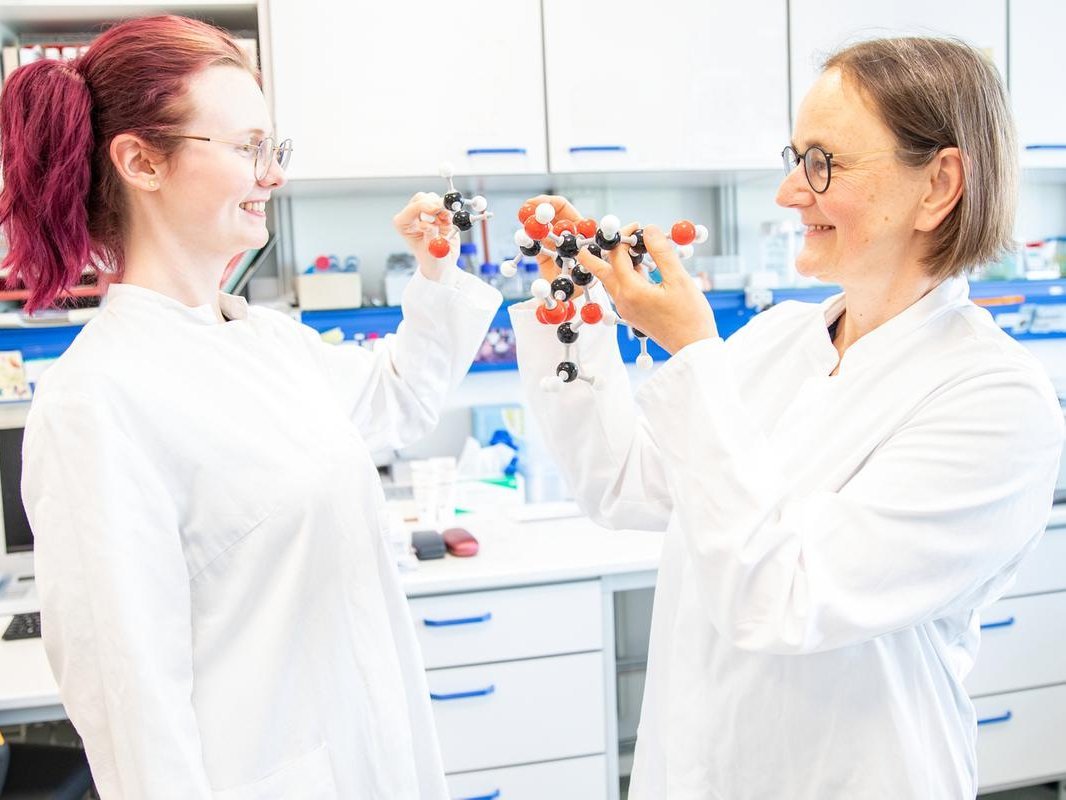
Ready to dock: PhD student Lydia Bosse (left) holds the molecular model of the acetyl group in her hands, while PD Dr. Martina Mühlenhoff holds that of sialic acid. Copyright: Karin Kaiser/MHH
To ensure optimal coordination of communications between trillions of body cells, our organism uses molecular recognition patterns on the cell surface that consist of sugar chains. Their most important chemical component is sialic acid. An altered sialic acid pattern can influence the immune system’s recognition of the body’s own cells. This can promote autoimmune reactions or, in the case of tumor cells that carry increased amounts of sialic acid, protect them from the immune system. A common modification of sialic acid is so-called O-acetylation, in which a building block is replaced at one or two sites. The targeted chemical modification of cell-surface sugars influences both cellular communications and interactions with pathogens.
A research team led by associate professor (PD Dr.) Dr. Martina Mühlenhoff, a scientist at the Institute of Clinical Biochemistry at Hannover Medical School (MHH), investigated how these building blocks reach their target. In the process, the researchers confirmed a previously hypothesized pathway and also discovered a previously unknown mechanism. These fundamental scientific findings are also significant because various viruses use O-acetylated sialic acids as receptors for entry into host cells, and certain tumors exhibit increased O-acetylation of sialic acids. The results have been published in the journal *Nature Communications*.
Acetyl group modifies sialic acid
The chemical process of O-acetylation takes place in the Golgi apparatus, the cell’s central “mail and distribution station.” It proceeds roughly according to the principle of a chemical Lego building set, in which individual parts can be exchanged and reassembled. In this process, the hydrogen atom bound to one or two oxygen atoms (O atoms) of the sialic acid is replaced by a compatible but larger chemical building block. This building block, known as an acetyl group, increases the overall size of the sialic acid and permanently alters its properties. “The question is how the acetyl building block finds its way into the distribution station,” says PD Dr. Mühlenhoff. One hypothesis was that the building block enters the Golgi apparatus via a transporter protein called SLC33A1. The research team has now been able to demonstrate this for the first time. “We were also able to show that genetic changes in SLC33A1, which have been found in children with Huppke-Brendel syndrome, impair the O-acetylation of sialic acids,” explains the biochemist. The consequences of these rare mutations are severe, as they lead to serious neurological and developmental disorders as early as infancy.
Two transport pathways
The sugar modification itself is initiated by the protein CASD1. It is located in the membrane of the Golgi apparatus and accelerates the modification process of sialic acid. Chemists also refer to this effect as catalysis. The research team identified a second catalytic centre in the protein and was thus able to explain for the first time how CASD1 attaches acetyl groups at different positions within sialic acid. The newly discovered catalytic centre is located in a protein segment that extends through the Golgi apparatus membrane and forms a kind of gate for acetyl groups. “In this study, we provide evidence for the existence of two distinct pathways for the transport of acetyl units through the Golgi membrane, both of which converge in CASD1-mediated catalysis,” says Lydia Bosse, a PhD student and the study’s first author.
Gateway for viruses
The findings are not only of interest for basic research. As a gateway for viruses, the chemical state of sialic acid on the cell surface can be crucial. “Influenza C viruses, which cause respiratory diseases primarily in young children, require O-acetylated sialic acids as a gateway to enter the cell,” explains PD Dr. Mühlenhoff. “Influenza A and B viruses, on the other hand, can only enter if the sialic acid is present in its unmodified form.” Certain coronaviruses use O-acetylated sialic acids as a molecular key to open or activate their spike protein. Only then is the interaction with the host cell receptor—which is necessary for infection—made possible. “Sialic acids could be an interesting approach for better understanding viral infections and, in the future, combating them more effectively,” the biochemist notes.
SERVICE
The original publication, “Interplay of SLC33A1-dependent and -independent Golgi sialic acid O-acetylation in CASD1 catalysis,” can be found here:
Text: Kirsten Pötzke