MHH researchers are using lipid nanoparticles for more efficient base editing of a gene mutation associated with an inherited iron storage disorder.
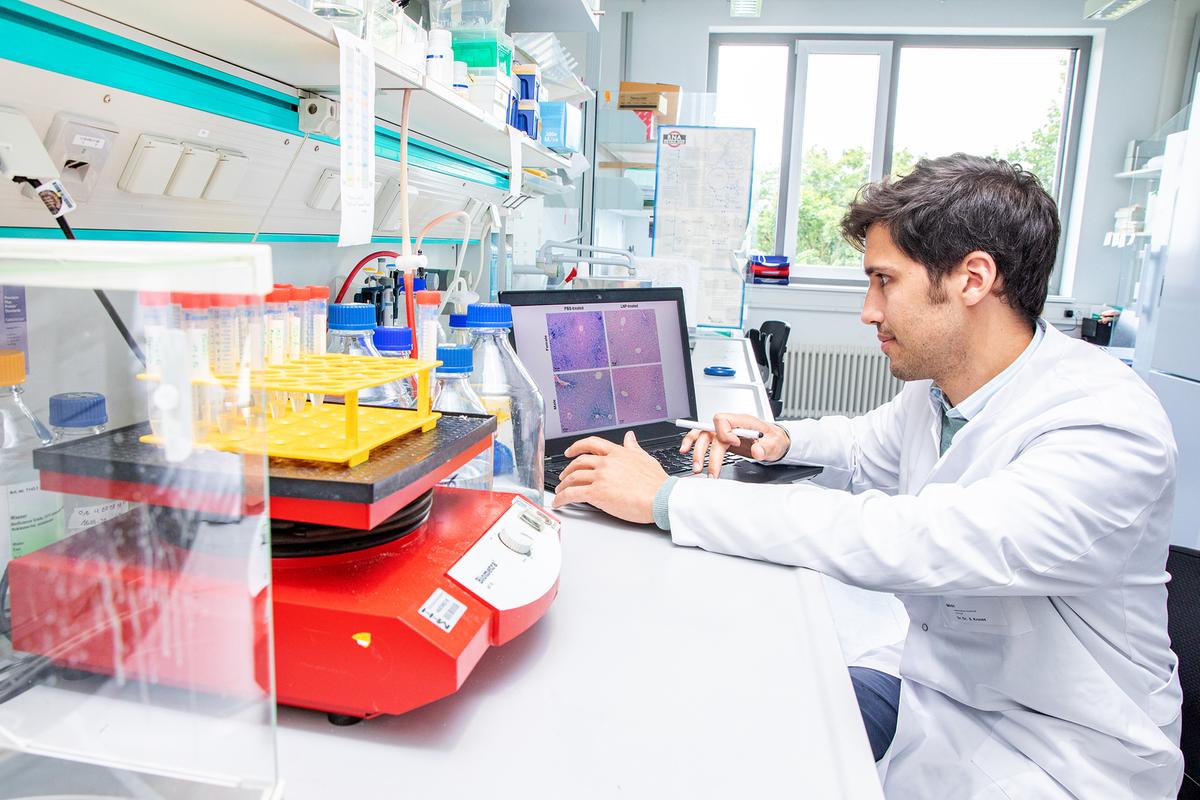
Aims to effectively reduce iron accumulation in the livers of people with hemochromatosis through gene correction: liver researcher Dr. Dr. Simon Krooss. Copyright: Karin Kaiser/MHH
Hereditary primary hemochromatosis is one of the most common congenital metabolic disorders in Europe. In this disorder, also known as iron storage disease, excess iron accumulates in various organs. This can lead to severe symptoms such as joint pain, diabetes, and serious complications such as liver cancer. The cause is a genetic defect that disrupts the regulation of iron absorption through the small intestinal mucosa. In 2022, a research team led by Prof. Dr. Michael Ott and Dr. Dr. Simon Krooss from the Clinical Department of Gastroenterology, Hepatology, Infectious Diseases and Endocrinology at Hannover Medical School (MHH) developed an approach to treat this hereditary disease using targeted gene correction. The researchers have now further refined this method using cells from patients and in a mouse model. Instead of delivering the molecular biological tools into the cells using a viral vector—also known as a “gene taxi”—they now used so-called lipid nanoparticles (LNPs) to transport the therapeutic RNA into the liver. These offer decisive advantages over viral vectors, as they are safer, easier to produce, and allow the gene-correction tools to remain in the body for a limited time—ranging from a few hours to several days. The study has been published in the prestigious journal *Journal of Hepatology*.
Faulty regulation of iron uptake
“In most cases, hemochromatosis is caused by a defect in the HFE gene, which is located on chromosome 6,” says Professor Ott. It occurs only in people who have inherited this defect from both parents—that is, who do not have a “healthy” gene to compensate. In more than 80 percent of those affected, a specific change—known as the C282Y mutation—is found in both copies of the HFE gene. This leads to the replacement of an amino acid—that is, a protein building block—in the HFE protein. As a result, the HFE protein loses its ability to regulate iron absorption. To deplete iron stores and normalize iron levels in the body, patients must undergo bloodletting for the rest of their lives. This is burdensome and, moreover, does not work for everyone affected. Medications that bind to and neutralize iron directly in the body are also not ideal due to severe side effects.
Cell completes gene repair on its own
The MHH researchers, however, are tackling the problem at its root. They are using the body’s own repair mechanisms to repair the defective HFE gene. With the help of CRISPR/Cas technology—known as “genetic scissors”—and a linked enzyme, they specifically modify a tiny defective building block in the mutated HFE gene. In technical terms, this procedure is called base editing. What makes this gene repair unique is that the gene scissors are used in such a way that they do not simply cut the DNA double strand completely at the desired location, as in the classic application. “A double-strand break always carries a certain risk of unwanted mutations,” explains Dr. Dr. Simon Krooss. In base editing, however, the two single strands are separated from one another and only one of them is modified. As a result, the cell automatically initiates its natural repair program and incorporates the correct counterpart into the second strand as well, so that the C282Y mutation disappears from the entire double strand.
LNPs efficiently transport mRNA into the liver
The research team sends only the blueprint for the base-editing system as so-called messenger RNA (mRNA), which is broken down in the body and disappears after 48 hours. This method is also used in mRNA vaccines, such as those against the SARS-CoV-2 coronavirus. Until now, the team had used viral vectors as delivery vehicles. Now, the blueprint—along with a “navigation aid” that guides the gene scissors precisely to the correct location on the DNA—is packaged into lipid nanoparticles. These have a structure similar to the cell membranes in our bodies. Upon contact with the cell, they fuse with its outer membrane and release their contents. “LNPs consist of a combination of synthetic fats and are considered safe in terms of potential immune reactions,” says Professor Ott. Furthermore, compared to viruses, they can be produced in large quantities very quickly and cost-effectively.
Iron overload is significantly reduced
“We tested the system, on the one hand, in a mouse model with iron overload,” says Dr. Dr. Krooss. “On the other hand, we investigated it in cell cultures derived from mouse liver cells, as well as in cell cultures derived from human liver cells that we obtained from blood cells of patients with hemochromatosis that we reprogrammed from induced pluripotent stem cells.” The result: In the mouse model, the base-editing system successfully corrected up to 67 percent of the defective bases, and iron overload in the liver decreased significantly. In the mouse liver cells, the success rate was about 70 percent; in cell cultures with human liver cells, it was around 65 percent. With a correction rate of 50 percent, the body has access to enough functional HFE proteins to adequately regulate iron absorption. For this reason, people with only one affected gene copy—heterozygous carriers—are not at risk. “It is particularly noteworthy that the high efficiency of the gene correction was accompanied by high precision,” explains the physician and scientist. “We were unable to detect any relevant off-target effects. The gene scissors thus acted specifically at the intended site in the genome without causing unwanted changes in other genomic regions.”
Potential Applications for Other Diseases
“These results provide evidence that gene editing is both safe and efficient, effectively reduces iron accumulation in the liver, and thus prevents harmful pathological processes in the liver,” emphasizes Professor Ott. The method is now to be investigated as quickly as possible in clinical trials at the MHH. If the treatment proves effective in humans as well, a single injection could in the future protect carriers of the mutation from severe disease progression, liver cancer, or even the need for an organ transplant. “Injection instead of transplantation,” is how liver researcher Ott summarizes this vision. In addition, the two researchers are working to apply base editing as a definitive treatment for many other congenital diseases.
Text: Kirsten Pötzke
SERVICE
The original publication, “In vivo base editing alleviates hepatic iron accumulation and fibrosis in models of HFE-related hereditary hemochromatosis,” can be found here.