Real-time data exchange: The telePIN network connects Clinical Departments and enables highly qualified remote treatment
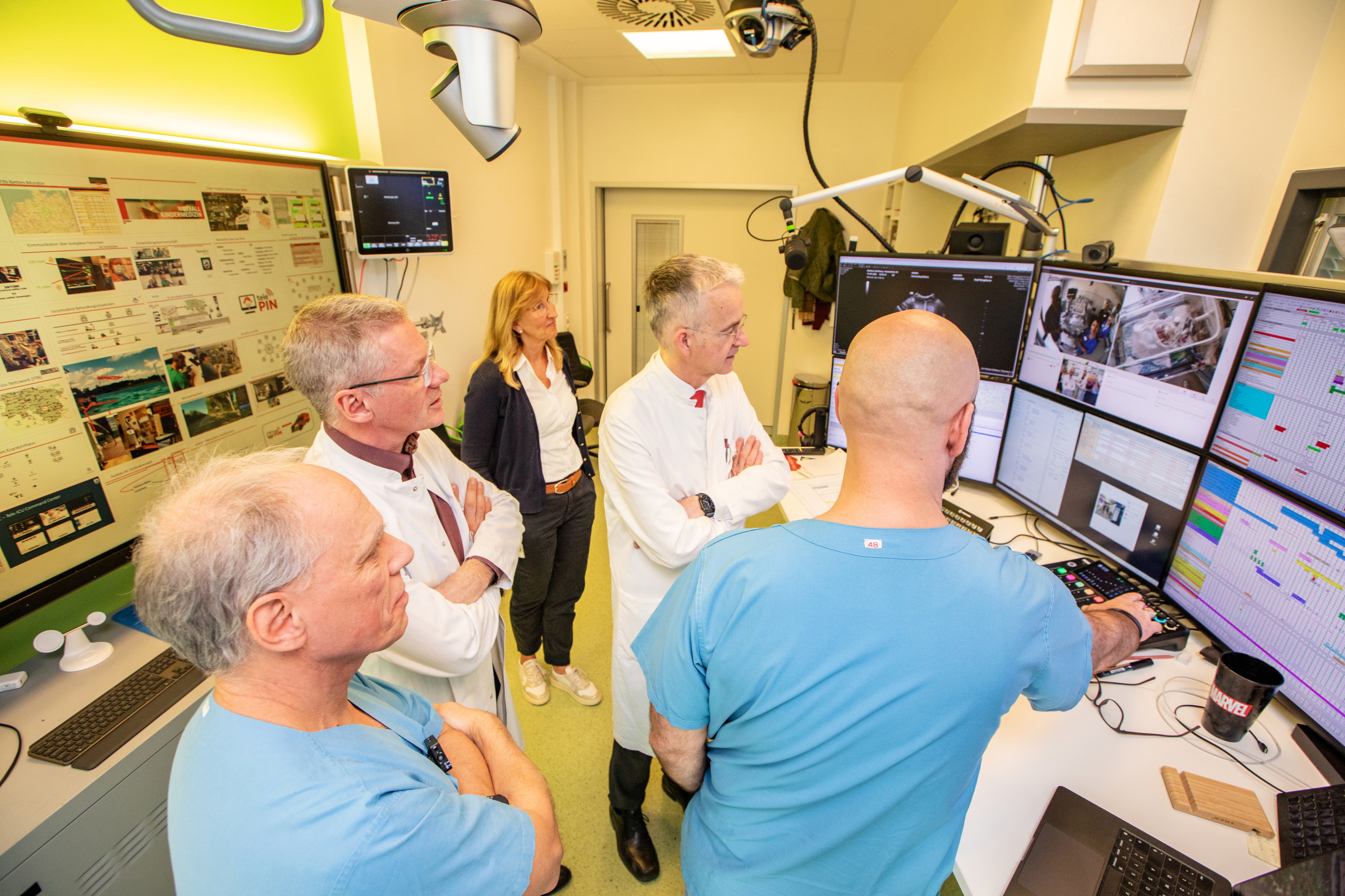
In the telePIN “cockpit”: Dr. Sasse, Professor Beerbaum, Sibylle Schiele, Clinical Performance Development, Professor Lammert, Dr. Rathert (from left). Copyright: Karin Kaiser / MHH
In Germany, care for critically ill children is at risk—there is a lack of functioning structures, technical equipment, and, above all, staff. Of the 29 children’s hospitals in Lower Saxony, only four currently have a specialized paediatric intensive care ward. And in these facilities, only half of all paediatric intensive care beds can be operated because of a statewide shortage of nursing staff and physicians. The team at Intensive Care Unit 67 at the MHH Children’s Hospital has long been fighting against this dire situation. More than 20 years ago, they founded the Paediatric Intensive Care Network (PIN) to facilitate closer collaboration with other Clinical Departments. This cooperation is now reaching a new level. The PIN is being expanded to include a telemedical PIN: data, images, and videos can now be exchanged in real time between participating children’s hospitals. For example, a small children’s hospital can bring in experts from a larger center to assist with a complex case. The examination or treatment of the child then takes place jointly “live.”
Real-time acute care
After three years of intensive planning, telePIN entered the pilot phase in early 2025. Currently, six pediatric hospitals in Lower Saxony and the MHH Pediatric Clinic, serving as the central control unit, are participating. “It’s working well; we’ve already been able to save children’s lives,” explained Dr. Henning Rathert of the telePIN team during a visit by Prof. Dr. Frank Lammert to Ward 67. The Vice President responsible for patient care at the MHH participated live in a telehealth consultation with the Wolfsburg Hospital. Prof. Dr. Philipp Beerbaum, Director of the Clinical Department of Paediatric Cardiology and Intensive Care Medicine, senior physician Dr. Michael Sasse, and Dr. Henning Rathert welcomed him to the “telePIN cockpit.” This specially equipped room houses all the technology needed for live communications with other children’s hospitals, including seven giant screens and a mobile camera robot with three integrated cameras. The team demonstrated what is possible with telePIN during a live connection with the Children’s Hospital in Wolfsburg, where a camera robot is also installed. During the examination of a premature infant, the MHH experts are present in real time: they view ultrasound images, track the heart’s movements, and monitor the child’s vital signs on the screen. In addition to these detailed views, they also get an overview of the overall situation at the patient’s bedside. “The technology enables us to provide remote support during examinations and procedures, both in terms of execution and interpretation,” explains Dr. Sasse.
Ensuring comprehensive care
The system complies with data protection regulations and is particularly well-suited for acute and emergency care in paediatric intensive care. The MHH team’s long-term goal is to connect all children’s hospitals in Lower Saxony and Bremen, the adjacent regions of neighboring states, and emergency medical services to telePIN. This aims to ensure comprehensive, high-quality care for children with life-threatening illnesses. “This reduces the number of transfers to other children’s Clinical Departments and helps alleviate staff shortages,” says Professor Beerbaum. At the same time, the system—which allows all Clinical Departments to network with one another—serves as a valuable tool for sharing expertise. A shared patient data management system is currently being integrated into telePIN, and an information tool for bed occupancy is already available.
Forward-looking project
The MHH system is technically transferable to other intensive care areas such as surgery, cardiology, and pulmonology. “telePIN is an excellent example of team spirit, digitalization, and cross-site networking in healthcare,” summarizes Prof. Lammert. The project is funded by the Federal Ministry of Health and the Lower Saxony Ministry of Social Affairs.
Text: Tina Götting