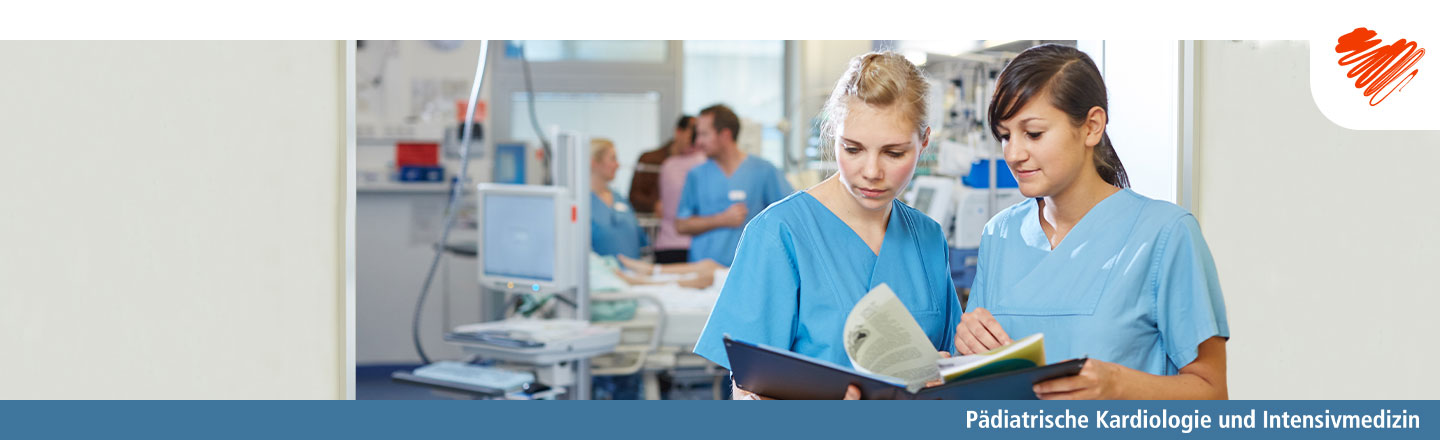
Intensive care unit 67 is the largest pediatric intensive care unit in the German-speaking world and has 18 fully equipped ventilation places. We treat around 1200 children of all ages and adults with congenital heart defects (EMAH) here every year.
Your child or relative has been admitted to us for monitoring, therapy and Nursing. Whatever the reason for admission to our ward, we want you to feel well cared for at all times, even if the period of intensive care may be emotionally stressful at times. Your questions and concerns will relate to many different medical and non-medical aspects - the well-being of your child or relative, the prognosis of the disease, the time after intensive care, your future and that of your family as a community. On the other hand, you will have many hopes and expectations of our therapy and ward, of which we as practitioners often only know a fraction and which we cannot fulfill in every case or with absolute certainty.
What we can promise you in any case is that you can rely on us!
We will do everything we can to provide your child or relative with the best possible treatment and care.
At the same time, we will endeavor to address all your concerns and fears and make your stay with us as pleasant as possible. And you will always receive honest and sincere answers and information from us, even if they are unpleasant and uncomfortable.
And last but not least: there are no stupid questions! Dare to ask - this will help us to understand you better, to give you the right answers that are important in the respective situation and to be able to support you appropriately with your worries, hopes and fears. And if we don't do this well, please tell us that too - because nobody is perfect and your re-registration will help us to do better in the future. Always remember: you as a parent or relative and we as the people treating you are a team for your recovery. With this in mind, we hope you have a good time with us and feel that you are in good hands and well looked after.
Click here for the brochure of ward 67
Questions and answers about hospitalization
Many patients require a planned stay in an intensive care unit 67 - after surgery or interventions that require intensive monitoring or ventilation. However, the ward also cares for patients after emergencies that occur suddenly and unexpectedly. This often gives rise to many questions, which we have addressed and answered here. What is the normal daily routine on the intensive care unit 67? Which tubes are for what? What do I have to consider as a visitor? Is there a room for parents and visitors where I can spend time? We have therefore put together some information for you on the rest of this page.
Please understand
We are an intensive care unit whose daily routine - due to planned and unplanned new admissions, medical rounds, nursing and medical handovers, examinations or necessary short interventions on patients - often has to be flexible. Therefore, it will unfortunately happen more often that you are temporarily unable to be with your child or relative and are asked by the nursing staff or physician to leave the room or the ward.
Visiting times
To avoid unnecessary waiting times, you should plan your visits within our core visiting hours if possible:
- 09.00 to 12.15
- 3.00 p.m. to 7.30 p.m.
Number of visitors and siblings
A maximum of 2 visitors per "bed" should always be present at the same time, whereby one of these persons must always be a parent in the case of minors. Before siblings under the age of 14 are allowed in, they must be briefly examined by one of our duty physicians to rule out infectious childhood diseases.
Use of the "bell" telephone system
Before each visit, we would ask you to ring the telephone system at the ward door in the respective room and ask whether you can come to see your child or relative. If you have to wait, we will be happy to inform you by telephone in the visitors' room or on your private telephone when you can come back in.
Room telephone numbers (also shown on the bell system)
- Room 1: -6291
- Room 2: -6292
- Room 3: -6293
- Room 4: -6294
- Room 5: -6295
- Room 6: -6296
Notes on hygiene
After entering the ward - i.e. before entering the patient's room - please take off your hand and arm jewelry and keep these items safe with you. Then wash your hands and disinfect your hands after drying them.
- Instructions for this can be found in the anteroom of the ward, at the washbasin.
- Please also disinfect your hands again before leaving the ward.
If you have an upper respiratory tract infection, herpes on your face or diarrhea, please inform the staff at the intercom before entering the ward and wait for further instructions from the staff.
Valuables
You may take valuables such as keys, important papers or your handbag into the patient room. Please look after these items yourself; unfortunately, we cannot accept any liability for lost items.
If you have to wait, we invite you!
Visits from parents or relatives are extremely important to us. However, for various reasons (e.g. admissions/emergencies/etc.) you may have to leave the patient room as a visitor or parent. To make your waiting time as pleasant as possible, a cozy visitor's room has been furnished with donations from the parents' association "Kleine Herzen Hannover". You are very welcome to wait there during the "visiting breaks". It is possible to make yourself a cup of tea or coffee. A drinking water dispenser and a microwave are also available. You can switch on the TV on the comfortable sofa to try and shorten the waiting time.
We will let you know when you can return to your room!
We can reach you via the telephone on the wall as soon as you are allowed back into the patient room. You will receive the door opening code from the responsible nursing staff.
Please be considerate
As this room is available to all parents and relatives of our patients, mutual consideration should be a matter of course. We also ask that all visitors leave the room as they would like to find it themselves.
Visits, handover & parent meetings
Communications are very important to us. During our daily morning ward rounds, our young and old patients are discussed and visited together at the bedside. This handover also takes place in small groups at lunchtime and in the evening. Due to the duty of confidentiality towards the parents and relatives of fellow patients, visits are unfortunately not possible during this time.
We attach particular importance to regular discussions with our patients and their relatives and always keep them informed about the clinical progress. Even in acute situations, we are available for personal discussions with patients and parents, if necessary in larger groups with the various specialist disciplines involved. Our aim is to always provide our patients and their relatives with honest, trustworthy, comprehensive and continuous information about their current clinical condition and all planned medical measures, as well as psychological support for our patients and their relatives in every phase of their intensive care stay.
Mobilization & early rehabilitation
How can we support our patients in their recovery process? What can we do in detail? Such questions are not only asked by physicians and nursing staff in our pediatric intensive care unit. Numerous professions are closely involved in the treatment - and together they form the first interdisciplinary mobilization team at the Medical School. This team includes three Nursing staff, four physiotherapists, a massage and hydrotherapist, an occupational therapist, a sports scientist, a dysphagia therapist and two physicians. They all meet every Wednesday for a joint mobilization visit, look at each patient and discuss the next sensible therapy steps. This is how we decide when, what and how much supportive therapy and encouragement is right for your child. Times when scheduling problems arose due to a lack of coordination between all those involved are now a thing of the past. Our patients receive the best possible support right from the start so that they can leave our intensive care unit as quickly as possible.
In order to be able to administer medication and infusions in an intensive care unit, a so-called central venous catheter (CVC) is often inserted, which has several lumens (channels) and thus enables the administration of different substances at the same time as well as "prick-free" (and therefore pain-free) blood sampling.
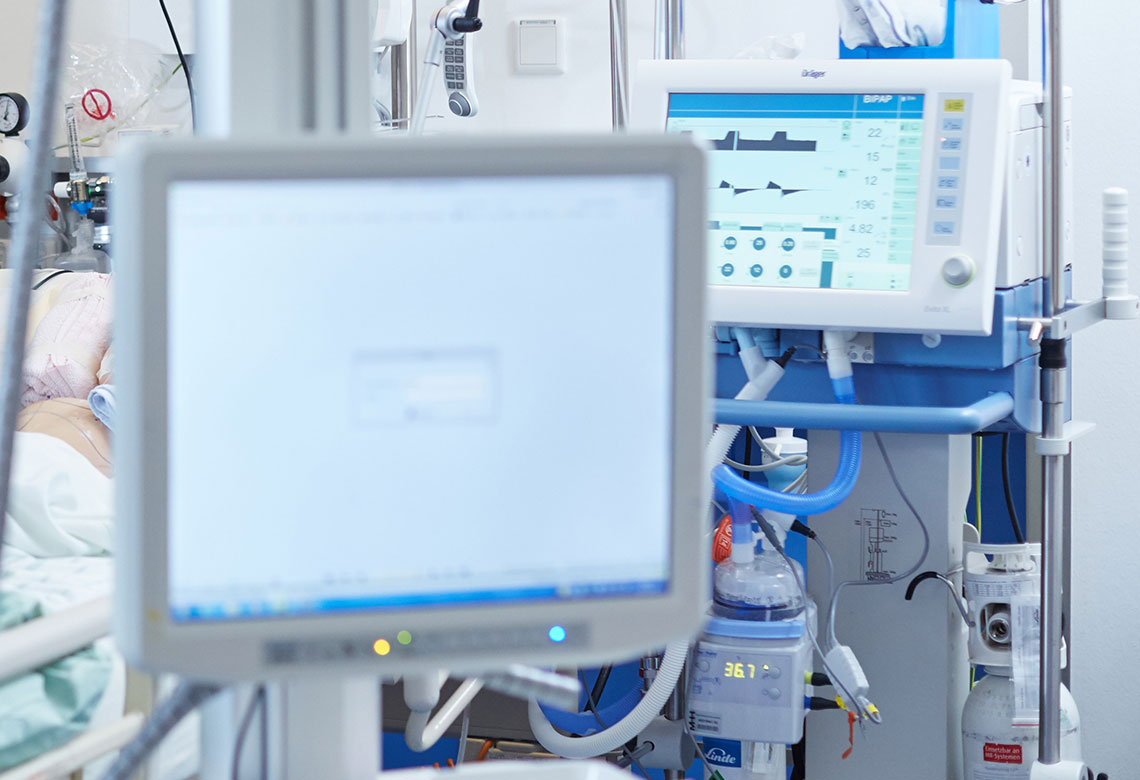
The ventilator takes over the patient's breathing or respiratory support as required, for as short a time as possible and as long as necessary. This device can also respond to minimal changes in the needs of even the smallest patients using integrated technology.
Each patient is connected to a monitor to monitor the cardiovascular and respiratory systems. The monitor usually simultaneously displays the ECG as a green curve, the central venous pressure as a blue curve and the pressure in an artery as a red curve. In addition, the oxygen saturation in the blood and optionally many other values can also be displayed. If the values deviate from the predefined limit values that have been specifically set for the respective patient, the monitor issues an alarm and an immediate response can be made. An alarm is therefore nothing threatening, but merely an indication of a change.
If fluid or air accumulates in the body in places where it does not actually belong, it may be necessary to drain it away using a so-called drainage system. If necessary, drains are inserted intraoperatively after operations. These "tubes" are removed as early as possible while avoiding pain.
The nurse in charge will be happy to explain to you what type of drainage is involved.
If it is necessary to ensure safe urine drainage (under deep anesthesia, for precise export control, etc.), a small silicone tube is inserted into the bladder and drained into a measuring vessel. This catheter is also only left in place for as long as is absolutely necessary.
After heart surgery, it may be necessary to control the heart with the help of a pacemaker. The electrodes for this are placed intraoperatively and connected to the external pacemaker. This therapy provides temporary (temporary) support and in most cases can be stopped after a few days, with the pacemaker wires only being removed during the course of the stay.
If the course of the disease and prognosis make it necessary, organ replacement procedures can be used as part of extended intensive medical therapy.
These include partial or complete replacement of the kidneys using various dialysis procedures, enrichment of the blood with oxygen in the event of lung failure and relief of the heart using ECMO (extracorporeal membrane oxygenation) or mechanical support of the heart using an "artificial heart" (berlin heart®).