Marc Vives Enrich is the first MHH PhD student to participate in the Lindau Nobel Laureate Meeting.
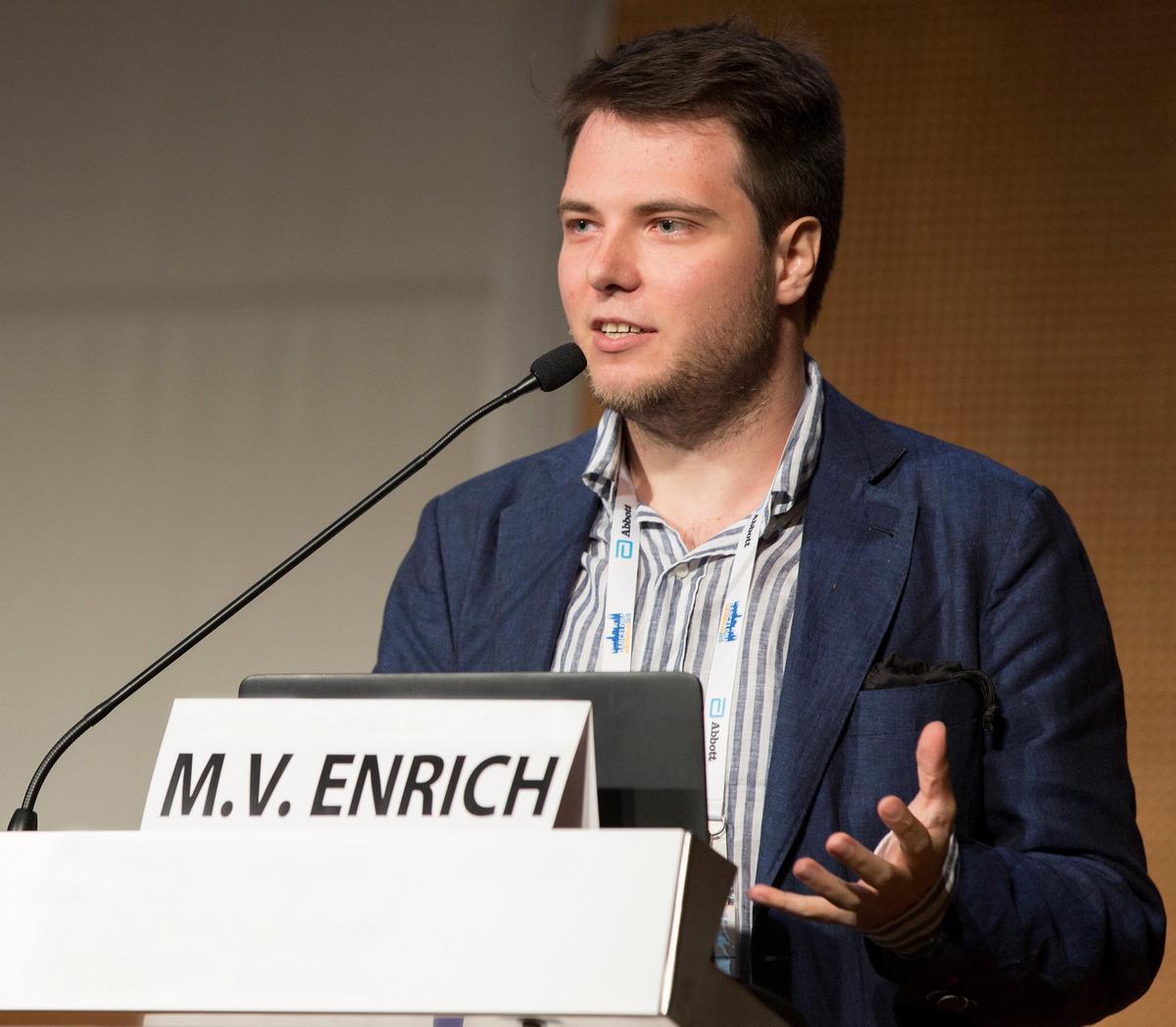
Marc Vives Enrich has already gained experience as a speaker at professional conferences—here at Euromedlab 2019 in Barcelona. Copyright: MOMO/Judit Contreras
When Marc Vives Enrich received the invitation to the 75th Lindau Nobel Laureate Meeting at the end of June, he could hardly believe his luck: After all, only 600 postdocs worldwide are given the opportunity once a year to discuss current topics with 72 Nobel laureates. Researchers from Hannover Medical School (MHH) have previously participated in this annual conference, but no PhD student had ever attended before.
Vives Enrich is pursuing a Ph.D. in “Regenerative Science” at the MHH and conducts research in Prof. Dr. Hermann Haller’s research group “Endothelial Cell Function and Vascularization in the Kidney; Molecular Mechanisms of Peritoneal Dialysis” at the Clinical Department of Nephrology and Hypertension. “My first thought was that I absolutely wanted to take advantage of this opportunity to discuss my project with these outstanding researchers,” says Vives Enrich. The 31-year-old DAAD (German Academic Exchange Service) scholarship holder therefore immediately submitted an application to give a presentation and will now have the opportunity to present his research to the Nobel laureates during the conference. The 75th Lindau Nobel Laureate Meeting will take place from June 28 to July 3, 2026, on the island of Lindau on Lake Constance.
Macrophages as Developmental Aids
Vives Enrich is investigating how stem cells and immune cells work together to promote the development of artificial kidneys. “Inspired by findings on the interactions between macrophages and the vascular system in developing mouse kidneys, we aim to replicate similar signaling pathway dynamics in vitro.” In his research, the PhD student is investigating how the co-cultivation of human stem cells (iPS cells) with specific immune cells—known as macrophages—derived from donor blood can lead to the iPS cells developing into well-vascularized, kidney-like cell clusters. In particular, he is investigating how macrophages influence blood vessel formation in these artificially cultured kidney tissues.
Together with other members of his lab, Marc Vives Enrich discovered that the addition of macrophages enhances blood vessel formation, reduces iPS cell death, regulates mesodermal patterning, and leads to a better-developed, more organized, and better-perfused kidney organoid. These findings suggest that macrophages play a crucial role in enabling kidney organoids to develop more naturally (in a manner similar to in vivo conditions) and thus in a way similar to how they develop in the human body. “I hope to exchange ideas at the Nobel Laureate Conference on how various interdisciplinary approaches can bridge the gap between developmental biology, immunology, and regenerative medicine.”
Text: Bettina Dunker