At the KinderUniHannover, 300 girls and boys at the MHH discover why our largest organ is a real marvel.
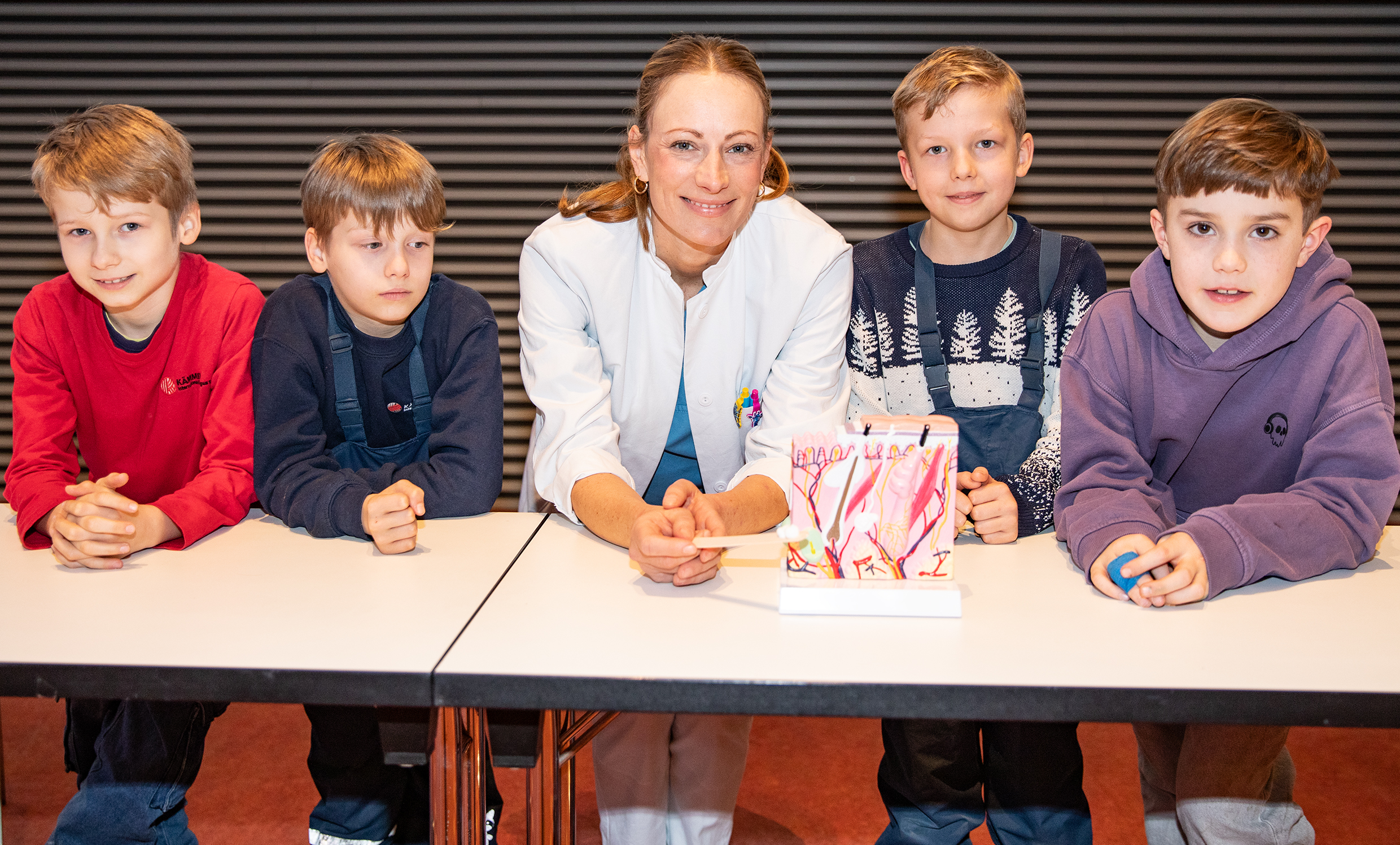
Surrounded by the inquisitive young students Alex, Robert, Jason and Michel (from left): Dr. Eva Moennig explains what makes our skin so special. Copyright: Karin Kaiser/MHH
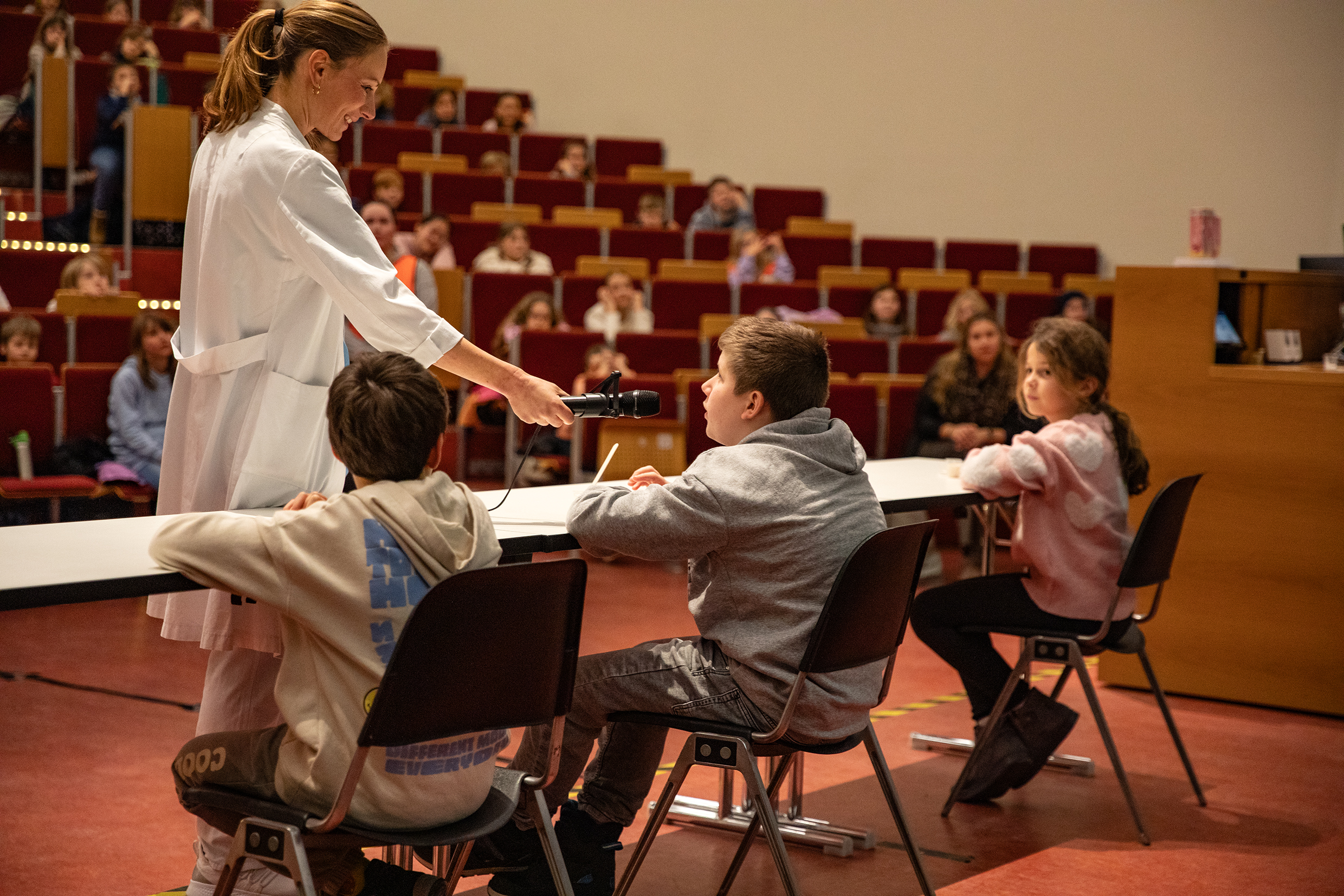
The young students took home a lot of knowledge about the skin. Copyright: Karin Kaiser/MHH
What makes our skin so special, how it protects us and why it is essential for our health - this is what around 300 curious girls and boys learned at a lecture held by the KinderUniHannover (KUH) at Hannover Medical School (MHH). Under the title "It's your skin: What our largest organ can do!", Dr. Eva Moennig, a specialist in paediatrics and adolescent medicine and researcher at the MHH Clinical Department of Dermatology, Allergy and Venereology, took the young audience on an exciting journey under the skin. In the packed lecture hall F, she vividly explained how the skin is structured, what tasks it performs and what everyone can do to keep it healthy.
A room door made of skin and ten kilos of school books
At the very beginning, the children were amazed when Dr. Eva Moennig explained to them how big the skin is: "The skin of an adult would have an area the size of a room door and weigh as much as a whole stack of school books: 10 kilograms!" Using a skin model, she illustrated to the children how the skin (cutis) is structured: the epidermis forms the protective outer barrier, underneath is the dermis with blood vessels and sensory receptors, followed by the subcutis, which stores heat and cushions with its layer of fat. The eight to twelve-year-olds learned what happens when the skin sweats, how it regulates heat and how it makes us feel.
The young students took home even more knowledge, such as the fact that melanin is responsible for our skin color and that the skin of a polar bear is not white under its fur, but black. At the end of the lecture, Dr. Moennig gave the children a few tips on Nursing their skin and let some of them try out how different creams feel for different skin types. Afterwards, the skin expert answered many interested questions from the girls and boys. Her conclusion: "The children were incredibly interested and curious. I really enjoyed introducing them to our largest and perhaps most beautiful organ."
Outlook for the next KUH lecture
The cross-university KinderUniHannover (KUH) lecture series continues on Tuesday, February 10, 2026, at 5:15 p.m., at the University of Veterinary Medicine Hannover Foundation, with the question: "We get puppies - what actually happens before that and where do vets help?"
Text: Bettina Dunker