The award is for a project to digitize stroke care. An integrated smartphone app and simulation training ensure faster treatment and more effective teamwork.
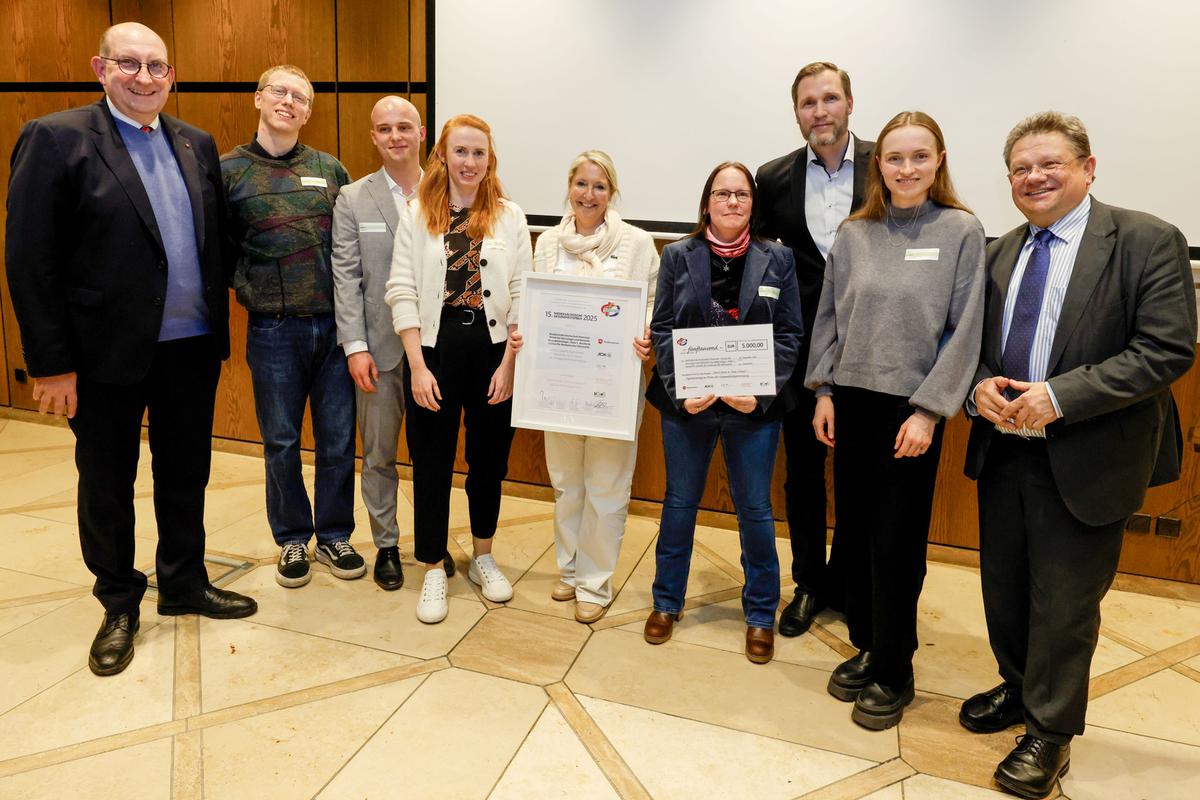
The winning team from MHH: The prize was presented by Dr. Andreas Philippi, Lower Saxony's Minister for Social Affairs, Labour, Health and Equality (right) and Matthias Wunderling-Weilbier, State Secretary of Lower Saxony's Ministry of Economic Affairs, Transport and Building (left). Copyright: Florian Petrow
A special honour for an interdisciplinary team from Hannover Medical School (MHH): the project "Time is Brain & Team is Brain - Digitalization in the Process of Stroke Acute Care" was awarded the Lower Saxony Health Prize 2025 on 4 December. The team of medical and IT experts came out on top in the "Digital Health - Using the opportunities of AI and digital technologies" category. The prize was awarded jointly by the Lower Saxony Ministry of Social Affairs, Labor, Health and Equality, the Lower Saxony Ministry of Economic Affairs, Transport and Building, the Association of Statutory Health Insurance Physicians of Lower Saxony, the AOK - the health insurance fund for Lower Saxony and the Lower Saxony Chamber of Pharmacists.
A stroke is always an emergency
In Germany, around 270,000 people suffer a stroke every year. And every stroke is an emergency. "'Time is Brain' and now also 'Team is Brain' are the most important principles in stroke treatment," says associate professor (PD) Dr. Hans Worthmann. The neurologist is leading the award-winning digitization project together with Mareike Schulze from the Peter L. Reichertz Institute of Medical Informatics (PLRI) at TU Braunschweig and the MHH. In addition to specialists from the Clinical Department of Neurology and the PLRI, the team also includes specialists from the Emergency Department and MHH Information Technology (MIT).
Every minute counts
"Time is Brain" means that every minute counts in the event of a stroke. The person affected needs acute treatment as quickly as possible to minimize the risk of permanent damage. "Team is Brain" means that all those involved in the treatment from different areas such as the emergency services, emergency room, neurology and neuroradiology work together smoothly hand in hand to help patients quickly. With the "Time is Brain & Team is Brain - Digitalization in the Process of Stroke Acute Care" project, the team has succeeded in giving these two principles a significant boost. Over the past three years, treatment times have become faster and communication and documentation processes within the team have become simpler.
Informing everyone with one call
"The core of our measure is the connection of a commercial smartphone app to our hospital information system," explains PD Dr. Worthmann. "This app makes single call activation possible. Instead of informing each professional group individually by telephone, as was previously the case, we can now notify all the teams involved at the same time and communicate important information about the patient's symptoms and arrival time at the Clinical Department. This means that everyone involved in the process can start preparing the individual work steps." The technical and data protection requirements for integrating the smartphone app were developed by experts from the PLRI's Medical Informatics department together with medical professionals. Simulation training sessions are held regularly to prepare the interdisciplinary treatment team for the optimized digital working environment. So far, more than 200 people from Clinical Departments and emergency services have taken part in the popular "Stroke Team Training".
Improved by seven important minutes
"More than 1,000 stroke patients are treated at the MHH every year - now in the context of optimized digital stroke care," reports Prof. Dr. Aiden Haghikia, Director of the Clinical Department of Neurology. Single call activation is now routine. The positive effect of the digital infrastructure is demonstrated by a one-year observational study: the "door-to-needle time", i.e. the time between admission and the start of the so-called "lysis therapy" to dissolve the blood clot in the brain, has been reduced from an average of 27 minutes to 19.5 minutes. That is an important seven and a half minutes in which brain cells are saved from dying. "This is considerable progress and shows the great potential of digital applications in optimizing healthcare processes," says PD Dr. Worthmann.
Close cooperation
The complex undertaking was only possible thanks to close cooperation, emphasize project managers PD Dr. Worthmann and Mareike Schulze. "Dr. Johanna Ernst, Dr. Anna-Lena Boeck and Tom Nolden from Neurology and Clara Fricke from MIT deserve special mention here," says Mareike Schulze. The team also received support for the project from two medical doctoral students and two master's students in computer science from the structured research training group "DigiStrucMed". "That helped us a lot. Early collaboration between IT and medicine is extremely important in order to efficiently shape the digitalization of the healthcare system," says PD Dr. Worthmann with a view to the future.
The Lower Saxony Health Prize was awarded for the 15th time this year. The award recognizes creative and practical projects and approaches that contribute to the further development and optimization of health promotion and care and pursue the goal of creating innovative care solutions. At the same time, they are intended to inspire imitation and serve as role models.
Text: Tina Götting