MHH researchers find novel regulatory RNA that controls inflammation and scarring of the heart muscle during repair processes.
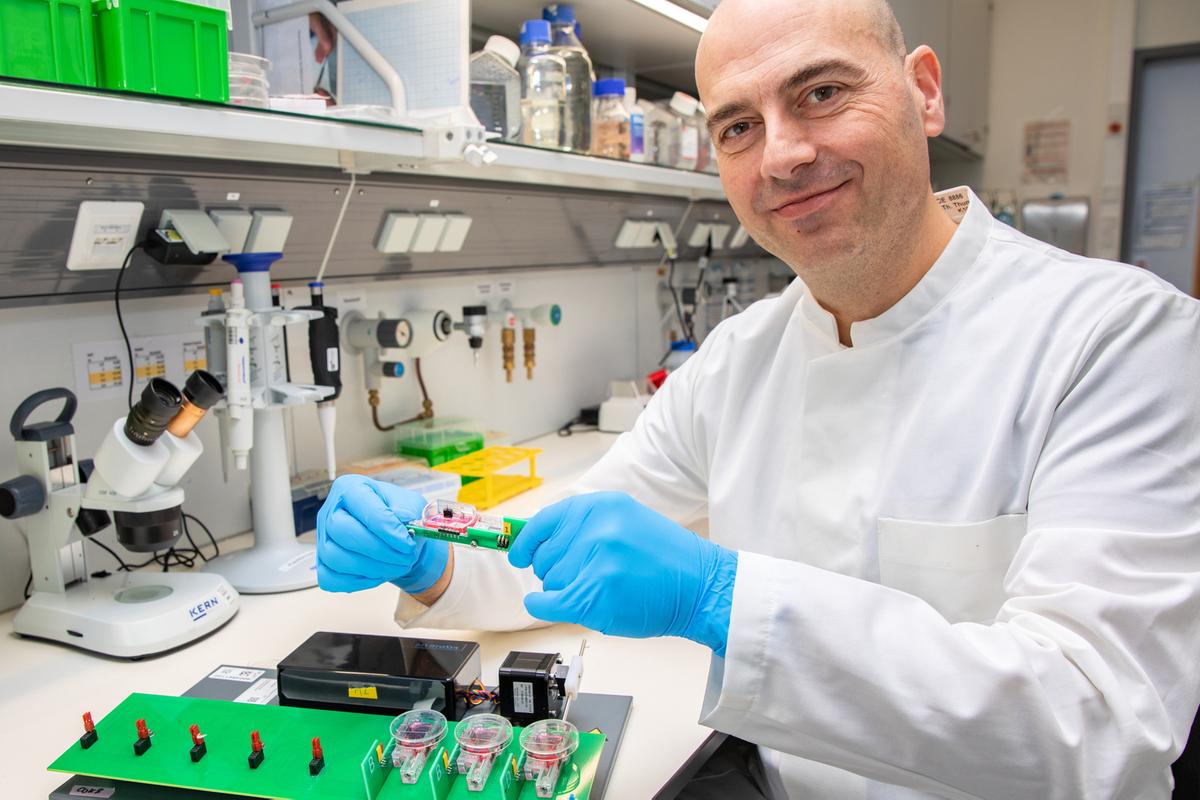
Prof. Dr. Dr. Thomas Thum has investigated a new RNA therapy for heart attacks on living heart slices. Copyright: Karin Kaiser / MHH
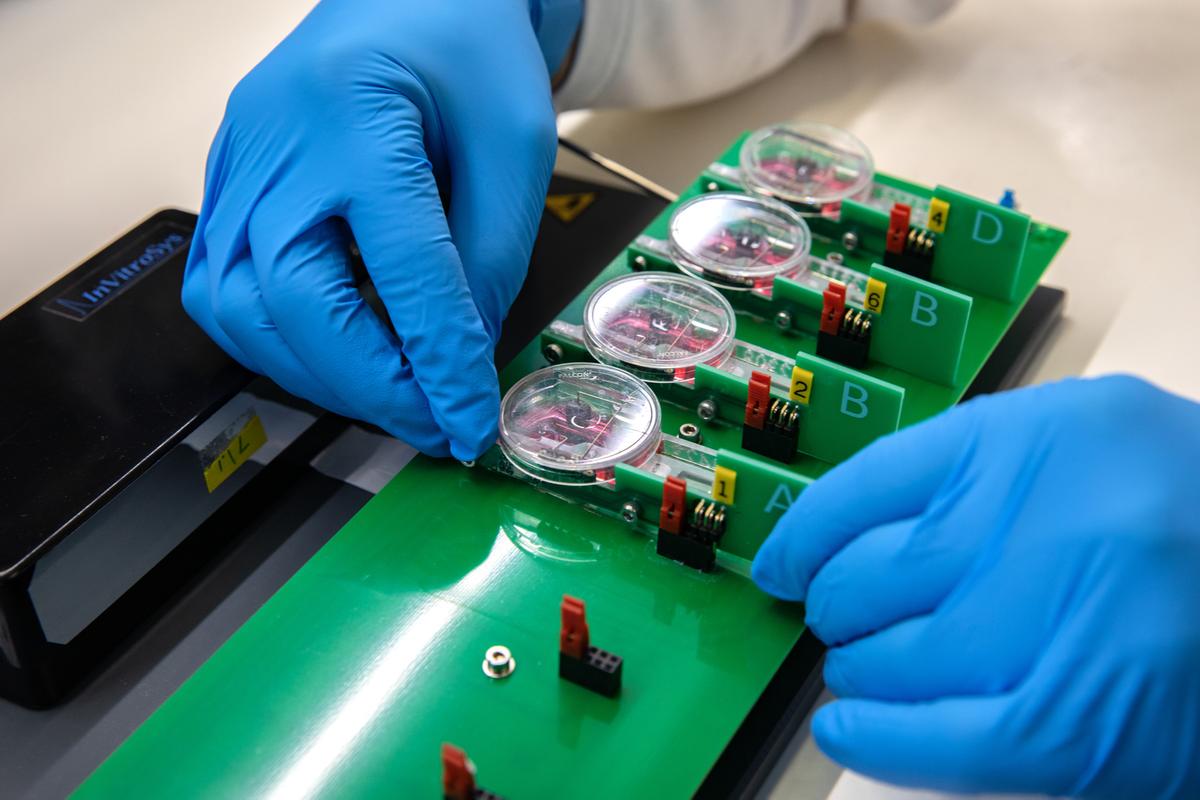
Allowing testing on human tissue: living heart slices for testing the new RNA therapy. Copyright: Karin Kaiser / MHH
More than 300,000 people suffer a heart attack in Germany every year. The heart muscle is then no longer supplied with sufficient blood and oxygen, and part of the tissue dies and scars. Unlike the liver, the heart of an adult can hardly regenerate itself. However, it is able to initiate limited repair processes. Macrophages play an important role in this. These giant scavenger cells of the innate immune system remove dead tissue and initiate the subsequent - albeit small - self-healing process. However, the immune cells are ambivalent and can also trigger negative processes that lead to chronic heart failure (cardiac insufficiency).
The decisive factor for the positive or negative influence is the so-called polarization of the macrophages. In this reversible process, the immune cells either react as M1 macrophages to promote inflammation or they resolve inflammation as M2 macrophages and support tissue repair. A team led by Prof. Dr. Dr. Thomas Thum, Head of the Institute of Molecular and Translational Therapy Strategies at Hannover Medical School (MHH), has now discovered an important molecular switch in macrophage polarization. This could open up a completely new therapeutic approach for the treatment of myocardial infarction and heart failure. The results have been published in the renowned "European Heart Journal".
circHIPK2 regulates macrophage polarization
In their study, the researchers discovered circHIPK2, a new type of circular RNA (circRNA), which was found to be increased in inflammatory M1 macrophages after a heart attack. Circular RNAs are non-coding RNAs (ncRNA) and, unlike messenger RNA (mRNA), do not function as a blueprint for protein production and therefore do not translate genetic information. Instead, they regulate many processes within the cells. Within the family of ncRNAs, circRNAs are particularly stable and species-conserved, i.e. largely unchanged over the course of evolution. This makes them ideal target structures for drugs.
"We have identified circHIPK2 as an important regulator of macrophage polarization after a heart attack," explains Professor Thum. "As a molecular switch, circHIPK2 promotes the formation of so-called stress granules in the macrophages." This triggers an inflammatory cascade. Once activated, the immune cells release pro-inflammatory messenger substances and thus contribute directly to fibrosis. As a result, the heart muscle tissue in the infarct region stores more connective tissue, becomes scarred and stiffens. Fibrosis means that the heart muscle can no longer work properly, which can lead to heart failure.
Targeted elimination improves cardiac performance
The researchers have investigated the newly discovered circHIPK2 in various systems - including directly in human heart tissue. In model systems, they were able to show how the inhibition of circHIPK2 in macrophages affects existing heart failure. Cardiac function was assessed using cardiac ultrasound and positron emission tomography (PET) imaging, among other methods. PET examinations are used to visualize molecular processes in the body. "The targeted elimination of circHIPK2 in macrophages reduced inflammatory reactions, slowed down scarring of the heart muscle and significantly improved cardiac performance," says Professor Thum.
Test model "living heart slices"
This protective effect was also evident in human tissue. The researchers used induced pluripotent stem cells (IPSC) for this purpose. These are genetically reprogrammed body cells that have similar properties to embryonic stem cells and can therefore develop into all types of tissue - in this case macrophages. The special feature: The inflammation-promoting molecular switch circHIPK2 was deactivated in them. "We tested the circHIPK2-modulated human macrophages in heart tissue from patients with heart failure," says the cardiologist. The researchers used the "living heart slices" method. The material for this comes from the MHH ClinicalDepartment of Cardiothoracic, Transplantation and Vascular Surgery and is, so to speak, tissue waste from hearts that are no longer functioning and have been removed as part of a transplant. These heart muscle slices continue to live and beat in nutrient solution for many days to weeks.
New therapeutic approach
"This unique platform enabled us to translate the molecular findings into a clinically significant context - and to show that silencing circHIPK2 promotes cardiac healing and reduces inflammatory damage," emphasizes Professor Thum. The targeted treatment of immune cells - in particular macrophages - with RNA-based therapies could open up a completely new treatment approach for the treatment of heart attacks and heart failure.
The work was carried out in cooperation between the Institute of Molecular and Translational Therapy Strategies and the MHH Clinical Departments of Cardiology and Angiology, Pediatric Pneumology, Allergology and Neonatology and Nuclear Medicine, the Department of Molecular and Translational Cardiology and the Center for Translational Regenerative Medicine at MHH.
The original paper "Macrophage-specific circular RNA circHIPK2, inflammation, and fibrosis after myocardial infarction" can be found here.
Text: Kirsten Pötzke