At the MHH, a Fulbright scholarship holder is combining engineering technology and immunology to improve the treatment of wounds.
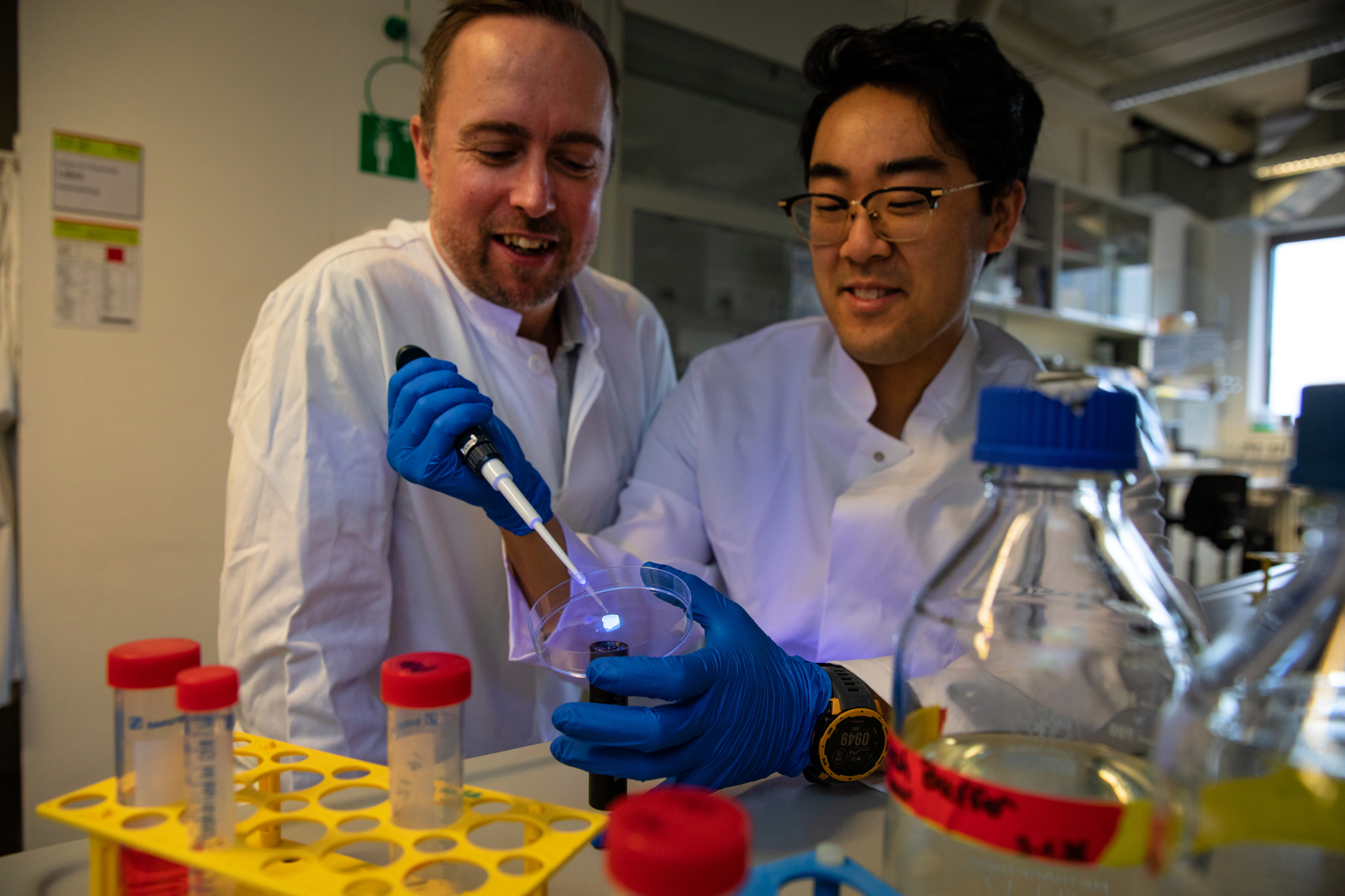
Samuel Sung (right) demonstrates in Prof. Dr. Nico Lachmann's laboratory (left) how he adds scavenger cells to a dish of hydrogel to help heal wounds. Copyright: Karin Kaiser/MHH
Chronic wounds are often very stressful for those affected, as they heal very poorly, cause pain and restrict movement. At Hannover Medical School (MHH), Fulbright scholarship holder Samuel Sung from the USA is now spending a year researching new therapeutic approaches together with Prof. Dr. Nico Lachmann's team in order to improve the healing of chronic wounds in a targeted manner. To this end, he combines engineering technology with immunology and relies on the use of specialized immune cells.
Macrophages (scavenger cells) play a central role in wound healing. These immune cells coordinate inflammation, remove deposits and create new tissue. If these processes do not function properly, wound healing can no longer take place correctly and can lead to chronic wounds. Professor Lachmann's team at the Clinical Department of Paediatric Pneumology, Allergology and Neonatology at the MHH can specialize macrophages and produce them from human so-called induced pluripotent stem cells (iPS cells), which could serve as a replacement in the future.
The goal is the next generation of wound healing therapies
However, it is still unclear how these cells can be specifically introduced into the wound. Which compresses and gels are suitable for this? To answer these questions, Samuel Sung uses artificially produced hydrogels that serve as a carrier material and are loaded with specialized macrophages. He is investigating how the gels influence the behavior of the macrophages and thus the immune response and whether they can promote skin regeneration efficiently and in a controlled manner. "Together, we want to develop the next generation of wound healing therapies," says Professor Lachmann.
Samuel Sung has also worked with macrophages in his previous work in Professor Kara Spiller's laboratory at Drexel University in Philadelphia, but now he can link his studies with human immune cells. "His arrival strengthens our growing partnership with Professor Spiller's lab, which is internationally recognized for its expertise in biomaterials and immune engineering," emphasizes Professor Lachmann. Immune engineering combines engineering techniques with immunological research to develop innovative therapeutic approaches - not only for chronic wounds, but also for organ regeneration and infection research.
The Fulbright Program
The Fulbright Program supports outstanding young researchers in establishing international collaborations. It promotes academic exchange to and from the USA. In Germany, the program is supported by the German-American Fulbright Commission (Fulbright Germany). Samuel Sung is the fifth person to come to the MHH from the USA as part of the program. Six scientists have already gone from the MHH to the USA.
Highest proportion of foreign doctoral students
Of a total of 13,817 doctoral students at 13 universities in Lower Saxony in 2024, 25 percent had foreign citizenship, according to the State Statistical Office of Lower Saxony. The MHH had the highest proportion of foreign doctoral students at 37.6%. Most of them are doing their doctorates under the umbrella of the international graduate school Hannover Biomedical Research School (HBRS) at MHH as part of structured programs.
Text: Bettina Bandel