MHH researchers discover a previously unknown signaling pathway for the formation of new blood vessels to aid in the recovery of the infarct region.
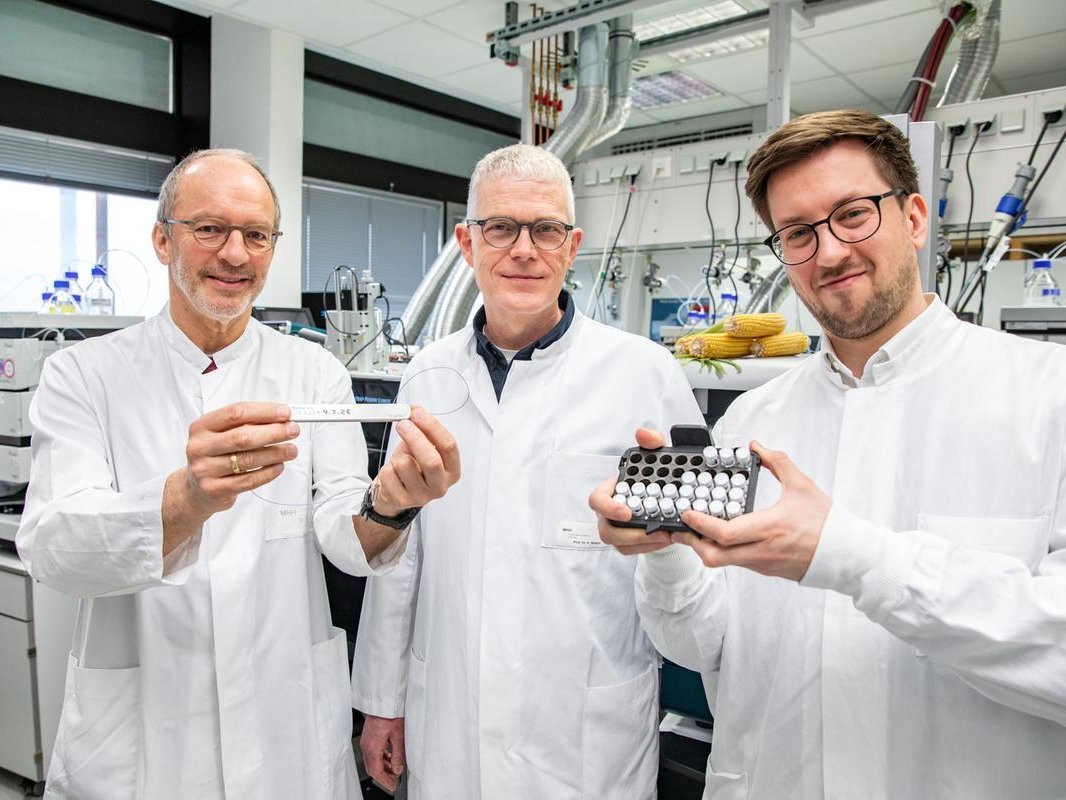
Have clarified the role of the microprotein BRICK1 in heart attacks (from left): Prof. Dr. Andreas Pich, Prof. Dr. Kai Wollert, and Dr. Felix Polten. Copyright: Karin Kaiser/MHH
Every year, more than 200,000 people in Germany suffer a heart attack. The cause is blocked coronary arteries. As a result, part of the heart muscle is no longer adequately supplied with blood and oxygen; the tissue dies after a few hours and scars over. Severe heart failure (cardiac insufficiency) is a possible consequence. Unlike the liver, the heart of an adult human can hardly regenerate. However, it is capable of initiating repair processes. Monocytes—white blood cells from the bone marrow and spleen—play a role in this. In the heart, these immune cells mature into macrophages (scavenger cells), remove the dead heart muscle cells, and promote healing of the infarct. Until now, the signaling pathways responsible for this process were not precisely known. Now, a research team led by Prof. Dr. Kai Wollert, Head of Molecular and Translational Cardiology at the Clinical Department of Cardiology and Angiology at Hannover Medical School (MHH), has discovered that a microprotein called BRICK1 plays a key role in this process. This small protein not only stimulates the endothelial cells inside the blood vessels to form new vessels and repair the infarct tissue, but it also protects the still-functional heart muscle cells in the infarct region. The findings have been published in the prestigious journal “Science Translational Medicine.”
First discovered in corn leaves
BRICK1 consists of only 75 individual building blocks, known as amino acids, and is widespread throughout the plant and animal kingdoms. “The protein was originally discovered in corn,” says Professor Wollert. “If the associated gene is mutated, the cells of the leaf epidermis take on a brick-like shape, whereas they normally have lobed edges—hence the name ‘brick’.” The gene has hardly changed over the course of evolution. The BRICK1 microproteins from mice and humans differ by only one amino acid. Until now, it was only known that BRICK1, as a component of the cytoskeleton, controls processes such as cell movement, cell division, and cell shaping. After a heart attack, the researchers were able to detect it in the blood—that is, outside of cells—in both mice and patients. But how did the microprotein get there?
Release Following a Heart Attack
The research team was able to show that BRICK1 is released by macrophages. This occurs when these cells die after their 24-hour cleanup work in the heart attack region and their cell membranes become permeable. The spent immune cells are then replaced by new macrophages. “We investigated in a mouse model of heart attack what effects occur when the BRICK1 gene is absent in macrophages or when we specifically block the microprotein outside the cells using an antibody,” explains Dr. Felix Polten, a research associate in the cardiology research group and first author of the study. The result: Without BRICK1, microvascular formation in the infarct area was disrupted, leading to severe heart failure. Conversely, treatment with the microprotein improved heart function in mice after a heart attack by protecting heart muscle cells and promoting increased vascular formation.
Both the measurement of BRICK1 concentrations in the blood and the elucidation of the reparative signaling pathways in endothelial cells were conducted at the MHH Core Facility for Proteomics. “Using two specialized mass spectrometers, we were able to elucidate how BRICK1 stimulates cell division,” says Prof. Dr. Andreas Pich, director of this central research facility.
Patent Application and Clinical Trials
“The release mechanism from dying inflammatory cells that we have identified is novel and unexpected,” emphasizes Professor Wollert. Until now, it was only known that heart muscle cells damaged after a heart attack release various proteins and small molecules, some of which trigger the inflammatory response that clears away the dead heart muscle tissue and replaces it with connective tissue. In contrast, the release of BRICK1 occurs only during the repair process, i.e., significantly later. Because BRICK1 has therapeutic potential, the researchers have filed a patent application for the use of the microprotein. They are now seeking an industry partner for clinical trials. These trials aim to demonstrate whether treatment with the microprotein could help patients minimize the damage caused by a heart attack following vascular occlusion and improve wound healing in the days following the attack.
Text: Kirsten Pötzke
SERVICE:
The original paper “Extracellular BRICK1 drives heart repair after myocardial infarction in mice” can be found here.