MHH doctoral student receives research grant to develop more sustainable methods for cultivating stem cells.
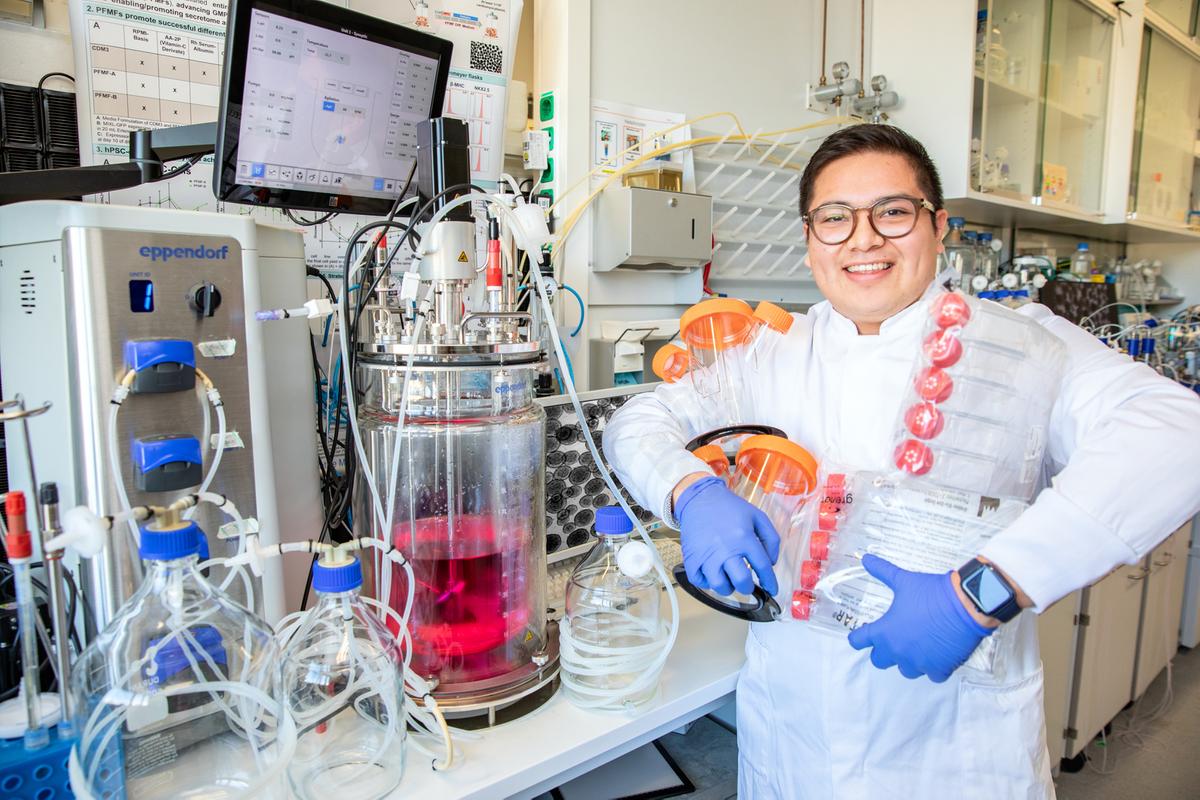
Declaring war on plastic waste in the lab: doctoral student Carlos Hernandez Bautista. Copyright: Karin Kaiser/MHH
Research is essential for progress in medicine - but unfortunately it also generates a lot of waste. Every year, around 5.5 million tons of plastic waste are generated in laboratories worldwide. That is 2 percent of the global amount of plastic waste - even though researchers make up less than 0.2 percent of the world's population. Carlos Hernandez Bautista, PhD student in the "Regenerative Sciences" PhD program at Hannover Medical School (MHH), wants to change this. As a member of the research group led by associate professor (PD Dr.) Robert Zweigerdt at the Leibniz Research Laboratories for Biotechnology and Artificial Organs (LEBAO) of the Clinical Department of Cardiothoracic, Transplantation and Vascular Surgery, he wants to develop new, efficient bioprocesses for the mass production of human pluripotent stem cells (hPSCs) in reusable glass stirred-tank bioreactors. The hPSCs are somatic cells that have been reprogrammed back to their original state and can now develop into almost any type of cell. In his project "Development of sustainable biomedicine for heart regeneration", the hPSCs serve as starting material for the production of cell therapy products such as heart muscle cells for the treatment of cardiac insufficiency. The Joachim Herz Foundation has selected the postdoc and his project "Development of sustainable biomedicine for heart regeneration" for the "Add-on Fellowship for Interdisciplinary Life Science" and is supporting him with a grant of 15,000 euros.
Bioreactors made of glass
Cell culture laboratories, especially those that use conventional 2D methods, are among the biggest producers of research plastic waste. This technology, which has been used in the life sciences for decades, refers to the two-dimensional growth of cells, for example in culture dishes or on the surface of plastic bottles. Carlos Hernandez Bautista is striving for low-plastic 3D workflows that meet the high demands of cutting-edge research without harming the environment. "I want to use reusable glass bioreactors and introduce the hPSCs produced and cold-preserved in our laboratory directly into the liquid culture medium. This will completely replace large quantities of plastic cell culture bottles that are required for 2D methods," explains the PhD student. One of the most important challenges here is to prevent the cells from being damaged or dying after thawing when they are transferred directly into 3D workflows. The biologist wants to solve this problem by adding various survival-promoting additives to the nutrient solution. The method is to be used both for the mass cultivation of stem cells and for their further development into different cell types. In his project, the hPSCs are transformed into heart muscle cells. These biotechnologically produced cardiomyocytes are needed in biomedicine to develop new cell therapies for the treatment of cardiac insufficiency.
Less consumption of culture media
While hPSCs have immense potential for regenerative medicine, the established 2D culture systems for the mass production of these cells are plastic-intensive, uneconomical and poorly scalable - meaning they cannot be effectively transferred from small laboratory scale to industrial production volumes without compromising quality or yield. "This unsustainable approach is at odds with the urgent need for more environmentally friendly laboratory methods," emphasizes PD Dr. Zweigerdt. This includes not only the use of plastic, but also the need for culture media. "To tackle this problem, we have developed a pioneering strategy for 3D suspension culture, which not only enables us to achieve a tenfold higher yield of hPSCs, but also to reduce the need for culture medium by 75 percent," says the head of the working group.
Healthcare system also benefits
The project is highly interdisciplinary and thus integrates various fields such as stem cell biology, heart regeneration, biotechnology, regenerative medicine, bioinformatics and environmental sciences in order to advance the clinical application of hPSCs and the resulting cell products. "The research grant gives me the opportunity to work with experts worldwide to develop a production process for regenerative cell therapies that meets the high scientific standards," explains Hernandez Bautista. The researchers at LEBAO would also like to use other environmentally friendly laboratory methods. The long-term goal is to obtain certification from the non-profit US organization "My Green Lab", which supports sustainable practices in research laboratories. However, the environment is not the only beneficiary of new production methods. By developing efficient, purely 3D-based workflows, new medical approaches are to be made affordable for patients and the healthcare system.
Add-on Fellowship
Every year, the Joachim Herz Foundation supports up to 80 researchers from the fields of engineering, economics and life sciences with financial and non-material resources. PhD student Carlos Hernandez Bautista was selected from more than 500 applications for the prestigious "Add-on Fellowship for Interdisciplinary Life Science". The fellowship will enable him to deepen his knowledge in the field of sustainability and apply more environmentally friendly processes in the laboratory. The funding is aimed at excellent researchers in the early stages of their career who are working on interdisciplinary research topics with social significance in the field of "Resources of the Future". The research fellowship includes individual support and the opportunity to network with other fellows over a period of two years and three months.
Text: Kirsten Pötzke