Research report 2010
Image description:
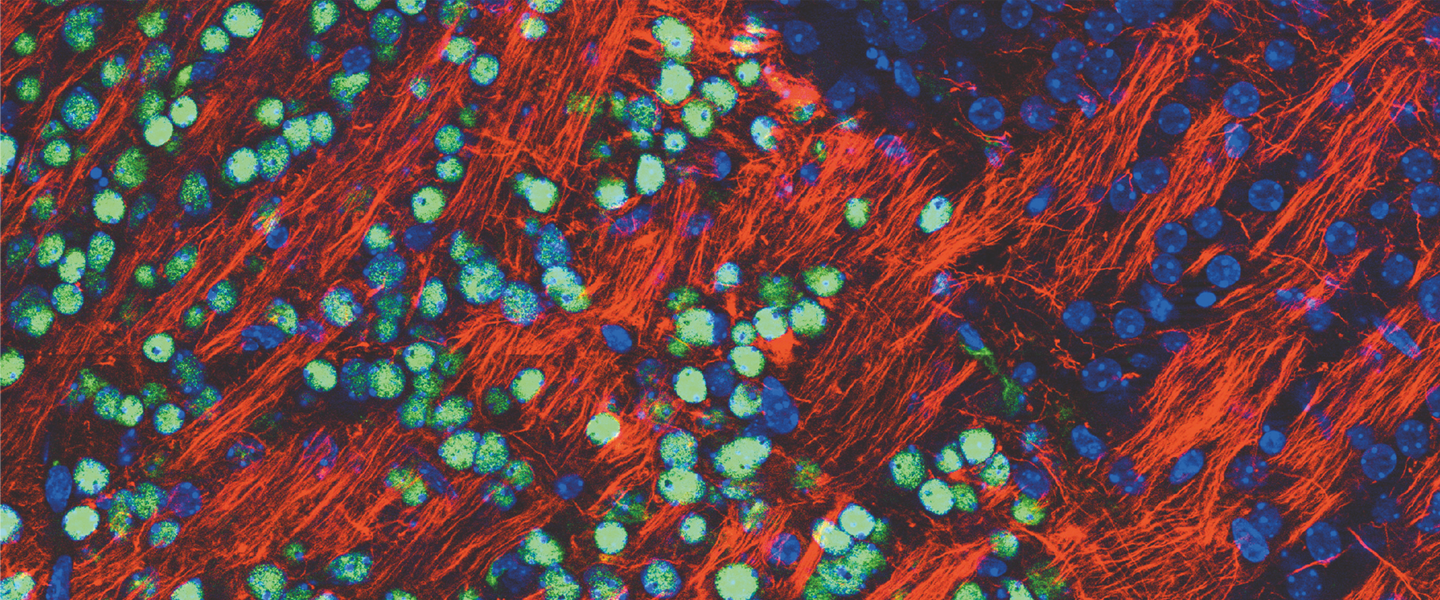
The cover image of the 2010 research report shows an immunohistochemical staining of nerve fibers (red) and cell nuclei (blue/green) from the brain of a mouse. The fibers marked in red connect the thalamus with the cerebral cortex and run in a highly ordered manner through an area marked by the cell nuclei marked in green, the reticular nucleus of the thalamus. As two recent studies from the Institute of Cellular Chemistry show, a carbohydrate compound of the cell surface, polysialic acid, is essential for the development of these nerve fibers. Similar to the mouse model, genetically determined deviations in polysialic acid synthesis and reduced connectivity of the cerebral cortex can also occur in schizophrenic patients. This leads to the assumption that a lack of polysialic acid during brain development favors the development of schizophrenic disorders. (Hildebrandt et al., Brain 2009; Schiff et al., Journal of Neuroscience, 2011).
Research report 2010
Research Report 2010
Editor:
The Dean of Research of Hannover Medical School
Prof. Dr. med. Christopher H. Baum
Editing and contact person:
Office of the Dean of Research at Hannover Medical School
Petra Linke
Phone: 0511/ 532- 6023
Fax: 0511/ 532- 6024
E-mail: linke.petra@mh-hannover.de
Design and typesetting:
Hannover Medical School Print Shop
Joachim Barke
Phone: 0511/ 532- 2963
Production
Hannover Medical School Printing Office
Telephone: 05 11/ 532- 2963
Wewould like to thank the staff of the library of the Hannover Medical School, Usage Department: Ms. Schmidt-Rohland, for their support with the bibliographical information.
Wewould like to thank the staff of the Center for Information Management (ZIMt) under the direction of Mr. Dirk May for their support in the implementation of the ICT-supported data collection and the preparation of the printing process.
Alldata(including the links contained) in the research report are based on the information provided by the respective Facilities or Institutions. The entry is made without guarantee.
Themasculine form of all gender-specific descriptions applies accordingly to the feminine form.
Cover picture:
Thecover image of the research report shows an immunohistochemical staining of nerve fibers (red) and cell nuclei (blue/green) from the brain of a mouse. The fibers marked in red connect the thalamus with the cerebral cortex and run in a highly ordered manner through an area marked by the cell nuclei marked in green, the reticular nucleus of the thalamus. As two recent studies from the Institute of Cellular Chemistry show, a carbohydrate compound of the cell surface, polysialic acid, is essential for the development of these nerve fibers. Similar to the mouse model, genetically determined deviations in polysialic acid synthesis and reduced connectivity of the cerebral cortex can also occur in schizophrenic patients. This leads to the assumption that a lack of polysialic acid during brain development favors the development of schizophrenic disorders. (Hildebrandt et al., Brain 2009; Schiff et al., Journal of Neuroscience, 2011).