Tutorials
- From students for students -
As part of the peer teaching concept, we offer a variety of tutorials. You can find a short description of each tutorial here.
Registration for the individual tutorials takes place via ILIAS
For a summary of the tutorials by academic year, click here → Download
Simulation and emergencies
Tired of learning nothing but dry theory at university? Would you like to put your skills to the test? Would you like to know what to expect in an emergency room?
Then this tutorial is just right for you! For one evening, you can experience what it's like to work in an emergency room. In teams of two, you will be given your own (acting) patient, who you will have to treat just like in a real emergency room. It is not important to us that you already have a lot of clinical experience. You are welcome to make mistakes with us. We will help you through the situations and give you tips on how you can improve. So no matter what year you're in, come along!
Suddenly someone falls over. The person is no longer breathing. What to do? In this tutorial, you will learn the basic measures of resuscitation. For ALL students, whether you are a first semester student or about to start your final year, you can learn or refresh your knowledge of resuscitation techniques here.
You know the basics of resuscitation and are fit in Basic Life Support, but don't know what to do if another emergency occurs? Then the advanced emergency course is just right for you, because here you will be taught the basics of emergencies, combined with practical skills. For everyone from 1st to 4th year, emergency course - Basic Life Support desired.
In this tutorial, we will get you up to speed on emergency management so that you can start your final year or your professional life perfectly prepared. Using simulated cases on mannequins or acting patients, we will go through structured emergency management and the most important emergencies with you.
You can expect a tutorial with lots of practice and adrenaline!
As preparation , you should have already had the Emergency Medicine module from the 4th year of study and our two tutorials on Emergency Basic and Professional, i.e. suitable from the 5th year of study.
Senior physician: "Who admitted the next patient?"
Patient: in: "Um...me?"
Senior physician: "Then get started!"
Don't panic, but practise presenting patients confidently with us!
In this course, we want to help you to not just look down at your feet in this situation. Using many exciting patient cases, we will work on and practise structured patient presentations together.
Suitable from the 3rd year of study.
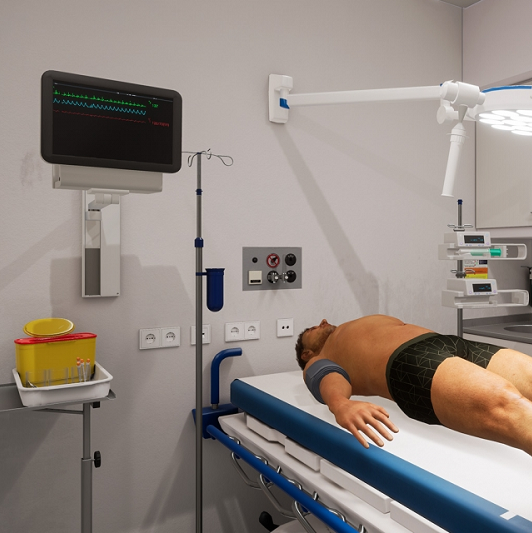
Virtual emergency room 2.0
Works as a physician in the virtual emergency room and cares for the virtual patient.
Taking a medical history will lead you to a possible diagnosis, which you can support with laboratory, ECG, ultrasound or other examinations.
Learn the structured approach to emergency patients and clinical decision-making from admission to transfer of the patient.
Don't worry, no one will get hurt, you can try out, learn and make mistakes in the safe environment of the simulation.
Immerse yourself in this completely new and extremely real world of simulation.
Try it out!
Practical skills
In this tutorial, you will have the opportunity to learn how to take blood samples , insert a brown needle and take blood samples from each other.
But don't worry: we won't leave you to do the punctures on your own and we always have a physician on call. As expected, nothing has happened so far apart from a few bruises!
However, the MHH cannot be held liable for any complications. If you want to take advantage of this offer, we therefore ask you to read the liability waiver at the beginning of the tutorial and sign it if you agree with the content. If you are under the age of 18, we would need the signature of your legal guardian on the declaration.
Useful from the 1st year of study!
Are you already familiar with the basics of taking blood samples and browning? Then you've come to the right place for "pricking without introduction"!
Here you can hone your pricking skills to your heart's content.
Our team of tutors will be on hand to give you all kinds of tips and tricks.
However, the MHH cannot be held liable for any complications. If you want to take advantage of this offer, we therefore ask you to read the liability waiver at the beginning of the tutorial and sign it if you agree with the content.
Have you already mastered the basics of taking blood samples and will soon be starting your block internship or clinical traineeship and want to expand your skills? Then you've come to the right place!
We will show you how to take blood from the CVC, from the port and blood cultures ! We will also show you how to puncture a port and how to work correctly under sterile conditions. Last but not least, we will carry out a bedside test with you!
Afterwards, you will carry out the whole thing yourself and practice with mutual venipuncture and on our models. So if you are interested in a varied and practical tutorial, please register. We look forward to seeing you!
You want to go to OR? But no idea what to expect there and how to behave?
Together with the surgical technical assistants from the OTA/ATA school, we have created a tutorial for YOU in which you will learn how to dress properly in sterile clothes, how to behave correctly in the OR , how to operate surgical instruments and much more! Questions such as: "Why should I wear safety goggles in the OR?" or "Why is a second pair of gloves important?"
This tutorial is divided into 2 days . On day 1, we will practise skills relevant to the OR together in the SkillsLab. On the 2nd day, we will visit the MHH central OR to get the real "OR feeling".
But how do you do this correctly? And how do you inject into a muscle, into subcutaneous fatty tissue or even into a vein? That's what we want to practise with you in our interprofessional injection tutorial !
We have created the course together with the anesthesia technicians and will supervise you together. You can benefit from the practical experience and know-how of the ATAs, which they bring to the course. Regardless of the semester, whether in preparation for your nursing internship, as a refresher before your clinical traineeship or simply out of curiosity - you are very welcome!
Investigation and diagnostics
Has it been a while since your examination course but your next clinical traineeship is just around the corner? Then you can use this tutorial to further improve or refresh your examination techniques .
The three topics of heart, lungs and abdomen are all discussed in one session. We focus on the correct execution of the examination techniques. For optimal learning success, you should therefore already know the theory behind them and read through the handout in preparation for the crash course.
When you think of strength levels, do you think mainly of the gym, and have you long since forgotten the names of the cranial nerves? Then change your vigilance state from soporous to awake and learn how much you can examine neurologically in patients without EMGs and cerebrospinal fluid punctures!
Haven't had a proper orthopaedic examination course and have no idea how to examine the large joints? And the clinical traineeship/block internship is just around the corner? Then you've come to the right place!
In this tutorial, we want to teach you how to examine the "most important" joints (spine, hip, knee, shoulder) and their associated muscles. It is very important to us that you understand and practise the examination in a small group and have fun!
What you need for this course: - You have passed the pre-clinic - Your "examination course underwear" (no diagnosis through your pants!) - Good mood!!!!
We look forward to seeing you!
Hold the transducer the wrong way round and the liver is under the bladder! That can't happen to you with us, just take part in the sono seahorse! Would you like to learn how to use the sono device and how to adjust and measure organs? Then you've come to the right place! Because we require knowledge of anatomy, the tutorial is aimed at students in their 2nd year or higher.
A crash course in structured abdominal sonography for students from the 5th year of study and in the PJ.
Registration is only possible via the link sent by e-mail.
How do I start to evaluate an ECG? What is a sinus rhythm? How do I attach ECG electrodes?
We answer all these questions and more in this tutorial. Here you will learn the most important basics for a structured ECG evaluation, the physiological basics of the most important pathologies and the correct use of an ECG ruler.
Recommended from the 2nd year of study.
Why does WPW syndrome show a delta wave? What is the Sokolow-Lyon index? What is a bundle branch block and can I recognize hypokalemia in the ECG?
Using case studies, we will go through important pathologies with you and deduce the ECG changes individually based on the respective pathophysiology. You will also have the opportunity to evaluate pathological ECGs together with us and practise the structured procedure.
What you need to bring: Basics of structured analysis of an ECG
Recommended for 3rd year students and above.