Improved organ preservation through machine perfusion
International studies show a success story - lack of funding in Germany
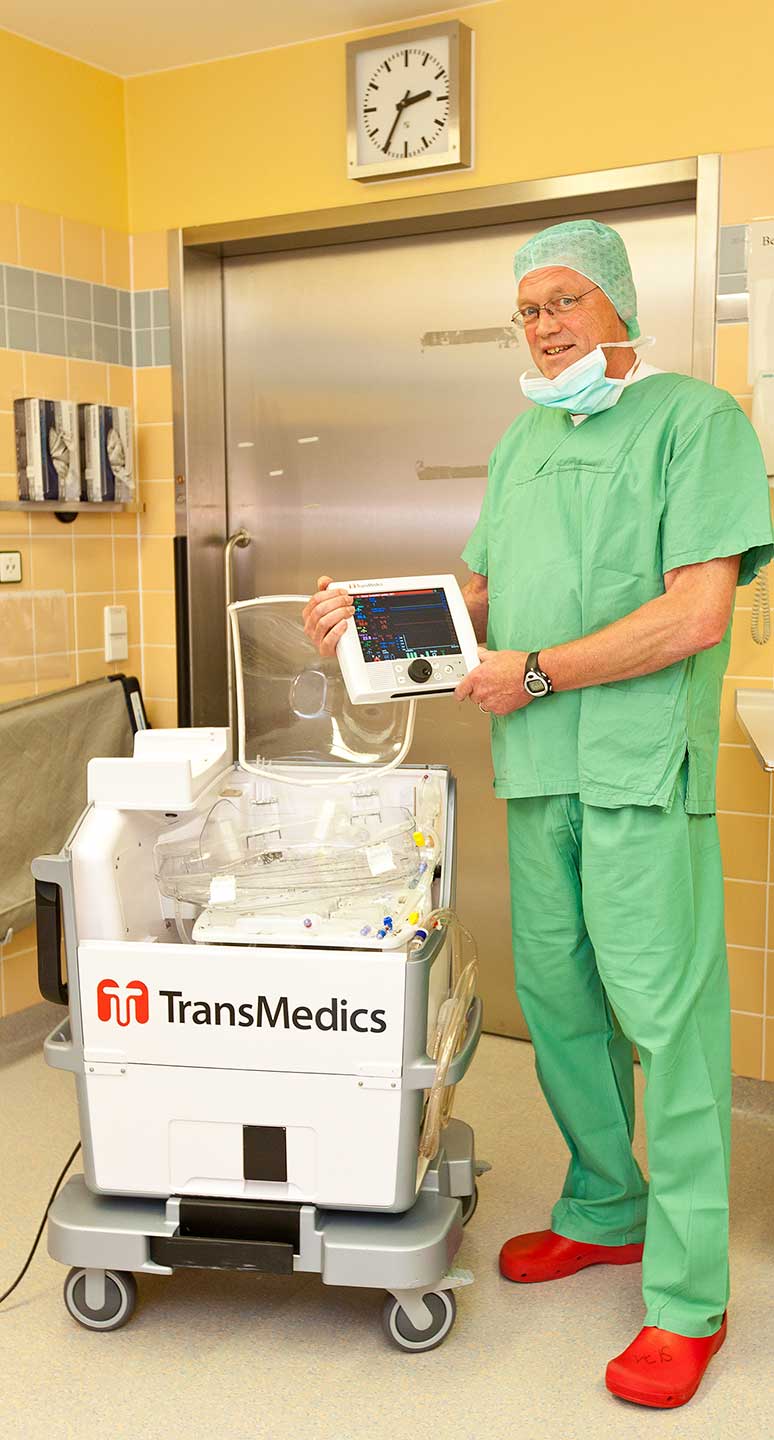
The mechanical perfusion of donor organs has opened up new perspectives for transplant medicine and its patients in recent years. Until now, organs have been disconnected from the bloodstream, cooled at four degrees Celsius in transport boxes and transported to the Transplant Centre within a few hours in order to be transplanted as quickly as possible. Continuous machine perfusion with a blood-like solution at body temperature can help to ensure that the donor organ is preserved for longer and is less damaged. In addition, donor organs that previously had to be rejected as unusable can be used.
Ex vivo perfusion not funded by health insurance companies in Germany
It was shown years ago that cold machine perfusion of kidneys has clinical advantages (1) and is now the clinical standard in many places outside Germany. Organ perfusion was one of the main topics at the 28th annual conference of the German Transplantation Society DTG.
In April 2018, an international group of experts led by the Hannover Medical School published the INSPIRE study on normothermic ex vivo perfusion at body temperature (with the transportable Organ Care System, OCS) of donor lungs compared to cold storage in a cool box, with the MHH as the lead study center (2).
Transplantation with OCS is easier to plan and safer
The lung is ventilated in the OCS and connected to an artificial blood circuit that supplies it with a blood-like solution and nutrients at body temperature. The device gives physicians up to twelve hours to transport the donor organ and to assess and improve lung function. This allows fluid deposits to dry out and mucus to be suctioned out. "The organ reaches the recipient in a much better condition than with the usual cold storage," explained Prof. Dr. Gregor Warnecke, principal investigator of the study and senior consultant at the MHH Clinical Department of Cardiothoracic, Transplantation and Vascular Surgery at a press conference at the DTG conference on October 17, 2019.
Patients who had received an organ from the OCS were less likely to suffer from early graft failure. "This can mean that patients are ventilated for a shorter time and discharged more quickly," says Professor Warnecke. "OCS also makes transplantation easier to plan - which benefits patient safety," says Prof. Dr. Axel Haverich, Director of the MHH Clinical Department of Cardiothoracic, Transplantation and Vascular Surgery.
Based on the data from the INSPIRE study, the Organ Care System Lung received Food and Drug Administration (FDA) admission in the USA. This was followed in August 2019 by the publication of the EXPAND study, in which the successful preservation of donor lungs with extended donor criteria in the Organ Care System Lung was again demonstrated with the significant involvement of MHH scientists (3).
For heart transplantation, the Organ Care System Heart is available, which is used extremely successfully in Great Britain, Australia, Belgium and Austria for the resuscitation and subsequent transplantation of hearts from donors after cardiovascular death (4). In Germany, this organ donation is excluded by law. The Organ Care System Heart is also used successfully for standard donors after brain death (5). Data on the very successful use of the Organ Care System Heart for complex pre-operated heart recipients in Germany (currently mainly in Hanover and Freiburg) were presented at the DTG Congress 2019 in Hanover (6).
Due to the extended preservation time, lungs and hearts from distant European countries can also be transported to Germany.
Fewer organ failures and greater transplant safety
The results of clinical studies are also available for liver transplantation (7). Two randomized international studies on machine perfusion of donor livers are currently underway, but for logistical reasons only with limited German participation.
Based on this large number of clinical studies, transplantation physicians assume that machine perfusion can improve the success of transplantation and provide more patients with an organ. In Germany, the system is currently used for lung and heart transplants, but is not funded by health insurance companies. Despite scientifically proven benefits, mechanical perfusion systems are not used for the transportation of donor kidneys in Germany.
Contact person:
Prof. Dr. Gregor Warnecke
Transplant surgeon at the Clinical Department of Cardiothoracic, Transplantation and Vascular Surgery at Hannover Medical School
Telephone (0511) 532-6590
Literature:
Moers C, Pirenne J, Paul A, Ploeg RJ; Machine Preservation Trial Study Group.
N Engl J Med. 2012 Feb 23;366(8):770-1. doi: 10.1056/NEJMc1111038.
Warnecke G et al
Lancet Respir Med. 2018 May;6(5):357-367. doi: 10.1016/S2213-2600(18)30136-X. Epub 2018 Apr 9. Erratum in: Lancet Respir Med. 2018 Jun;6(6):e27.
Loor G, Warnecke G et al
Lancet Respir Med. 2019 Aug 1. pii: S2213-2600(19)30200-0. doi: 10.1016/S2213-2600(19)30200-0. [Epub ahead of print]
Chew HC, Dhital K.
J Am Coll Cardiol. 2019 Apr 2;73(12):1447-1459. doi: 10.1016/j.jacc.2018.12.067.
Ardehali A et al, PROCEED II trial investigators.
Lancet. 2015 Jun 27;385(9987):2577-84. doi: 10.1016/S0140-6736(15)60261-6. Epub 2015 Apr 14.
- Plenary session DTG Congress Hannover, Friday, 18.10.2019,
10:30 Ex Vivo Organ Perfusion - Heart
Matthias Siepe
University Heart Centre Freiburg - Bad Krozingen, Clinical Department for Cardiovascular Surgery, Bad Krozingen
Nasralla D, Friend PJ etal Consortium for Organ Preservation in Europe.
Nature. 2018 May;557(7703):50-56. doi: 10.1038/s41586-018-0047-9. Epub 2018 Apr 18.
Links:
Organ perfusion in liver transplantation
Science Media Center 18.04.18