Benign prostate enlargement
Benign prostatic hyperplasia
Benign enlargement of the prostate (benign prostatic hyperplasia) is caused by the proliferation of otherwise inconspicuous cells. In addition to drug therapy, which slows down cell growth or reduces symptoms, surgical intervention may be necessary in some cases, namely if the enlargement of the prostate affects the urethra to such an extent that it leads to urinary retention or increased bladder emptying pressure. If your urologist has given a corresponding indication, we have various minimally invasive endourological procedures available to you:
- Enucleating procedures
- Conventional monopolar TUR prostate(transurethral resection)
- Bipolar TUR prostate
- Laser procedure
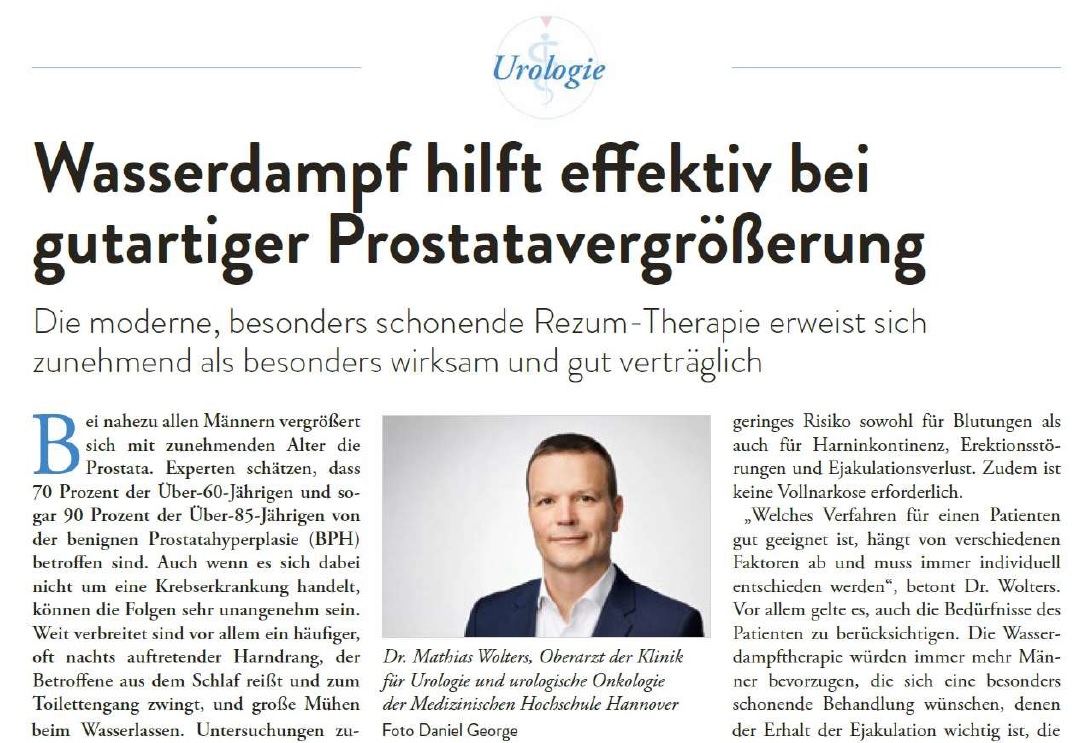
- Minimally invasive therapy for prostate enlargement
These procedures are all performed through the urethra using video technology and can be described as truly minimally invasive procedures.
We will also be happy to provide you with information on this topic during our consultation hours:
- Monday - Friday: 09:30 - 12:00
- Urodynamics: Monday - Wednesday 7:30 + 9:30 a.m.
Treating physicians: Prof. Dr. Tezval, Dr. Wolters
Further information
All information on the topic:
ThuLEP represents a combination of the advantages of traditional open adenomectomy (without thermal energy, anatomically complete) with the advantages of access through the urethra - complete removal of the internal gland with complete preservation of the external gland and attached structures. The recognizability of the anatomical boundaries through mechanical dissection and subtle hemostasis enables orientation throughout the entire operation.
In principle, any energy source can be used with this surgical technique, i.e. surgical success does not depend on the energy source (Ho:YAG, Tm:YAG, bipolar current, etc.).
Holmium laser enucleation (HoLEP), Tm:YAG vapoenucleation (ThuVEP) and bipolar enucleation (BipolEP) are also offered at the MHH.
Although transurethral loop ablation/peeling of the prostate (TUR-P) is still regarded as the gold standard of surgical treatment for small and medium-sized prostates, numerous minimally invasive techniques have emerged in recent decades due to the undesirable side effects of the standard procedure, of which laser procedures in particular have gained in importance due to their reduced side effects, shorter catheterization time and hospital stay.These also make it possible to treat patients with bleeding disorders and those taking anticoagulant/anticoagulant medication (ASA, heparins, coumarins (e.g. Marcumar)).
To date, procedures that remove the entire internal gland while preserving the external gland, so-called enucleating procedures such as open prostatectomy and transurethral holmium laser enucleation of the prostate (HoLEP) have shown superior efficacy and durability compared to TUR-P. The latter has contributed to enucleating procedures being the method of choice for medium and large prostate sizes since 1998 based on the data available.
The ThuLEP technique involves the complete removal (enucleation) of the inner gland through the urethra while preserving the outer gland with the assistance of the Thulium:YAG laser, making various reported complications for other techniques such as damage to the neurovascular bundle with associated erectile dysfunction or sphincter damage resulting in incontinence unlikely.
Our ThuLEP team consists of Prof. Dr. med. Hossein Tezval and Dr. med. Mathias Wolters.
The MHH has established itself as a supra-regional center, especially with regard to anticoagulated patients and large prostate glands.

Vaporization of the prostate as the sole therapy is particularly suitable for patients with symptoms caused by benign prostate enlargement who have a small prostate or for whom only partial removal of the internal gland (duct) is planned. Vaporization can also be an alternative for patients on anticoagulation (ASA, coumarins (e.g. Marcumar), heparin). An alternative to laser vaporization is vaporization using bipolar vaporization.
In recent years, various laser systems have been introduced to treat the prostate (Greenlight®, RevoLix™, diode laser).
There are purely vaporizing/vaporizing therapy approaches (photoselective vaporization PVP, Greenlight®, vaporization using diode lasers) and approaches in which tissue is removed by laser cutting either as chips or as prostate lobes (ThuLEP, HoLEP, ThuVEP).
In vaporizing laser procedures, for which Greenlight® PVP is the proto-procedure, no tissue is produced that can be examined histologically. In other words, histology is not possible. Proof of prostate carcinoma cannot be provided. However, a histological examination is recommended, especially for young patients under the age of 65.
Since the entire tissue must be vaporized, this therapeutic approach should be limited to small and medium-sized prostate glands (photoselective vaporization, Greenlight®, vaporization using diode lasers) in order to ensure sufficient tissue removal. Laser vaporization with Tm:YAG laser is offered at the MHH (Revolix).
In conventional and bipolar resection, prostate tissue is "shaved off". Conventional monopolar TUR is the oldest of the established minimally invasive surgical procedures; the instrument used is called a "resectoscope" and has a light source, an optical system for visualizing the surgical field, a fluid supply and a working channel. During TUR, the urologist inserts the resectoscope through the urethra to the prostate and "peels off" layers of tissue with an electric loop electrode using high-frequency current. The aim of the operation is dessobtruction, i.e. widening of the urethra to make urination easier. Any bleeding that occurs is cauterized electrically. During the procedure, irrigation fluid is continuously flushed through the instrument into the urethra and bladder to remove removed tissue and blood from the body.
Transurethral resection of the prostate (TUR-P) is the best-studied standard procedure for removing urinary obstructions caused by the enlarged prostate.
Conventional TUR prostate uses a monopolar current where the energy travels from the resection snare through the prostate tissue and surrounding body tissue to an electrode taped to the leg. This works using a saline-free irrigation solution. With this solution, however, there is a risk of TUR syndrome, which is characterized by the washing of large amounts of irrigation solution into the circulation and can lead to serious cardiovascular complications if left untreated.
As a modern alternative to monopolar prostate TUR, the Clinical Department of Urology and Urological Oncology offers bipolar resection. Here we use physiological saline solution as an irrigation solution and can therefore avoid the risky TUR syndrome. As the inflow and outflow of the high-frequency current runs via the resectoscope during bipolar resection, the risk of damage from the current flowing through the body is avoided. In addition, the current flow creates a plasma bubble at the resection snare, which enables targeted and effective incision guidance with efficient coagulation (sclerotherapy), so that blood loss is lower with this new procedure than with conventional procedures.
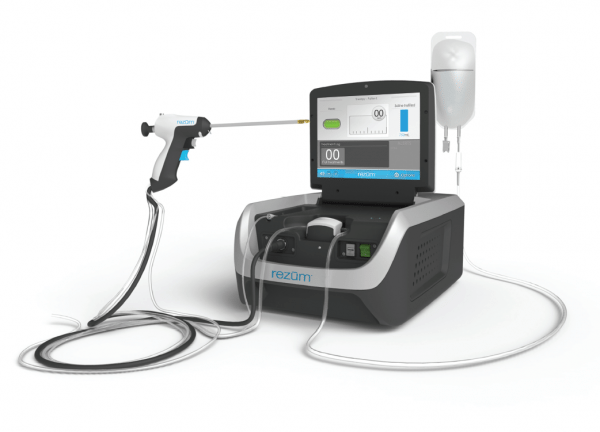
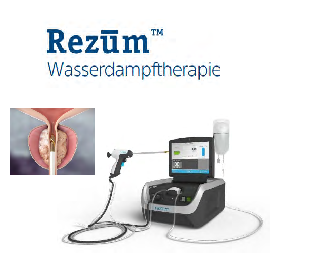
- 9-second water vapor treatment
- 0.42 ml water as steam, T=103°C, at the site of action T~70°C
- Procedural duration 2-7 minutes
- Middle lobe treatment possible
- Minimal side effects
- Good patient compliance
- Evidence RCT vs. sham
What are the indications for using the Rezūm system?
- The Rezūm system is indicated for male patients with a prostate volume of ≥ 30 cm3 and ≤ 80 cm3* .
- In addition, the RezūmSystem is indicated for the treatment of hyperplasia of the median lobe of the prostate. (*Currentstatement IFU, according to the current status of the study, an extension of the size range is currently being discussed)
What are the contraindications for the RezūmSystem?
The use of the RezūmSystem is contraindicated in patients
- with an artificial urethral sphincter implant
- with erectile tissue implants.