Treatment options for kidney stones
In our Clinical Department, we offer many ways to treat kidney stone disease effectively. Visit us in our urology outpatient clinic for a detailed consultation. Findings such as ultrasound images or computer tomography images on CD should be brought along to the initial consultation, as we can then quickly discuss the appropriate procedure with you.
General information on kidney stones
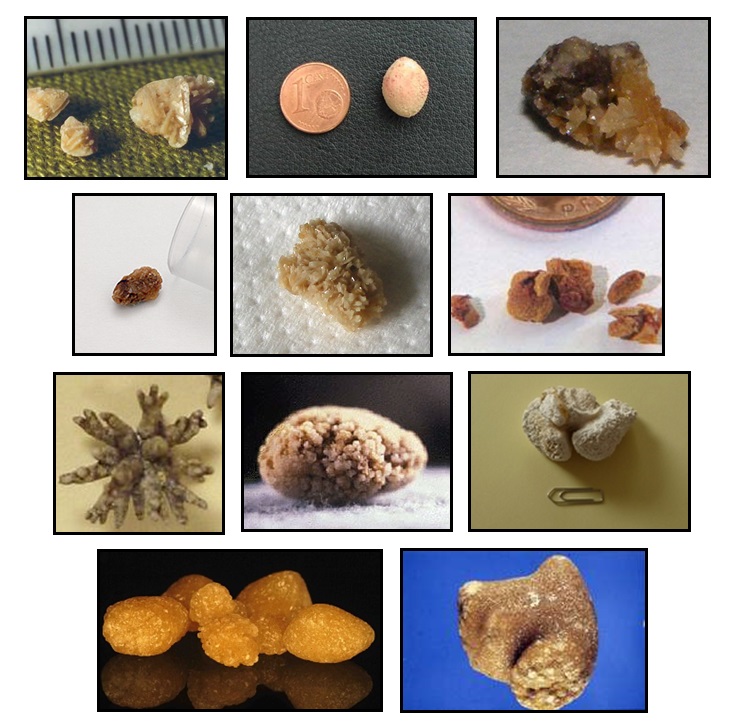
Urinary stones can occur in the entire urinary tract. Approximately five percent of the German population will experience a urinary stone at least once in their lifetime. The stone disease (urolithiasis) manifests itself in the form of pain and blood in the urine, but in some cases it remains an incidental finding during routine diagnostics or as part of a clarification of recurring urinary tract infections. In the worst case, the patient suffers a sudden onset of cramp-like renal colic with pain in the flank or lower abdomen.
There are various risk factors that predispose to stone disease. These include older age, occupation, lack of physical activity, dietary habits and low fluid intake. In the case of recurrent stone events, there is usually a family predisposition.
The most modern technologies are available as a treatment option in our Clinical Department. Based on findings from over 20 years of stone treatment, the various procedures are applied individually depending on the size and location of the stone.
Further information
Acute renal or ureteral colic occurs as soon as a kidney stone finds its way into the ureter and thus obstructs the transportation of urine from the kidney into the bladder. It manifests itself with sudden, severe pain in the flank radiating into the lower abdomen.
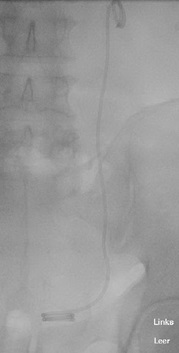
The aim of treatment for acute colic is to relieve the pain and restore urine transportation. If the cause of the colic is a ureteral stone that cannot be removed spontaneously, this is achieved by inserting a ureteral stent (or double-J catheter, or ureteral stent).
In so-called shock wave therapy, high-energy, bundled sound waves are directed from outside the body ("extracorporeal") into the inside of the body via a water cushion attached to the patient's body. The shock waves lead to vibrations and cause cracks in the stone and even break the stone on site. ESWL usually does not require anesthesia. Patients with kidney stones up to 2 cm in size are suitable. A prerequisite for successful treatment is the appropriate location of the stone in the branched renal pelvis.
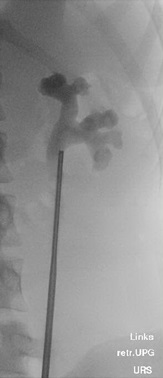
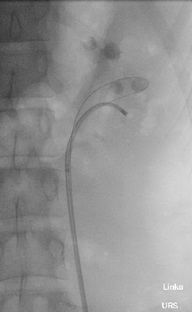
In endoscopic urinary stone removal, the urethra and bladder are used to look into the ureter and kidney with tiny rod instruments. Here, kidney and ureteral stones are sought out with an instrument under direct camera vision, fragmented if necessary and removed. A pulsed holmium laser (HO:YAG) is used for fragmentation. We use a flexible endoscope (instrument) in order to be able to see all the calices of the kidney. This procedure is suitable for small stones (<1cm) of the renal pelvis, the lower calyx group and the ureter.
Percutaneous nephrolitholapaxy (PCNL or PNL) is a minimally invasive procedure in which kidney stones are removed by puncturing the kidney through the skin and subsequent endoscopic endoscopy. This procedure is the treatment of choice for large stones in particular, as other procedures often reach their limits here. For example, ureterorenoscopy (URS) can usually only remove smaller stone fragments, which often requires several procedures for larger stones. Shock wave treatment (extracorporeal shock wave lithotripsy, ESWL) is also often less effective in these situations, as it leaves behind numerous or larger residual fragments.
A typical application of PCNL is the so-called effusion stones that partially or completely fill the renal pelvis. In these cases, PCNL has largely replaced open surgery, which was frequently performed in the past, as it is significantly less invasive for patients.
Depending on the size of the stones and the choice of instruments, a distinction is made between classic PCNL and mini-PCNL. The latter uses smaller instruments and therefore enables treatment that is gentler on the tissue.
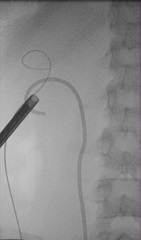
The procedure is performed under general anesthesia so that the patient does not feel any pain during the treatment. At the beginning of the operation, a thin catheter is inserted into the ureter. Contrast medium is injected into the renal pelvis via this catheter so that the kidney is better visible in the ultrasound image and under X-ray and can be punctured in a targeted manner. The kidney is then punctured with a fine needle under X-ray and ultrasound guidance to create a narrow access channel through the skin to the kidney. This channel is then carefully widened step by step and a so-called access sheath is inserted. A small endoscope can be inserted directly into the renal pelvis via this sheath. Under direct vision, the kidney stones can be broken up using a fine laser probe and the loosened stone fragments can then be flushed out.
At the end of the procedure, a thin renal fistula catheter is usually inserted and, if necessary, a DJ catheter is also inserted. These ensure that the urine can flow out unhindered until the mucous membrane is swollen away. If there are no stones, the catheters can usually be removed after a few days. The inpatient stay in hospital usually lasts a few days and depends on the individual healing process.
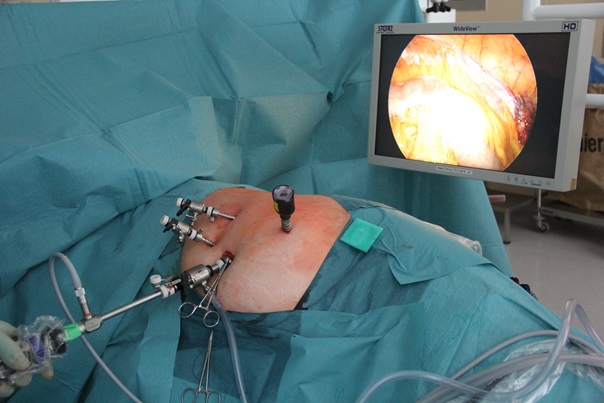
If an operation directly on the kidney is nevertheless necessary, the kidney can be exposed in the abdominal cavity by laparoscopy (without a flank incision) and stones can be removed from the renal pelvis. In this context, malformations such as a ureteral obstruction can be removed at the same time.
The aforementioned forms of stone therapy have almost completely replaced open surgical therapy (incisional surgery). Only in exceptional cases is this still used today, usually in the case of concomitant malformations of the urinary tract.
Whether it is possible to dissolve stones with medication depends on the chemical composition of the stone.
It is impossible to dissolve stones containing calcium with medication. Uric acid stones, on the other hand, can be dissolved by alkalizing the urine with medication (increasing the urine pH value) and increasing the amount of water drunk.
Drug-based stone therapy can also be used in some cases of special, rare stone compositions following surgical treatment.
If kidney or ureteral stones occur repeatedly, further clarification is required to rule out a metabolic cause for the stone disease. For this purpose, various laboratory parameters are determined in the patient's blood and urine. In addition, the composition of the stone is a decisive factor for further recommendations.
Stone diseases can occur at an early age, especially in the case of certain rare genetic diseases. In cooperation with colleagues from the Pediatric Surgery and Pediatric Nephrology departments, we also develop tailored treatment concepts for the youngest patients. The surgical rehabilitation procedures include all the methods already listed.
Children are admitted to the Clinical Department of Pediatric Surgery for surgical rehabilitation and are operated on by experienced endourologists from the Clinical Department of Urology.