Goals of our digital strategy
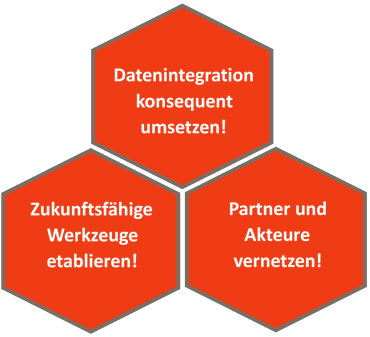
Implement data integration consistently!
Data is the basis for the development of new methods, knowledge and research. Barrier-free access to data sources to promote outstanding results is our strategic goal for deepening the integration model.
Establish future-proof tools!
The digital strategy enables specialists in university medicine to use the best tools, makes a significant contribution to improving the quality of results and increases competition for the best specialists. The aim is to create the basis for optimal collaboration in research, teaching and patient care through seamless process chains. Supporting processes relieve the burden on core tasks.
Networking partners and stakeholders!
Stakeholders and Facilities or Institutions involved in research and treatment use distributed data to network dislocated process chains. Our digital strategy creates the basis for research and knowledge networks through pioneering opportunities for collaboration.
MHH Information Technology digitization offensive
The Hospital Future Act (KHZG) is driving forward the digitalization of hospitals. Projects with a total volume of up to 4.3 billion euros are being funded. This also enables MHH IT to invest in future-oriented emergency capacities, digitalization projects and IT security.
Specifically, the MHH is investing in the development of patient portals, digital Nursing and treatment documentation,
clinical decision support systems, digital medication management and telemedicine procedures.
FTB 2 - Patient portals
The aim of the project is to set up and establish a patient portal with comprehensive appointment, information and document management, orientation options for patients, video conferencing functions and transfer management. By establishing the project, integrating the system into the internal IT systems and digital discharge management, the aim is to digitize the areas of admission management, treatment management, discharge and transition management at MHH across all sectors by 2024.approved applications from MHH Information Technology
FTB 3 - Digital Nursing and Treatment Documentation
The aim of the project is to achieve complete digitization of ward rounds, the ordering of therapy and nursing services, as well as the documentation of the implementation of nursing measures. The use of mobile devices and the introduction of documentation using integrated speech recognition and electronic dictation will avoid error-prone documentation on paper and the transfer of data from paper to the system. The high manual documentation effort for medical professionals is thus significantly reduced, which enables an increase in the quality of Nursing and treatment documentation, patient safety, faster and cross-departmental availability of data, as well as location-independent viewing of data within the Clinical Department.
FTB 4 - Establishment of partially or fully automated clinical decision support systems
The aim is to introduce decision support applications in routine clinical practice in order to create a centralized view of evaluations based on structured data from the interoperability platform. Data aggregation enables a complete overview of defined, relevant key figures. The clear presentation of the results enables medical staff to make data protection-compliant decisions faster and more securely and to increase the efficiency of their daily work.
FTB 5 - Digital medication management
The aim of this project is to introduce secure, digital and structured medication within the clinical workplace at MHH. This includes the electronic documentation of prescriptions, positioning and administration. In addition, electronic support for the recognition of allergies, interactions, contraindications and incorrect medication is to be implemented. This approach will make the medication process self-contained, comprehensive, transparent and digital and increase the safety of drug therapy. The data can be exchanged interoperably by using specified standards.
FTB 9 - Robotics-based equipment, systems / procedures & telemedical networks
The project aims to upgrade the MHH's telemedical infrastructure in order to improve patient care, particularly in areas with less specialist medical coverage. The rapid and geographically independent availability of expert knowledge should guarantee high-quality medical care. In the event of time-critical care requirements, diagnostics and treatment can be initiated and accelerated at short notice.