All good things come in fours!
Simone, four kidney transplants since 1978
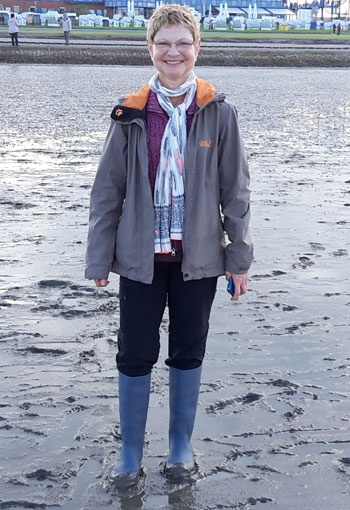
My name is Simone, I am 52 years old, married and live in Minden. I have had kidney disease since I was 7 years old. My first encounter with the MHH was on June 21, 1976, the beginning of summer. I was transferred from Minden Hospital to the MHH. I was admitted by a young ward physician at the time. His name was Dr. Ehrich, later Prof. Dr. Ehrich.
Those were still "pleasant" times
The physicians were able to maintain my kidney function for two years. But it didn't help, at the age of 9 I had to go on hemodialysis.
At first I was on dialysis with two teenagers (Heiner and Carola). We were on Mondays, Wednesdays and Fridays, the adults on Tuesdays, Thursdays and Saturdays. Those were still "pleasant" times. The nurses had a lot of time for us. The nurses took it in turns to read me individual chapters from the book "The Little Witch". Or they played Ludo with me. To tease Heiner, the sisters and Prof. Dr. Offner liked to have fun and often played the Smurfs' song. Heiner would always shout: "Turn that shit off!" Heiner and Prof. Dr. Offner also liked to play a game of chess.
I would like to take this opportunity to thank Prof. Dr. Offner very much, because she was always there for "her children".
Although medicine was not as advanced as it is today, I feel that things were more humane and calmer in some respects back then than they are today.
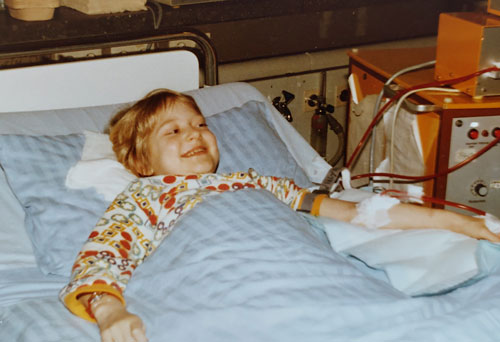
"Dr. Tidow cut my belly button!"
After six months of dialysis, I received my first kidney in September 1978, but it had to be removed the next day due to a blood clot.
In October 1978, I received a living donor kidney from my father. Unfortunately, there were a lot of problems with this transplant. I had several operations. Either the kidney was constricted, there was bleeding somewhere or there was an intestinal blockage.
However, I remember a funny incident after the bowel obstruction operation: when I saw the surgical scar, I said in horror: "Dr. Tidow has cut my belly button!" Dr. Tidow was my surgeon and had a distinctive beard: a beard on the left and right corners of my mouth and a beard in the middle of my chin. I thought it was great that Dr. Tidow took time for me. He arrived all excited and asked: "What am I supposed to have done? I cut neatly around your belly button!" I can definitely confirm that, my belly button is still intact.
At that point, I just didn't feel like having surgery anymore, I would rather die.
But then life got serious again. After about two weeks, it was the night of November 9, 1978, my main artery to my legal leg ruptured. I was in danger of bleeding to death internally. I had to have emergency surgery in the middle of the night. My mother, who was staying in an apartment in the nurses' home at the time, was called in. At that point, I just didn't feel like having an operation anymore, I wanted to die. That's what I told my mother. In this emergency situation, she asked me once again for this one operation. And she promised me that this would be the last operation.
So I ended up back on Dr. Tidow's operating table. I suffered a cardiac arrest during the operation, but I was resuscitated and the operation was completed. However, the bleeding could not be stopped completely, so I had to be operated on again. Even Professor Pichlmayr was consulted. But my mother kept her word that she had given me. I was spared another operation. The physicians then asked my parents to consider switching off the life-support machines. My parents decided to switch off the devices. But then a miracle happened. It was no longer possible to switch them off. The physicians said: "Simone is fighting, she has stopped bleeding internally!" So I slowly came back to life.
Having just escaped death, I painted a flower vase with lots of colorful flowers.
When I woke up from the anaesthetic and the tube was removed, the first person I noticed was Prof. Dr. Offner. The ribbons of the hood of her protective clothing were so strangely knotted on her head, she looked like Widow Bolte.
Then I remember that I wanted to paint. Having just escaped death, I painted a flower vase with lots of colorful flowers. That really impressed Mrs. Ostermann. Mrs. Ostermann was a Protestant pastor, the good soul of the children's hospital and I was very fond of her. She asked me if I could give her the flower picture as a present after I was discharged, which of course I did. The picture hung in her office until she retired. Until her death in 2006, we were in regular contact and exchanged birthday, Easter, Christmas and vacation greetings.
What was really devastating for me, however, was the realization that the kidney my father had donated to me could not be saved in the emergency operation and that I would need dialysis again. I also had to relearn how to walk as my muscles had completely deteriorated.
I would like to take this opportunity to thank all the nurses on ward 64b who stood by my parents and me during our difficult time.
Then came the winter of 1978/1979. Three times a week I had to go from Minden to Hanover for dialysis. I usually went to dialysis alone with my cab driver Mr. Finke or Mr. Quint. The journey usually took 1¼ hours. One day that winter, my mother accompanied me. It took us about 4 hours to drive back. As soon as we got home, the MHH called. The physicians were worried that I wouldn't be able to make it to the next dialysis session in time because of all the snow, so they wanted to admit me as an inpatient the very next day.
Katharina and Thea also shared my fate and were admitted as inpatients because of the snow. Katharina and her cab driver even got stuck on the A7 and had to be "rescued" by the German army.
After 9 years with my 3rd kidney, I returned to dialysis in 1988.
I received my 3rd kidney in October 1979. The kidney worked great and after 3 weeks I was discharged. As soon as I got home, I suffered such a severe rejection that the physicians feared I would lose this transplant again. However, the therapies had an effect. The kidney started to work again, but much less well than before the rejection. However, it lasted 9 years.
During these 9 years with my 3rd kidney, as a teenager I experienced the side effects of the immunosuppressant Sandimmun optoral, which causes mucosal growths. I had severe problems with my period. This problem was completely foreign to the nephrologists at the children's hospital at the time. My mother raised the issue in the outpatient clinic, but the physicians really didn't take us seriously. It was only when I nearly bled to death that the physicians started to listen. From then on, a gynecologist was available as a contact person for the adolescent girls in the nephrology outpatient clinic.
However, when I was 20 years old, I had to have both my uterus and both ovaries removed.
After 9 years with my 3rd kidney, I went back on dialysis in 1988. I was on dialysis for a total of 5 years. During this time, I graduated from high school in 1989. I found an apprenticeship as an administrative assistant at Minden City Council. I then attended an administration course for further career opportunities.
My 4th kidney is still working very well! It has now been 27 years.
During this training I received my 4th kidney on September 15, 1993. Although I was absent for 3 months (hospital and rehab at the Ederhof), I still managed to complete the course well.
As I was in a good learning rhythm and no longer needed dialysis, I joined another administration course. Today, I have the equivalent of a senior civil service qualification. I still work for the city of Minden today.
By the way: my 4th kidney is still working very well! It's now 27 years old. I would never have thought that I would be so well physically and be able to lead a "normal" life. Sometimes I even forget that I'm ill. I owe it all to my unknown donor. The physicians told me at the time that it was a "full-house kidney".
Every physical pain is also a mental pain.
Since the beginning of 2020 (even before corona), however, my soul has been speaking out more and more. I keep reliving the events that happened with my 2nd kidney in particular (my father's living donation). My biggest fear is to lose this 4th kidney again. Then the whole procedure would start all over again: life is dependent on a machine, severe restrictions on eating and drinking, etc. It also brings back memories of my youth, because that time was very much characterized by human disappointments. For example, if you look like you're 12 at the age of 16, the "healthy" girls simply don't want to have anything to do with you. That really offended me at the time.
I still experience human disappointments in connection with my illness today, for example in my professional life. I have been unable to work for a year now due to my mental health problems.
I have sought psychotherapeutic help and am trying to work through my emotional pain. I think things are gradually getting better.
It's very good that medicine today has recognized that it's not just the child's illness that needs to be treated, but also their soul. Because every physical pain is also an emotional pain. Psychotherapy helps children to come to terms with their experiences at an early stage.
This is all the more important when it comes to the subject of death, which chronically ill children are very often confronted with. At least that's what happened to me. Because of the thin cupboard walls on ward 64b, I was able to "listen in" one night as Carola died in the next room. What's more, most of my little sick friends never reached adulthood.
When I was a child, this knowledge did not yet exist. For this reason, at the age of 52, I am in the process of coming to terms with the experiences of my childhood and adolescence. Telling my story is part of this.
At this point, of course, I can only describe the experiences from my point of view. How my parents fared at the time and the emotional rollercoaster they went through is certainly worth a story of its own.
A little anecdote about the Easter bazaars in the 1980s
Finally, and in keeping with the Easter season, I must mention the legendary Easter bazaars that took place in the entrance area of the children's hospital in the early/mid-1980s. The parents of children with kidney disease organized the bazaars with great commitment and diligence. They were very popular with both staff and visitors. Even the nurses from the ward block came over to buy cakes. The great success of the bazaars made up for some of the efforts of the organizers. The proceeds went to the parents' association. My parents, mainly my mother, were also among the organizers. When the conversation turns to the Easter bazaars, a smile appears on their faces.