Let the bones roll...
Stefan, three kidney transplants since 1978
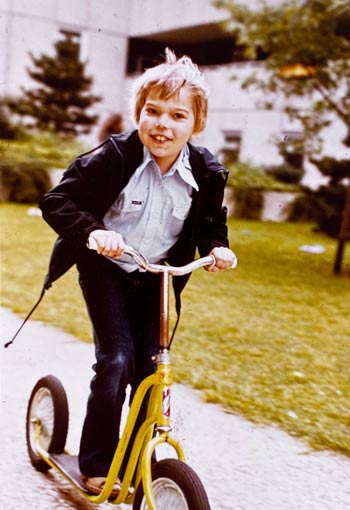
Let the bones roll... A brief anatomy of a physician-patient relationship ... "Or do you have a special relationship with our hospital in some way?" one of the head physicians at the MHH Children's Hospital asked me. "Yes! I've had two kidney transplants here!" I got the job. However, at the time of my application as a physician in internship (AiP) in pediatrics at the MHH, I had already been on dialysis again for several years and was waiting for a 3rd kidney transplant (NTX). Dr. med. Stefan Fromm, born in 1969, developed a fever when he was three years old. There was a serious illness behind it, called FSGS (focal segmental glomerulosclerosis). The devil is not actually in the kidneys but in the blood, but the two urine producers are the ones that are suffering and are going down the drain due to the disease. I was first treated in Hamburg, then in my home town of Oldenburg and the MHH took over the torch when my own kidneys came to an end. She still carries it today. Thank you! I had my first hemodialysis (HD) in 1978 and was transplanted in the summer of the same year. My mother donated the kidney to me. Thank you! After 6 weeks I was allowed to go home again, where my mother was already back, but the pleasure was short-lived. Howard Carpendale didn't sing "Hello again"(1) until 1984, but the FSGS anticipated it. Shortly after the operation, the new kidney was damaged again. In the following 2 years I was hungry - 1000 kcal is not much. The little food I ate tasted bland, as it was cooked with practically no salt. My blood pressure was a disaster, I was a frequent guest on ward 64b and didn't grow much. At least I was allowed to drink a lot at times. HD followed again.
"Hello again!"
I was thirsty again! On February 27, 1981, I came to dialysis with only a slight weight gain and I was looking forward to drinking the full 500 ml. But I had to stay dry, because a kidney from a brain-dead donor was already waiting for me in the operating theater. Thank you! Prof. Pichlmayr was in charge of the surgical team, but there were still complications. But that was also the case in 1978. It will pass, you can get everything under control, and after a second operation I only had to wait 4 weeks before I was allowed to go home. "Hello again!" Crap, but the FSGS was only moderate. The cunning devil hid, but remained visible behind the curtain, and he's still there today. But more on that later. I repeated a grade and went to grammar school in 1982. My kidneys were doing so well, I grew better thanks to cyclosporine, but my gums grew uncontrollably and I became a teenager. My parents warned me - quite legally - about the Wild West of puberty because of all the medication. Blood pressure... yeah yeah... way too high, of course. yolo... Thick legs now and then, rarely a fat lip, but it worked. Inpatient stays were limited. "At 18"(2) ... No, at 16 I had a bacterial bone infection and was injected with antibiotics every day for several weeks. The blunt side of the injection seemed desirable to me.
"I graduated from high school and started studying medicine to become a physician."
I found my first snogging friend and made the acquaintance of a Nursing trainee on 64b. We went to the movies together. In the dark, I learned from the prospective student that a certain percentage of study places are allocated to so-called "hardship cases". Thanks for the info! The Abitur followed. I partied and listened to a lot of music, drank, smoked, smoked pot - not much, really - continued to be interested in girls and let the dolls dance in various discos. I was recognized as a hard case. I met my current wife on the first day of university. It wasn't love at first sight, because I didn't exactly look super sexy with chunks of gum between my teeth. But sometimes it just takes a little time for really big things. After 10 great years, my kidney function went into a steep decline. But at 1.76, I was of normal height, had graduated from high school and started studying medicine to become a physician. I didn't really prepare for the physics exam with lousy lab results and 18 hours of sleep a day. I wouldn't have taken the exam at all if Prof. H. hadn't talked me into it. An HB of 6 was no reason not to at least try, he was legal once again. And I was lucky with my 5, because I was able to make up for it with an oral 2. I was andialyzed again between the written and oral parts of the preliminary medical examination. Familiarity gives you confidence, so HD again? Prof. B. - I had moved to the adult department in the meantime - tried to convince me of peritoneal dialysis (PD). Tube in the abdomen? How stupid! I could practically drink normally. I agreed! Tube in my stomach, learned how to change the bag, received an invitation to the oral exam, got a good combination of subjects and examiners, slept again, was given erythropoietin, had no time to think and I managed a "good" in anatomy and psychology. Passed by hook or by crook. Studying and PD go well together.
In the Caribbean, we learned little surgery, but a lot of English and simply a different kind of medicine to ours.
"Roll the bones"(3), which can be loosely translated as "throw the bone dice, challenge your life...", was a music tip from a good friend. "Get out there and rock and roll the bones!" rhymes with "Get out there and make something of it!". My gums shrank to their normal level and Dani and I got together. I took a cure at the Ederhof and enjoyed not having to set up the machine myself every day, just as I enjoy it today when I don't have to cook. My passion for the mountains was awakened. In my final year at university, we flew to the Caribbean for 3 months to complete our surgical internship. The company GAMBRO® was kind enough to send me 2 tons of dialysate to Barbados(4) and to cover the costs. Thanks again for that! In the Caribbean we learned little surgery, but a lot of English and simply a different kind of medicine than ours. It was one of my best times. I had brought the cycler, a dialysis machine for PD, which I now had changing the bags during the night, with me as special luggage. The planning worked. A board sawed to size and drilled to fit exactly into the suitcase replaced the tubular steel stand. A shelf made from cardboard boxes gave the whole thing enough shape and support to ensure that everything only collapsed once at night. Everything remained intact and the dialysis worked perfectly. I went swimming every day with a PD catheter, did a diving course, plundered my bank account in favor of a good life and was soon to be a physician. Yep, but there was a limit(5). Working days for physicians are pretty much always long days. The white coat I had figuratively put on was just a disguise, I remained a patient. My dialysis program at the time required 12 hours. With the "last bag" by hand, I was able to shorten it to 11 hours. I often didn't get home until around 7 pm. I had to be back at the Clinical Department by 8:00 am. I quickly organized a load of fast food somewhere, there was no time to shop or cook, that didn't work well. I had psychological problems as a physician in "my" children's clinic. They helped me and put me on sick leave. The pediatric dialysis and TX outpatient clinic gave me a kind of protected workplace. Thank you for that. Things got better again. But I had felt the limit. Not everything works under all circumstances. I knew some of the problems of my young patients from my own experience. Sometimes both sides could benefit, but most of it remained personal experience.
I had my 3rd kidney transplant in the summer of 1998. Routine.
The call reached me in Oldenburg, where my girlfriend was now trying her luck as a trainee ophthalmologist. "We have a kidney for you!" I accepted the offer. This meant that the living donation I had asked my father for, who was in the middle of the preparations, was a thing of the past. Thank you for agreeing! In the summer of 1998, I had my 3rd kidney transplant. Routine. After a week I was allowed to go home. After an extended vacation, I went back to work. "Hello again!" said not only my fellow physicians and nurses, but also the FSGS. Shit, not again! Multiple biopsies, plasmapheresis, a kind of special dialysis to remove harmful particles from the blood, other immunosuppression... In between, I continued to work, because sick days were not counted towards an AiP, you had to add them on. My salary was lower than my income as a student and the workload was many times higher, so I wanted to get through it quickly. I took a shortcut... Quite suddenly I could hardly hear. Inpatient admission. My vision also got worse and worse, but I couldn't find a reason. The new kidney, which was only a few months old, was on a knife edge. My legs were so thick that the top layer of skin burst, the Krea rose ... and fell again. The kidney stayed in.
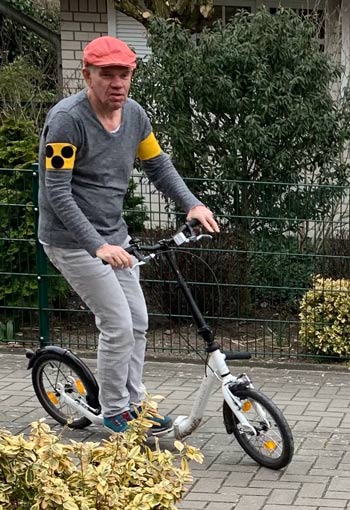
The disability became normality.
After 13 weeks at the MHH, I was able to leave the Clinical Department on my 30th birthday with severe hearing and visual impairments. My brother, who had visited me almost every day, drove me to my parents. I stayed with another brother for a long time and eventually moved into an apartment in Oldenburg together with Dani. Thanks to my brothers! My visual acuity has been so bad since then that I am considered blind. Cause? No answer. There were assumptions, none of which were clear. Most likely an infection, what else? I was put on disability leave. The FSGS improved spontaneously, or was it a result of the plasmapheresis after all? It didn't matter. We got married, didn't have any children, probably a side effect of very early attempts at therapy. I played chess, read with a screen reader, at some point was even able to understand audio books, learned to write blind, run a household and just got on with life. The disability became normality. A blind journalist once wrote that you can still do everything, you just have to relearn it. Creating paper became a hobby and I learned to bind books, which is how I made my own book of poetry. Shortly before my 36th birthday, I started running and I still do. I am now almost 52. My greatest success was taking part in a half marathon in Hanover, where I finished, and a 10 km run, which I completed in under 1 hour. I climbed many mountains, the highest was the Suldenspitze at 3376 m, the most strenuous the Ilmenspitze at 1400 meters, both in South Tyrol. I wrote two stories, painted pictures, self-published them, memorized them, performed them and continued writing the script of my life. I felt practically healthy for 2 great decades. I didn't want anything for my 50th birthday. I was rich in experience, which is much more valuable than too much fuss. An old acquaintance got in touch: "Hello again!", and my legs got big. The devil had kept a low profile for 20 years, I thought he was practically defeated, then FSGS came back on the scene. Panic(6), biopsy, therapy. In the meantime, the white coats(7) had researched a possibility that was too ⅔ effective. I was lucky again!
And for those of you reading this, it should encourage you to continue writing our stories.
I enjoy my life, which I wouldn't trade with anyone, drink coffee, water, beer, tea, cola and wine with relish, eat everything and as much as I want, and am pretty content most of the time. Admittedly, not always, but most of the time. Thanks to all my fellow campaigners: patients, nurses, organ donors, physicians, researchers, my family and especially my wife Daniela. Some of those who can no longer read this - and that applies to both sides of the syringe - have nevertheless contributed. And to those who are reading this, it should encourage them to continue writing our stories. "Get out there and rock and roll the bones!"
Background music:
1) "Hello again", Howard Carpendale 1984 2) "Mit 18", MM Westernhagen, 1978 3) "Roll the bones", Rush, 1995 4) "Die rote Sonne von Barbados", Die Flippers, 1986 5) "On the border", Al Stewart 1976 6) "Panic", The Smiths, 1987 7) "White Coats", New Model Army, 1989