Physician-patient communication in cancer medicine
How can good Communications succeed?
Status: 29.05.2024
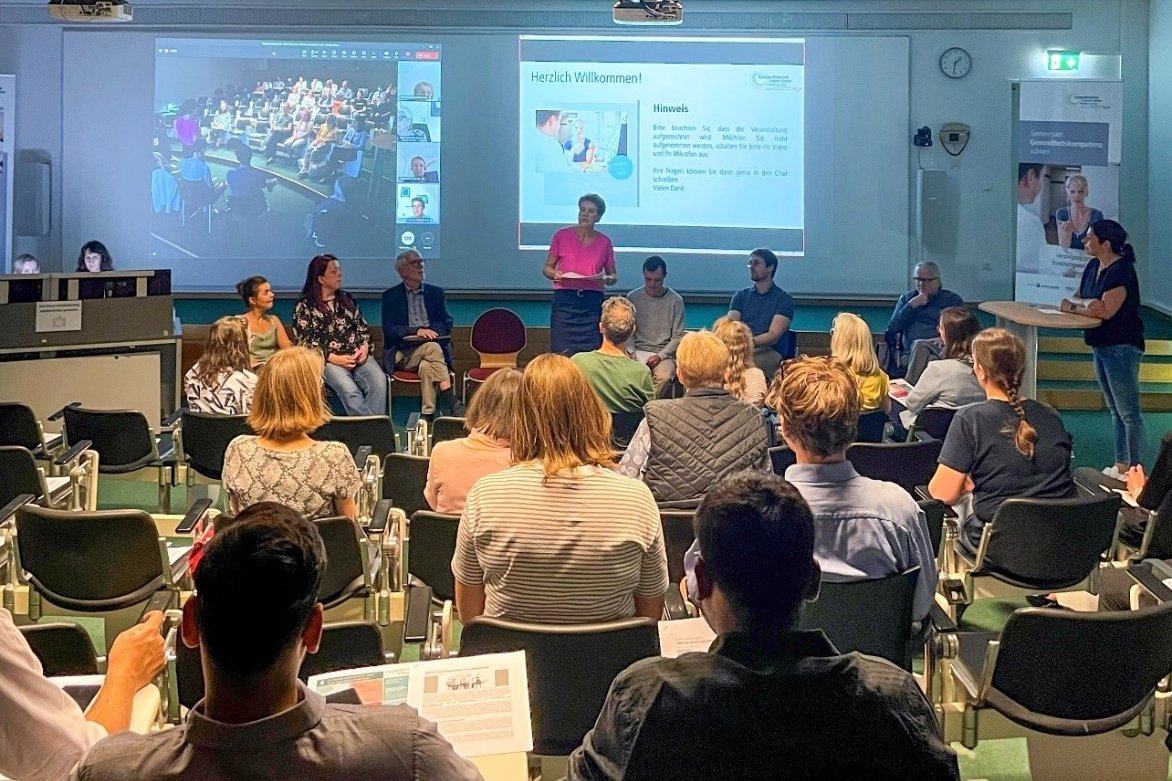
Good physician-patient communication is crucial for the healthcare of those affected. It can alleviate fears and promote the healing process and quality of life. But how can good Communications be achieved? This question was discussed on Tuesday, May 14, 2024 in the panel discussion "Doctor-patient communication in cancer medicine". Patients reported on what went well or not well from their perspective and what they would have liked to see in concrete terms. The event was organized by the OnkoAkademie of the Comprehensive Cancer Center (CCC) at Hannover Medical School (MHH). The communication seminar was aimed at medical students to prepare them for their Practical Year (PJ) and their future medical careers. The initiative came from the CCC's Patient Advisory Board. There were also contributions from the fields of ethics and psycho-oncology. In total, more than 40 participants took part in the panel discussion.
Initiator Silke Schwethelm, member of the patient advisory board and head of the Onko-Stammtisch self-help group: "We see that it is often more difficult in practice for medical professionals and patients to come together than is taught in theory. That's why we wanted to talk to the physicians of tomorrow - the medical students - about the challenges of physician-patient communication and share our experiences from a patient perspective."
Marek von Reusner, medical student at the MHH and co-organizer of the event: "For us as students, this format offers a great opportunity to interact with patients and ask open questions."
Even long conversations can be bad and good ones can be short
The event was moderated by psycho-oncologist and Professor Dr. Tanja Zimmermann from the MHH. She knows: "Particularly in the period shortly after diagnosis, patients are often still in diagnosis shock. Instead of trying to fit all the information into one conversation, it's better to offer information in bits and pieces". Schwethelm confirms: "Even long conversations can be bad and good ones can be short". Patients should also be given time to take notes or be encouraged to bring a caregiver with them.
Empathy is needed
The participating patients mentioned empathy and attention through non-verbal gestures, e.g. offering a smile or a tissue, as being particularly important. "We don't want to feel like something that is being processed," said the patients.
The best answer from medicine is not always the best for patients
Dr. med. Gerald Neitzke, Chairman of the Clinical Ethics Committee at MHH, emphasized: "Patients have freedoms. It is important to understand that physicians only make an offer of professional expertise to patients before treatment. Then they ask how the offer feels for the person concerned. The criterion does not always have to be successful treatment, but can also be quality of life."
Saying when you are (not) satisfied
The guests taking part in the panel discussion were unanimous: you are allowed to say if you were not satisfied with a conversation. But also if the treatment or conversation went well and you felt comfortable. This is the only way to improve physician-patient communication.
Good to know
The psycho-oncology team has therefore drawn up a factsheet for Communications with cancer patients. It contains helpful tips, recommendations and do's and don'ts. ► Factsheet for download
The CCC Patient Advisory Board plans to continue working with students on the topic of physician-patient communication. If you are interested in joining the communication team, please contact us by e-mail at ccc@mh-hannover.de. People affected by cancer and students between the 5th and 12th semester are very welcome.
Text: Maike Isfort