Dear visitors to our homepage,
We would like to welcome you to the Center for Internal Medicine and introduce you to our range of services for internal emergency care.
The interdisciplinary emergency department of the MHH is located in the entrance area of the MHH, Carl-Neuberg Str. 1, 30625 Hannover and is best reached via the access ramp to the upper parking deck from Carl-Neuberg Straße.
Pediatric emergencies are treated directly at the children's clinic.
Obstetric emergencies (pregnancy) are treated directly in the gynecology department.
Dentistry emergencies are treated directly at the dental clinic .
All other emergencies are treated in the Central Emergency Room of the MHH. The following topics explain the procedure in the emergency room:
Who should come to the emergency room?
In life-threatening emergencies, the emergency services must be called immediately - telephone 112! These emergencies include unconsciousness, acute or severe shortness of breath, severe or acute chest pain, severe abdominal pain, severe headaches, acute paralysis, acute poisoning and serious injuries. If a GP or specialist in private practice issues a referral (Sample 2: Prescription for hospital treatment) without a cross being made in the "Emergency" field, prompt inpatient admission is usually sufficient, which can be organized via the respective Clinical Departments of the Centre for Internal Medicine, but not via the Central Emergency Room.
Newly occurring or acutely increasing complaints with impairment of well-being are also treated in the emergency room.
The Central Emergency Room is not the right place to go if there is no serious health problem that requires immediate diagnosis and treatment. During consultation hours, the GP should generally be consulted first; outside of these hours, there is a medical on-call service provided by the Associations of Statutory Health Insurance Physicians. Details on this and a good overview of when the ambulance service or the medical on-call service of the Associations of Statutory Health Insurance Physicians should be used can be found at www.116117.de or by calling 116117.
If possible and available, please bring the following documents and records with you to the Central Emergency Room for treatment: Health card, referral (if available), relevant findings and physician's letters (at least the most recent ones), implant passport, allergy passport, anticoagulant passport, the current medication plan or, if no medication plan is available, tablet blisters, whole packs or pack outlines with the names and strengths of the medication taken. It makes sense to take a living will and power of attorney with you.
What is the procedure in the emergency room?
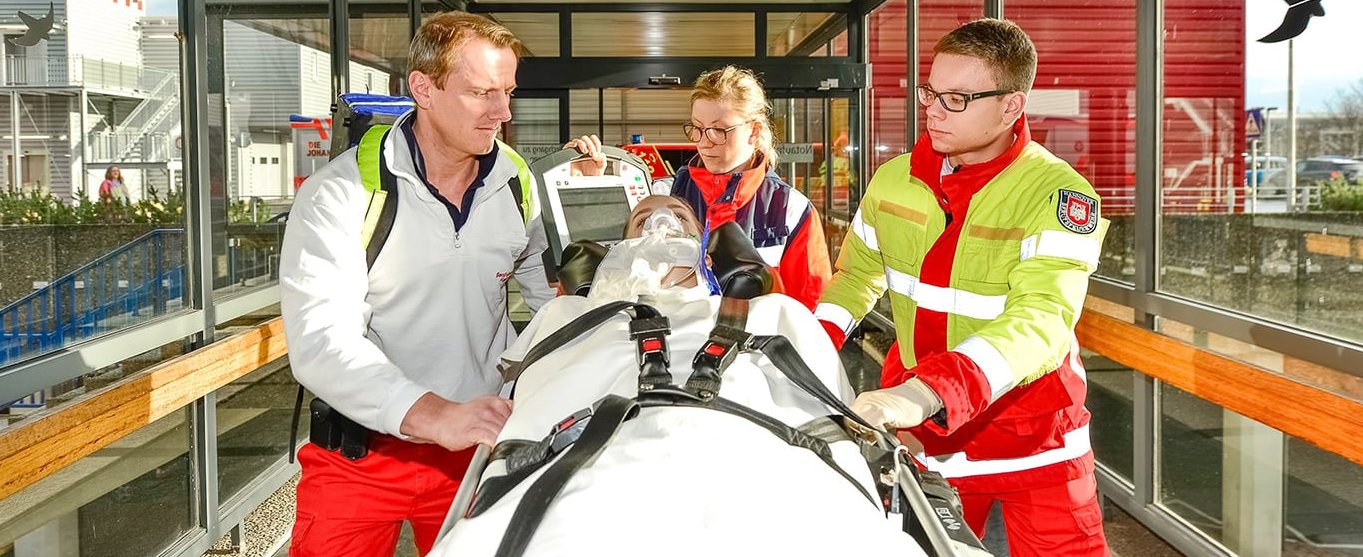
In the Central Emergency Room, an initial nursing assessment is carried out; on the one hand, the specialty is assigned, and on the other hand, the urgency of treatment. Life-threatening emergencies always have absolute priority, so the waiting time for less seriously ill patients is usually longer. Patients who reach the Central Emergency Room via the ambulance service have already been notified in advance via the IVENA electronic system with certain data (including age, gender, suspected diagnosis, urgency of treatment) in order to guarantee the best possible care.
As a rule, blood pressure, pulse, heart rate, temperature and oxygen saturation are then measured, an ECG is written and blood is taken for laboratory diagnostics; often a urine sample is also required for laboratory diagnostics.
This is followed by a medical interview and examination, and further instrumental examinations (X-ray, CT, MRI, echocardiography, sonography) may then be ordered, which take a corresponding amount of time.
Depending on the results of the examinations carried out and the questioning, the patient is either admitted to hospital or discharged for further outpatient care. In the latter case, a physician's letter is always provided. In both cases, the average length of stay in the Central Emergency Room is 3 to 4 hours. Occasionally, the Hannover Medical School has no free beds, so that a transfer to another hospital is organized if inpatient treatment is necessary.
What does the MHH emergency department do?
The MHH's Central Emergency Room now treats 70,000 cases per year, almost 11,000 of which are internal medicine cases, which in turn require inpatient treatment in just over half of all cases.
The medical team of the Central Emergency Room and the internal medicine admission ward is provided jointly by the Clinical Departments of the Center for Internal Medicine and consists of a senior consultant, a senior consultant and 15 assistant physicians. This team also cares for all normal internal medicine patients outside normal working hours. An internal medicine specialist is also available in the background at these times, so that a specialist presence is guaranteed around the clock.
If necessary, interdisciplinary treatment is provided with the involvement of physicians from the following Clinical Departments: Ophthalmology; Ear, nose and throat medicine; General, visceral and transplant surgery; Cardiac, thoracic, transplant and vascular surgery; Plastic, aesthetic, hand and reconstructive surgery; Trauma surgery; Urology and urological oncology; Neurosurgery; Neurology; Psychiatry, social psychiatry and psychotherapy; Oral and maxillofacial surgery; Dermatology, allergology and venereology; Gynecology and obstetrics. Life-threatening internal medicine patients are often treated by physicians from the Clinical Department of Anaesthesiology and Intensive Care Medicine.
Intensive care units
Patients with life-threatening internal illnesses are treated in our interdisciplinary intensive care unit (ward 14) or, in the case of severe heart disease, in our cardiology intensive care unit (ward 24B).
Intermediate care ward
An intermediate care ward is used to monitor and treat critically ill patients.
The nursing team at MHH's Central Emergency Room consists of 34 registered nurses and one MFA, who are employed full or part-time.
The staff work on an interdisciplinary basis and care for patients from all 21 specialist disciplines at MHH.
Children with injuries following accidents are also treated in the ZNA.
Polytrauma, resuscitation and other life-threatening illnesses are treated in the two dedicated shock rooms.
The ZNA nursing team also looks after the disaster camp (state of Lower Saxony and federal government).
The main tasks of the nursing team in the ZNA are
- Acceptance, care and monitoring of emergency patients
- Taking blood samples, preparing ECGs, vaccinations
- Assisting with wound care, applying plaster casts and support bandages
- Assisting with the care of seriously injured or ill patients
Close cooperation with external (e.g. ambulance service, fire department, police, etc.) and internal (laboratory, MRTAs, physicians, etc.) professional groups is professionally ensured across all interfaces.
Our students are also trained in internal emergency medicine and learn about patient care in the Central Emergency Room, the admission ward and the intensive care units.