Information on the ward
Welcome to our website
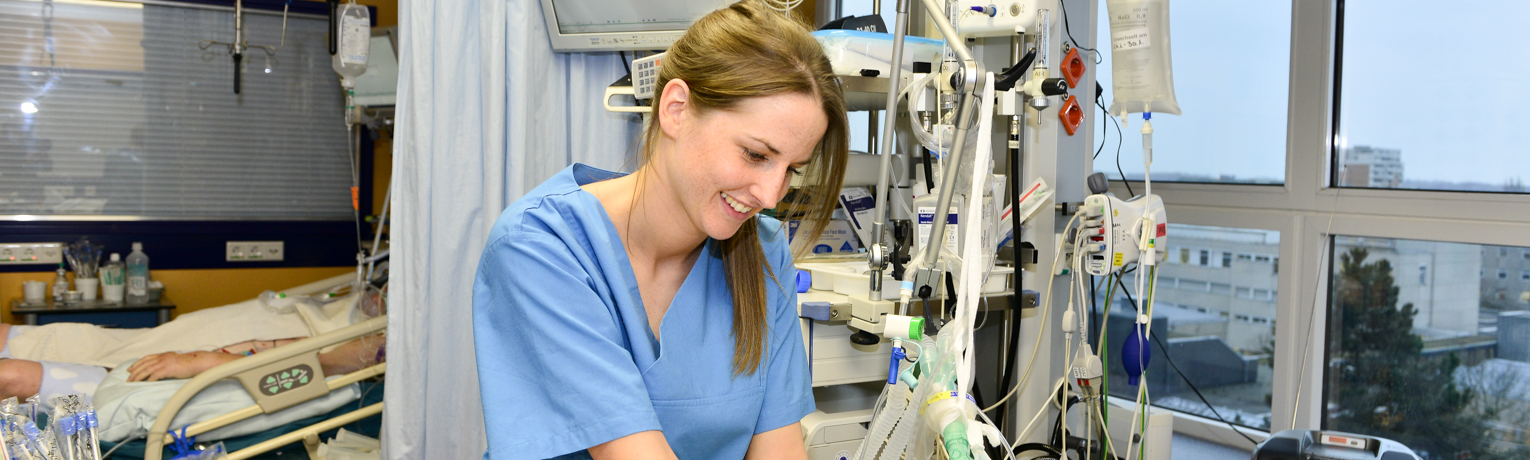
Ward 24 is a cardiology ICU (Intensive Care Unit) with IMC.
The cardiology ICU can treat and optimally monitor all cardiological conditions of varying severity at any time. Patients can receive the entire spectrum of intensive care and intensive medical care from intermediate care (for patients requiring intensive care and monitoring) to normal care, with permanent cardiovascular monitoring guaranteed. The advantage for our patients is that they are continuously cared for by the same nursing and medical team.
Our so-called Chest Pain Unit is integrated for patients with acute coronary syndrome. Our Chest Pain Unit is certified by the German Society of Cardiology and guarantees the fastest possible high-quality cardiological diagnostics combined with therapy and individualized Nursing.
- Integrated Heart Failure Unit (HF Unit)
- Integrated Cardiac Arrest Center
- Integrated PPCM and EMA Center
Our Nursing is based on the nursing mission statement and the nursing concept of Hannover Medical School. It is planned, carried out and evaluated in a patient-oriented manner, taking into account the psychosocial situation. We work according to the Rooper, Logan & Thierny nursing model.
Our patients are accommodated in single and double rooms, which are generally allocated according to medical criteria. We are happy to accommodate individual wishes.
Our nursing team consists of full-time and part-time registered nurses, some of whom have various additional qualifications, such as two-year specialist training in intensive care and anesthesia care, as well as practical instructors. Participation in internal and external training courses is an integral part of our Human Resources. New colleagues are introduced to their tasks in accordance with an induction guideline developed by our ward, which guarantees our patients a high standard of safety and care.
We guarantee continuous care by working in a three-shift system in order to restore the well-being and health of our patients through interdisciplinary cooperation.
Nursing care for cardiac patients is provided in close cooperation with physicians and results from the application of proven treatment methods and the development of new therapeutic approaches. Examples include cardiac catheter technology, implantable cardiac support systems and research into completely new diagnostic procedures.
The range of nursing tasks includes the care of patients with clinical pictures such as
- acute myocardial infarction
- malignant cardiac arrhythmias
- vascular occlusion
- cardiac insufficiency
- coronary heart disease
- pulmonary embolism
- after cardiologic or surgical heart valve interventions (TAVI)
- During therapeutic hypothermia
- Condition after resuscitation
- PPCM
- Cardiac support systems (ECMO, Impella)
Your relative is in our intensive care unit. This is probably a very worrying situation for you.
We would like to provide you with the following information to help you better understand the situation your relative is in.
For some patients, breathing must be supported by a ventilator. This device is connected to the patient via tubes. Air flows in and out via the breathing tube, which is inserted into the windpipe through the mouth or nose. Inserting the tube is called intubation, removing it is called extubation. If the patient needs the help of the ventilator for a longer period of time, a tracheotomy may be performed. As long as the tube is in place, the patient cannot speak, drink or eat. Depending on the patient's situation and the medication used, you may find your relative in an artificial deep sleep, dazed or awake. The awake patient has the opportunity to express themselves through signs and gestures or in response to specific questions. When the tube is removed and the patient is sufficiently awake, they can speak again.
The patient is connected to monitors for constant monitoring of heart function, blood pressure, body temperature, blood oxygen levels and other important bodily functions. The data is recorded via sensors (electrodes) attached to the body and connected to the monitoring devices via cables. The measured values can be read off in the form of curves or figures on the corresponding screens. Almost all devices in the intensive care unit react to even the smallest changes with audible and visible signals. This does not usually mean acute danger. However, the alarms draw our attention to a particular situation and help us to act in good time in an emergency.
Thin plastic tubes (venous catheters) inserted into a blood vessel ensure the necessary supply of medication, fluids and nutrients. As long as the patient is unable to eat and drink normally, nutrition is provided either via a tube inserted through the nose into the stomach (gastric tube) or via the venous catheter. Body fluids, such as gastric juice or urine, are drained through a gastric tube or bladder catheter. After an operation, tubes(drains) are sometimes placed in the wound area to drain secretions and blood so that wound healing is not impaired. These fluids are collected in collection bags or bottles attached to the edge of the bed. Special mattresses on the patient beds are designed to prevent the development of pressure sores (decubiti). Sometimes elaborate special beds are also used for special positioning.
Sometimes a patient has to be isolated because regular bacteriological tests reveal bacteria that are resistant to a large number of antibiotics, i.e. against which these antibiotics are no longer effective. These bacteria are therefore referred to as multi-resistant. If multi-resistant bacteria are detected in patients, it may be necessary to take special hygiene measures to prevent the transmission of these bacteria to other patients. A sign on the room door will inform you of this and the nursing staff will help you to behave appropriately.
We ask you to disinfect your hands regularly. You will find disinfectant dispensers in the visitors' room and in front of each patient room.
Our intensive care unit has regulated work processes. We try to maintain the day-night rhythm for the patient. Doctors examine the patient, determine the therapy and carry out the necessary treatments. They are supported by the nursing staff, who monitor the patient, carry out certain therapeutic measures and record the course of treatment. The nursing staff also support the patient with personal hygiene, mobilization and food intake. Various tasks are also carried out alternately by nursing staff and physicians. However, this routine can be interrupted by acute events. This then requires a change in the work routine and can temporarily give the impression of restlessness.
If necessary, please bring the patient's glasses, dentures or hearing aids with you. You are also welcome to bring your relative hygiene items such as a razor, toothbrush, deodorant or skin lotion. Other personal items and food only after consultation with the nursing staff.
If you have any questions, you are welcome to call us. For data protection reasons, we are only allowed to provide information to direct relatives. We would ask you to coordinate within the family so that only one person calls and asks for information and then passes it on.
We will inform you immediately of any serious changes in your relative's condition.
- You enter the MHH through the main entrance (building K6).
- To reach ward 24A, walk through the shopping street to elevator node_A. Take the passenger elevator to floor 4.
- To reach ward 24B, walk through the shopping street to elevator node_B. Take the passenger elevator to floor 4.
- This will take you directly to the respective entrance door.
Dear visitors,
It is important for our patients to be visited by people close to them, so you are very welcome. We would like to give you some important information below.
Please register via the intercom system. Depending on the situation, we will accompany you directly to your relatives or ask you to come to our visitors' room for a short time. We ask for your understanding if you need to be patient in order to visit your relative. There may be some waiting time due to the time-consuming care of patients.
Many nursing and medical procedures are carried out on patients, especially in the mornings. We would therefore ask you to visit your relative between 14:00 and 19:00 if possible, as we try to coordinate our work processes accordingly. Exceptions can only be made after consultation and in certain situations.
Personal contact with the patient through your visits is an important part of recovery. Visits are determined by the patient's ability to cope with stress and their treatment situation. In the interests of your relative and other patients, we ask you to make arrangements within the family and ensure that no more than two relatives visit at the same time.
The Visiting children and adolescents in an intensive care unit is problematic. Please make sure you discuss their visit with us in advance!
Please do not leave any personal belongings unattended, use the lockable cupboards in the visitors' waiting room and always take your valuables with you to the ward.
Flowers and plants are not permitted in the intensive care unit for reasons of hygiene.
Information about your relatives
Please understand that, for legal reasons, our nursing staff may only provide information about general and nursing aspects. The contact person for all questions about your relative's state of health is the attending physician.
You can obtain information about your relative's state of health and treatment from the ward physicians during visiting hours, provided they are not involved in acute patient treatment.
In order to protect the personal sphere of the patient, we will only provide information by telephone to a person known to us. Unfortunately, other callers cannot receive any information. Please inform each other.