Skin and wound healing
Next to the intestines, our skin is the organ with the largest surface area. It enables us to regulate our body temperature and protects us from major fluid loss, harmful environmental influences and germs. The function and integrity of our skin is vital for us. Modern wound management has already made great progress in the treatment of severe burns, chronic and acute wounds. Nevertheless, extensive injuries and pronounced scarring of the skin remain a challenge. Kerstin Reimer's laboratory is working on the development of therapy options based on donor skin or colonized matrices.
Skin bank
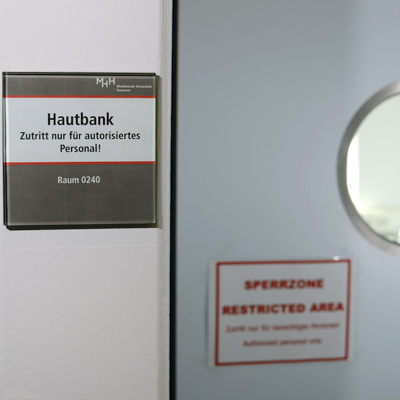
The establishment of the department's own skin bank should enable the initial treatment of severely burned patients with living donor skin in the future. Patients who receive skin tightening surgery in our Clinical Department have the opportunity to donate their "excess" skin to the skin bank. The donated skin is processed in our clean room, microbiologically and virologically tested and placed in a special antifreeze medium. Freezing and storage take place at the Hannover Unified Biobank(https://www.mhh.de/institute-zentren-forschungseinrichtungen/hannover-unified-biobank-hub). This will provide an alternative to the currently used synthetic products, matrices of animal origin or glycerol-preserved skin. If required, the appropriate quantity can be requested from the biobank at any time.
The development and establishment of the skin bank was made possible by the generous support of the Fritz Behrens Foundation and the Presidium of the MHH.
Contact person
Clinical management
Prof. Dr. med. Peter M. Vogt
Phone: 0511 532 - 8864
Scientific management
Dr. rer. biol. hum. Vesna Bucan
Phone: 0511 532 - 8788
Development of a biopharmaceutical to reduce the immunogenicity of donor skin
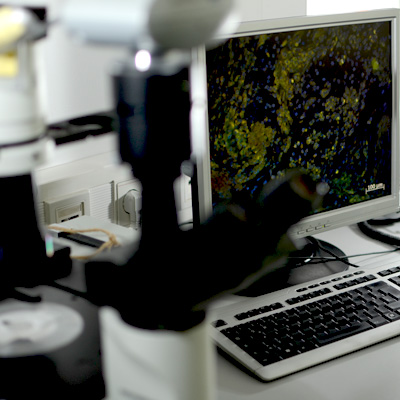
The transplantation of foreign tissue from one person to another (allogeneic transplantation, allograft) generates a rejection reaction in the healthy organism, which is based on the recognition of certain surface properties of the cells as "foreign". This prevents the permanent ingrowth of allogeneic donor skin or the survival of allogeneic cells. Although organ rejection can be suppressed by taking drugs that affect the recipient's immune system, these usually have severe side effects. The solution to this problem could lie in a change of perspective. In our project, we are trying to prevent recognition as "foreign" instead of suppressing the reaction to it. To this end, the surface properties of the donor cells are specifically manipulated. The feasibility of this has already been demonstrated on a genetic basis. The next step is now the transfer to the protein level.
This project is funded by the VHV Foundation.
Contact person
Scientific management
Dr. rer. biol. hum. Vesna Bucan
Phone: 0511 532 - 8788
Publications of our working group
Schlottmann, F., Strauss, S., Hake, K., Vogt, P. M., & Bucan, V. (2019). Down-Regulation of MHC Class I Expression in Human Keratinocytes Using Viral Vectors Containing US11 Gene of Human Cytomegalovirus and Cultivation on Bovine Collagen-Elastin Matrix (Matriderm®): Potential Approach for an Immune-Privileged Skin Substitute. International Journal of Molecular Sciences, 20(9), 2056.
Influence of water-filtered infrared A radiation on wound healing
It is known that water-filtered infrared A radiation (wIRA) has a positive influence on wound healing, among other things. According to the literature, irradiation with wIRA leads to a local increase in blood circulation, a slight increase in temperature and oxygen supply in the tissue. Furthermore, studies describe a reduction in inflammation and promotion of regeneration and healing. Patients in these studies also report pain relief. The Clinical Department of Plastic, Aesthetic, Hand and Reconstructive Surgery has been using wIRA successfully for several years. In the Experimental Department, we are working on the extended application possibilities of wIRA and have already been able to show that in vitro irradiation has a positive influence on cell migration and accelerates wound closure in the scratch assay. Whether transplants could also benefit from irradiation with wIRA is currently being investigated as part of a dissertation project.
This project is funded by the E. Baun Foundation.
Contact person
Laboratory management
Dr. rer. nar. Sarah Strauß
Phone: 0511 532 - 8863
strauss.sarah(at)mh-hannover.de
Clinical project management
Dr. Alperen Bingöl
Phone: 0511 532 - 0
bingoel.alperen(at)mh-hannover.de