From the private eye clinic "Maschstraße" to Hannover Medical School
While ophthalmology became an independent discipline in Vienna and Prague at the beginning of the 19th century, in Germany it remained an appendage and domain of surgery for around 50 years. It was not until the middle of the 19th century that the ophthalmologists Hermann v. Helmholtz, Frans Cornelis Donders and Albrecht v. Graefe succeeded in splitting ophthalmology off and reforming it. During this time, three renowned students of Albrecht v. Graefe were active in Hanover:
Carl Clemens Vogdsang (1830-1885) was initially a student of Ruete's in 1851/52 while he was still in Göttingen and then went to Berlin for seven months as an assistant to Albrecht v. Graefe in 1853. From 1853, he worked as a physician and ophthalmologist in Hanover, where he built a private eye clinic in Maschstraße in 1860, which was opened in 1863 and which he ran himself until shortly before his death. As a highly respected personality, he was consulted by the king himself as early as 1856. He maintained a warm friendship with his revered teacher Albrecht v. Graefe until the latter's death in 1870. Vogelsang was also a close friend of Albert Mooren in Düsseldorf and regularly attended the conferences in Heidelberg as well as the international congresses in Brussels (1857), Paris (1862 and 1867) and London (1872).
Leopold Dürr (1835-1902) even worked with Albrecht v. Graefe for several years before setting up as an ophthalmologist in Hanover in 1860, where he published several papers. From 1866, he worked at the Eye Department of the Henrietten-Stift, which had 24 beds and also performed operations. There was also the Hannoversche Augen-Heilanstalt, founded in 1819 and newly established in 1839, which only provided outpatient treatment, and the Hannoversche Blindenanstalt [1] from 1843.
After completing his studies,Hermann Esberg (born 1834) worked for three years as a private assistant to Ferdinand v. Arlt in Vienna and then for nine months with Albrecht v. Graefe in Berlin before working as a pediatrician and ophthalmologist in Hanover from 1864. He was a very good surgeon and taught ophthalmology at the University of Veterinary Medicine in Hanover for 25 years [1].
Foundation of the Medical School
100 years after the work of the three v. Graefe students mentioned above in Hanover, a Hannover Medical School (MHH) was founded there in 1965, with the eye clinic integrated into the building complex. In 1969, Bernhard Huerkamp, Head Physician of the Eye Clinic at the Municipal Hospital in Hanover-Nordstadt, was appointed the first Chair of the Clinical Department of Ophthalmology at the Hannover Medical School and was now in charge of two clinics. It was only under his successor Honegger that there was a complete separation between the MMH Eye Clinic and the Nordstadt Hospital; Honegger was "only" Director of the University Eye Clinic.
Bernhard Huerkamp
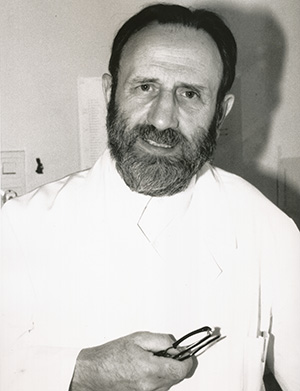
Bernhard Huerkamp (1912-1992) was born on 17.11.1912 in Freckenhorst in Westphalia. After studying medicine, he obtained his doctorate in Münster in 1938. From 1936 to 1938 he was an intern and trainee assistant at the Münster Eye Clinic under Marchesam and from 1939 to 1941 an assistant at the University Eye Clinics in Göttingen under Erggelet and in Bonn under Riehm. After his war service, he worked again from 1946 at the Göttingen Eye Clinic under Erggelet and then under Hallermann, from 1946 to 1949 as an assistant and after his habilitation in 1950 as a senior physician. Appointed associate professor under Hallermann in 1955, he worked as a panel physician in Hanover from 1959 to 1961 and became head physician at the eye clinic of the Hanover-Nordstadt municipal hospital in 1961. In 1969, he was the first person to be appointed to the Chair of Ophthalmology at Hannover Medical School. Huerkamp was very active scientifically, dealing with a wide variety of issues in clinical and experimental ophthalmology. His interests include cataracta syndermatotica, retinal detachment, eye pressure curves in glaucoma, its diurnal pressure fluctuations and drug therapy, retinal vessel width under various experimental conditions, Leber's optic atrophy, pupillotonia, essential iris atrophy, iris diagnostics, X-ray diagnostics of the lacrimal drainage system and infrared photography. In May 1971, Heinrich Honegger from Heidelberg joined his Clinical Department as Head of the Department of Ophthalmic Microsurgery and Experimental Ophthalmology, who became his successor in 1979 after Huerkamp's retirement in 1977 [5].
Heinrich Honegger
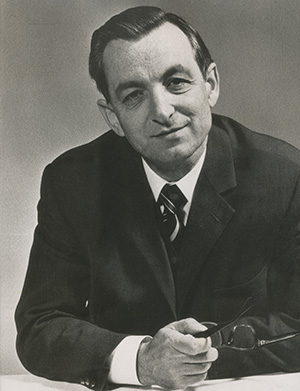
Heinrich Honegger (1925-1985) was born on September 24, 1925 in Aistaig/Rottweil. Before he could finish his schooling, he was called up for military service in the final years of the war, was seriously wounded in a military hospital at the end of the war and was then held as a prisoner of war for a year and a half. Only then was he able to take his school-leaving examination and subsequently study in Tübingen and Heidelberg, where he obtained his doctorate in 1953 with an ophthalmological thesis on the cornea [3, 4]. After completing his compulsory internship, he began his specialist ophthalmology training in 1955 under Engelking and then continued it under Jaeger, with whom he habilitated in 1963. He then worked as a senior physician at the Heidelberg Clinical Department for a further eight years, was appointed Associate Professor in 1969 and moved to the Ophthalmology Department of the Hannover Medical School in 1971 as Head of Department, where he immediately began to modernize the clinic, of which he was appointed Director and Chair in 1979 following Huerkamp's retirement. During his 16 years in Heidelberg, Honegger's scientific work included fibrinolysis in retinal vascular occlusion, visual acuity for moving objects, drug therapy for the eye, the treatment of calcification and the tolerance of antibiotics in the anterior chamber of the eye. However, he is particularly interested in the pathophysiology of the cornea and, in particular, the relationship between corneal swelling and endothelial damage as well as the regeneration of the corneal endothelium over time. In Hanover, he continued his scientific research into the regenerative capacity of the corneal endothelium and discovered that this is not only due to migration, but also to mitotic activity. Further studies focus on local anesthesia and, in particular, new long-term local anesthetics. He also continued his sensory physiology research, which led to results relevant to traffic ophthalmology and ergonomics [5]. His greatest achievement in Hanover, however, was the establishment of a Clinical Department and research facility that was soon able to compete with other university hospitals [3-5]. As head of department, he introduced microsurgery of the anterior segment of the eye to the Clinical Department in 1971, followed by the first pars plana vitrectomy in 1979. During his only six years as head of the Clinical Department, he continued his efforts to modernize the clinic with energy and all his strength [3]. He formed special working groups for glaucoma research and drug-based glaucoma therapy, influencing the healing of corneal epithelial wounds and the fluorescein angiographic detection of iris tumors using specially developed angiography techniques [5]. Personally, Honegger was very modest and always there for others with an untiring willingness to help [3]. He died completely unexpectedly on June 24, 1985 at the age of only 59 [3,4].
Manfred Mertz
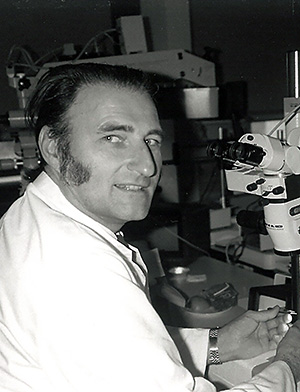
After the sudden death of Heinrich Honegger, Manfred Mertz (*1939 in Berlin) takes over the professorship. From 1958 to 1964, he studied in Göttingen, Vienna and Hamburg, where he obtained his doctorate in 1965. In the same year, he began his ophthalmologic training at the Hamburg Barmbek Eye Clinic under Wolfgang Papst and then continued his training at the Central Hospital of the German Armed Forces in Koblenz. From 1966 to 1969, he also completed specialist training in anatomy and histology including histochemistry, Electron Microscopy and embryology in Tübingen. From 1970, he was first an assistant and then senior physician at the Eye Clinic of the Technical University of Munich under Merte, with whom he habilitated in 1977. In 1983, he was appointed associate professor and three years later was appointed to the Chair of Ophthalmology at Hannover Medical School. Five years later, he accepted an appointment to the chair of his retired teacher Merte and took over the Eye Clinic at the Technical University of Munich in 1991 [4].
Rolf Winter
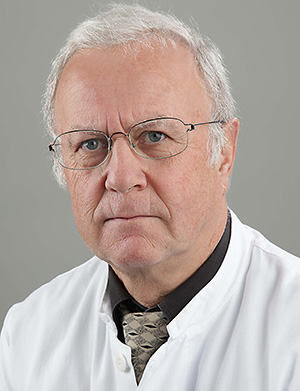
After Mertz returned to Munich, Rolf Winter became the next holder of the Hanover Chair in 1993. Born in Bremen on October 23, 1946, he studied in Kiel from 1966 to 1972, where he obtained his doctorate in 1973. He then completed his specialist training from 1974 to 1979 at the University Eye Clinic in Kiel under Wilhelm Böke, before moving to the Eye Clinic of the Municipal Hospitals in Bremen from 1979 to 1981 as a senior consultant to Draeger and following him, also as a senior consultant, to the University Eye Clinic in Hamburg in 1981 (p. 278), where he qualified as a professor in 1982 and was appointed C3 professor just one year later. After a further 10 years as a senior physician at the Hamburg Clinical Department, he was appointed as Mertz's successor in Hanover in 1993 and in the same year took up his position as Director of the Eye Clinic at the Hannover Medical School [6]. As a student of Draeger, Winter's scientific work focused primarily on the surgical field: transplantation surgery, detailed microsurgical solutions in anterior and posterior segment surgery, corneal preservation and the development of a corneal bank. After taking up his post in Hanover, his main focus will therefore initially be on further improving the surgical options there. Three fully equipped and state-of-the-art surgical units for all anterior and posterior segment techniques were set up. Furthermore, a corneal bank was set up in 1993 using the system developed in Hamburg. In 1997, an additional outpatient surgery center is built as an extension to the polyclinic, so that the number of hospital beds can be reduced to 45. In addition to corneal, glaucoma and vitreo-retinal surgery, great attention was also paid to macular degeneration in the following years and pharmacological therapies were established alongside the latest surgical procedures. Networking with the Clinical Departments of Neurosurgery, ENT and Oral and Maxillofacial Surgery also became a particular focus of his work. Winter retired on 30.09.2012 [6].
Carsten Framme

On October 1, 2012, Carsten Framme took up his new position as Director of the Eye Clinic at Hannover Medical School (MHH), returning to the place where he studied medicine (1989-1996). Framme subsequently worked at the eye clinics in Lübeck, Laqua, and Regensburg, Gabel and Helbig, among others. In Regensburg, he was most recently Senior Consultant and Deputy Director before moving to Wolf as Senior Consultant at the University Clinic for Ophthalmology at Inselspital Bern in 2009. In addition to his focus on ophthalmic surgery and retinology, Framme has also acquired expertise as a Medical Hospital Manager (MHM) and Master of Business Administration (MBA). The retina expert plans to raise the profile of the MHH Eye Clinic in the field of research. To this end, a research laboratory focusing on retinology is to be set up and scientific cooperation is to be expanded. As part of the change of management, the outpatient clinic, eye wards and operating theatres will be modernized.
Literature
(abridged, revised and expanded ) from:
H.J. Küchle, Augenkliniken deutschsprachiger Hochschulen in 19. und 20. Jahrhundert, Biermann Verlag
1 HIRSCHBERG, J: History of ophthalmology. The reform of ophthalmology II. In: Graefe A, SaemiscTh: Handbuch der gesamten Augenheilkunde. 2nd edition 1918, vol. XV/II:297-300. Berlin: Springer
2 HOFFMANN, K : Obituary for Prof. Dr. med. Bernhard Huerkamp. Inf. bl. Hanover Medical School 1992
3 JAEGER,W: Obituary for Professor Heinrich Honegger. Klin Monatsbl Augenheilkd 1985;187:563
4 JAEGER,W: Report 83 Zusk dtsch ophthal Ges 1986:3
5 WERRY, H: Ophthalmology. In: 20 years Hannover Medical School. 1985:389-391
6 WINTER, R: Personal communication 2002, 2012
7 FRAMME, C: Personal communication 2012