Fertility Center
Prof. Dr. Cordula Schippert

Have you been trying to have a baby for some time, but your wish has not yet been fulfilled? There are many reasons why you may not be able to conceive, as well as many treatment options. Our fertility specialists will discuss with you which dysfunctions of the female or male reproductive system are responsible for your unfulfilled desire to have children, as well as the treatment options tailored to your individual needs.
Our fertility team in gynecological endocrinology and reproductive medicine is highly experienced in carrying out all the therapies available in Germany for modern fertility treatment and works at the highest university level with a personal atmosphere and care.
We always incorporate the latest national and international study results, some of which are our own.
We invite you to plan your individual path to pregnancy or fertility preservation with us in a personal consultation.
Contents
- Appointments | Registration
- Your first appointment
- Information evenings for couples who wish to have children
- Services
- Family planning despite a cancer diagnosis? Fertility protection and preservation of fertility
- Supporting offers
Your first appointment
Please prepare the following documents

A referral from the gynecologist is required!
Please send us the following documents ONE WEEK before the initial consultation:
- Copies of all relevant previous findings for your patient file. This includes, among other things: Surgery reports, physician's letters about previous treatments, spermiograms, cancer screening smears, laboratory values, hepatitis and HIV values, rubella and chickenpox antibody titers, vaccination card, etc.
- Questionnaire for couples wishing to have children
- Questionnaire for same-sex couples wishing to have children
We conductthe initial consultation in a personal and confidential atmosphere in order to develop an individual diagnostic and therapeutic concept for each couple. During this consultation, we take enough time to answer your questions.
Information evenings for couples who wish to have children
as a live video chat
We look forward to introducing you to the Fertility Center of the Medical School and the possibilities of diagnostics and therapy as part of the information evenings and to answering your questions about your desire to have children. We would like to invite you to talk to our physicians via live video chat.
Technical requirements are a computer with (integrated) camera, microphone and loudspeakers or headphones. Access is also possible with a tablet or smartphone. Interested parties will receive the access link by e-mail one day before the information evening.
Please register by e-mail to frauenklinik-kinderwunsch@mh-hannover.de
- Monday, June 8, 2026
- Thursday, August 27, 2026
- Thursday, October 29, 2026
- Thursday, December 17, 2026
Time: Start of the live broadcast at 18:00
Duration: approx. 1-1.5 hours
Services
- General and special hormone analyses as required
- Vaginal and abdominal ultrasound procedures
- Clarification of habitual miscarriages (≥ three miscarriages)
- Investigation of implantation failure including various therapies (blastocyst culture, assisted hatching, calcium ionophore, EmbryoGlue, analysis of uterine NK cells and uterine plasma cells)
- Semen analysis (spermiogram) according to WHO guidelines
We offer women and men all therapeutic options for fertility treatment, including artificial insemination (IVF or ICSI therapy), including through excellent cooperation with other specialist areas such as urology, radiology, endocrinology, pediatric clinic within the Hannover Medical School (MHH) and external cooperation partners. In cooperation with sperm banks, we also carry out therapies with foreign sperm.
- Endocrinology treatments for ovarian dysfunction and cycle disorders in the desire to have children
- Insemination therapy after ejaculate preparation in the homologous and heterologous system (foreign sperm via the European Sperm Bank (ESB) in Copenhagen Insemination " Find sperm donors here - European Sperm Bank, the IRC in Hamburg(http://www.irc-hamburg.de) or the SEJ Samenbank Berlin GmbH(http://www.samenbank-berlin.de) for heterosexual or homosexual/lesbian couples
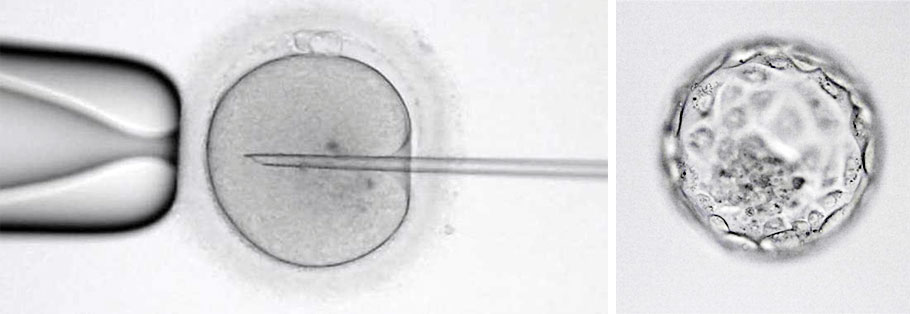
- In vitro fertilization (IVF) and intra-cytoplasmic sperm injection (ICSI) in the homologous/heterologous system
- PICSI (sperm selection procedure for ICSI in the homologous/heterologous system), Zymot (sperm selection procedure)
- Collection of sperm from the epididymis/testicles [MESA/TESE] in cooperation with the MHH Urology Department
- Cryopreservation (freezing) of fertilized eggs, embryos, sperm and testicular tissue
- Fertility protection (preservation of fertility) before chemotherapy and radiotherapy (http://www.fertiprotekt.com )
Cancer is a widespread disease. The period of diagnosis, treatment and aftercare is often very stressful for those affected and their relatives.
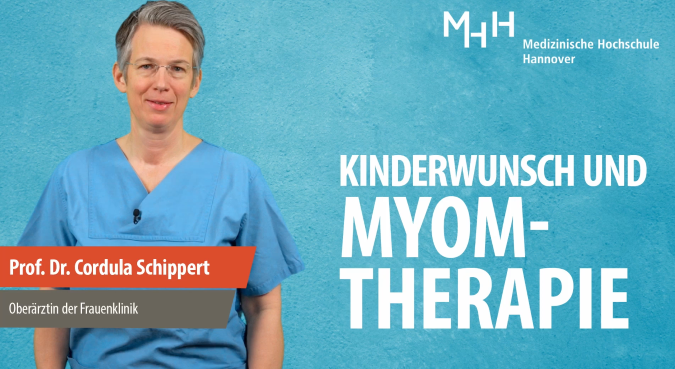
Family planning despite cancer? Prof. Dr. Dr. C. Schippert, Clinical Department for Gynaecology and Obstetrics, Gyn. Endocrinology, Reproductive Medicine MHH
What influence do chemotherapy or radiotherapy have on fertility in men or women?
Both chemotherapeutic drugs and radiotherapy can affect ovarian function in women and sperm production in men.
This means that a woman may have reduced ovarian function or even be unable to have children after chemotherapy. Unfortunately, chemotherapy drugs are not clever enough to kill or attack only the malignant cells, but can also affect all other rapidly growing cells in the body. Unfortunately, this also affects ovarian function and sperm production in men.
What measures can be taken before starting oncological therapy to preserve fertility?
For men it is relatively simple, i.e. we can freeze sperm in advance, i.e. cryopreserve them. This means that the man concerned then goes to a Clinical Department or practice, gives a sperm sample there and then this can be frozen for later fertility treatments.
For us women it is a little more complicated. But there are also several options here: firstly, in the case of radiotherapy in the lower abdomen, the ovaries can be lifted out of the radiation field before treatment by means of an operation in which they are fixed to the pelvic wall under the diaphragm, so to speak.
As a second option, parts of the ovaries can be removed and frozen. This is a fairly new method, practiced for the first time in 2004. In other words, I save half an ovary before chemotherapy and can then transplant it back into the woman's body afterwards if she no longer has ovarian function.
As a third method, we can retrieve the woman's eggs before chemotherapy and fertilize them with the man's sperm if she is in a stable partnership or freeze unfertilized eggs in order to be able to carry out fertility treatment later. However, this requires a period of around two weeks.
And as a last option, we can carry out an injection therapy called menopause therapy. The women concerned are given an injection once a month, which puts the ovaries to rest, i.e. puts them into menopause, so to speak.
With this method, we have to ask the oncologists beforehand how much time they will give us to take these possible measures. Because if chemotherapy or radiotherapy is very urgent and has to be carried out in a few days' time, then we can no longer carry out egg retrieval because we need a certain time window for this.
What are the chances of being able to have children afterwards?
If we have frozen the sperm of an affected man in advance, then the woman of the affected man usually only has the option of becoming pregnant afterwards via artificial insemination, i.e. fertilization outside the body in a test tube, because the sperm quality can suffer a little after we have frozen it - and it depends entirely on how old the affected woman is.
About 30% of women become pregnant per treatment attempt. If we have treated women before starting chemotherapy or radiotherapy, it depends on what methods were used. We reckon that if we have cryopreserved frozen eggs in advance, i.e. frozen them, around 25-40% of women can become pregnant afterwards if we use all the eggs.
If a piece of ovary has been frozen in advance, this is still a fairly new therapy, first carried out in 2004. Worldwide, 120 children have been born after ovarian re-transplantation, in Germany around 20. This is a fairly new method, but very promising and can also be used, for example, in patients who were still minors before the cancer diagnosis and were even children before puberty.
There is a lot going on at the moment and we hope that, by combining the various options, we can help some of the patients to become pregnant and have a child afterwards.

Where can I get more information on this topic?
The best place for patients to go is the FertiPROTEKTnetwork website -www.FertiPROTEKT.com. There is a lot of information there for both patients and physicians. This is a network from German-speaking countries, Germany, Austria and Switzerland, where you can find comprehensive information and contacts in the relevant regions.
Do health insurance companies cover the costs?
Unfortunately, the costs have not yet been covered by health insurance companies. And these are sometimes considerable costs. If we freeze egg cells, for example, it can easily cost €3 - 5,000, if we remove a piece of ovary, it can cost around e1,500. The cheapest option is the cryopreservation of sperm, which costs around €350. However, politicians are making efforts to ensure that some of the costs will hopefully be covered by health insurance in 2019. We and those affected are desperately waiting for this, because some couples have not yet been able to afford it. Which is an extreme shame, especially as chemotherapy drugs and radiation are many times more expensive than fertility-preserving measures. We are desperately waiting for a signal from politicians.
Status 2019
Fertility and fibroid therapy
When can fibroids affect the desire to have children?
Depending on various factors, fibroids can affect the desire to have children. These include the size and location of the fibroids and therefore how they affect the uterus. It also depends on the age of the person affected, whether they have menstrual problems and whether they already have children.
Which fibroids play the biggest role in the desire to have children?
These are mainly the fibroids that grow towards the uterine cavity. These are the submucosal fibroids and the intramural fibroids. However, large fibroids that grow into the abdominal cavity can also lead to serious symptoms, particularly during pregnancy, for example in the form of premature contractions or problems during childbirth.
What needs to be considered during treatment?
This is always very individual. For example, in a woman who wants to have children, the aim is to preserve the uterus, so the form of treatment must be carefully considered.
What role does a fertility center play?
The cooperation between gynecological surgery and the fertility center makes it possible to give special consideration to the desire to have children during treatment. The fertility center can also treat other fertility problems, for example if the man also has findings that affect his ability to get pregnant.