Welcome to Neuropathology
of the Hannover Medical School!
Neuropathology deals with the pathology of the central and peripheral nervous system. The central nervous system is understood to be the brain and spinal cord. Neuropathology is involved both in the examination of biopsies (tissue samples from patients for further therapy planning) and in autopsy diagnostics (cause of death diagnostics on deceased patients).
Neuropathologists thus diagnose diseases of the brain, meninges and adjacent tissue (e.g. pituitary gland, eye, eye socket, bone). The examination of cerebrospinal fluid for pathological cells (cerebrospinal fluid cytology) is also part of the field of neuropathology.
The peripheral nervous system is defined as the musculature of the musculoskeletal system as well as peripheral nerves and their connections. Neuropathologists therefore examine tissue samples from the musculature, from peripheral nerves (mostly biopsies of the sural nerve), as well as the nerve cells of the rectum (rectal biopsies).
Training to become a specialist in neuropathology takes at least six years and consists of two years of basic training in pathology and four years of specialist training in neuropathology. Neuropathology at the MHH has full authorization for further training.
Contact
Fax: 0511 - 53218512
Phone: 0511 - 5325236
Email: neuropathologie@mh-hannover.de
Open positions:
AG Digital Pathology
There are currently no vacancies.
However, inquiries about bachelor theses, master theses and internships can be sent to
feuerhake.friedrich@mh-hannover.de at any time.
Neurooncology working group
There are currently no vacancies.
However, inquiries about Bachelor's theses, Master's theses and internships can be sent at any time to
hartmann.christian@mh-hannover.de at any time.
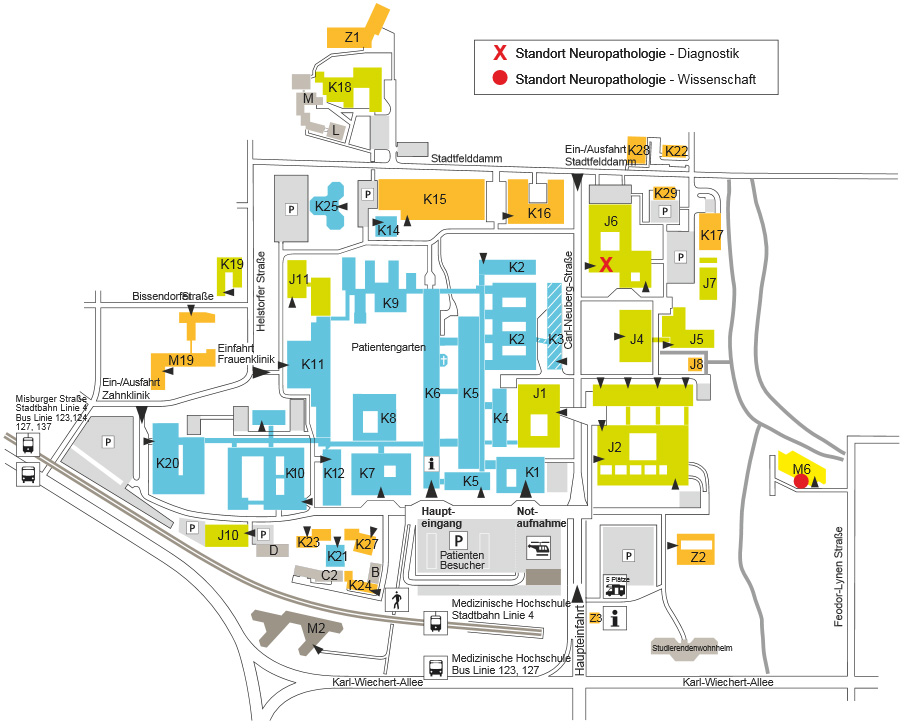
Site plan
Among others, the following diagnostic services are provided by the Neuropathology Department of the MHH:
- Diagnosis of brain tumors
- frozen section diagnostics
- Immunohistochemical diagnostics
- Molecular pathology diagnostics (MGMT, 1p/19q, IDH1/2, BRAF, BRAF:KIAA1549, EGFR, H3F3A, HIST1H3B, TP53)
- Cerebrospinal fluid cytology
- Diagnostics of skeletal muscle biopsies
- Enzyme histochemical diagnostics
- Immunohistochemical diagnostics
- Electron microscopic diagnostics
- Diagnostics of biopsies of peripheral nerves
- Immunohistochemical diagnostics
- Electron microscopic diagnostics
- Diagnosis of rectal biopsies (Hirschsprung's disease)
- Immunohistochemical diagnostics
- Enzyme histochemical diagnostics
- Autoptic diagnostics & expert opinion
Research focus on digital pathology
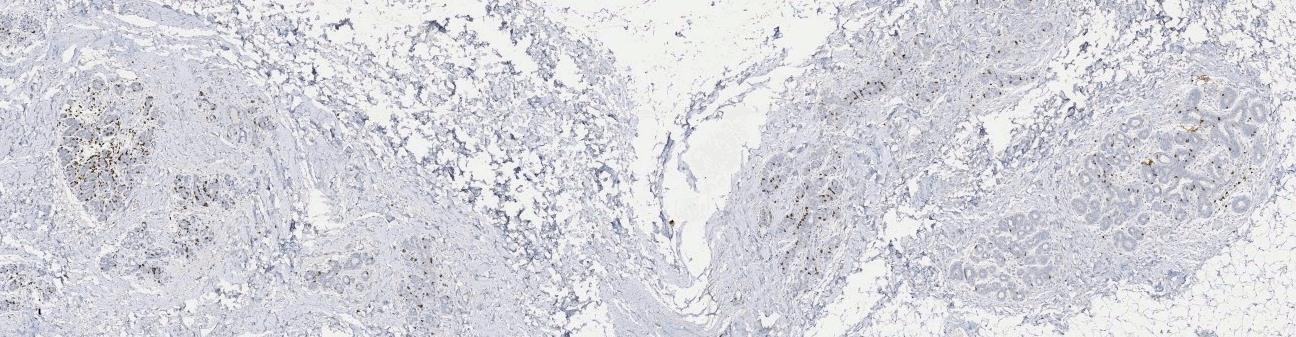
The scientific focus of the Digital Pathology working group is the development of innovative analysis methods for microscopic image data for use in translational biomarker research. In this context, "translational research" means that image analysis is developed on the basis of experimental, preclinical results and then optimized for practical application in biopsies from patients, for example in clinical studies.
The aim is to extend the limits of conventional evaluation of diagnostically relevant tissue markers by using modern methods of analyzing digitized microscopic images and to make them usable for better and more targeted patient therapy. In interdisciplinary cooperation with specialists in image analysis from other fields (e.g. geosciences) and mathematicians (e.g. systems biology approaches to the mathematical modeling of biological processes), the automated recognition of functionally or diagnostically relevant objects in microscopic images is integrated into the evaluation of clinical data and so-called "molecular profiles" (e.g. comprehensive examinations of gene expression or DNA changes).
Specific scientific questions are currently focused on the interaction between immune cells and their target structures in tissue. Ongoing projects deal with the question of how immunological interactions of immune cells with cancer cells or with "exogenous" tissue of a donor kidney after organ transplantation can be better characterized using complex image processing algorithms. Digital pathology offers new perspectives for interdisciplinary collaboration and extends beyond the obvious questions of brain tumors and inflammation of the nervous system in neuropathology.
Current collaborations with clinical and diagnostic colleagues within and outside the MHH are primarily aimed at improving the diagnosis and treatment of kidney transplant patients, as well as a better understanding of inflammatory changes in the development and treatment of breast cancer. The Digital Pathology working group is open to new collaborations and offers a wide range of opportunities for interdisciplinary medical research. For example, medical fields as different as nephrology and tumor immunology have in common that in both cases the quantitative recording of immune cells in the context of the surrounding tissue is of particular clinical relevance.
The experience in preclinical and clinical biomarker research as well as the analytical methods developed here in digital pathology expand the diagnostic possibilities and support the development of new concepts of biomarker-guided targeted therapies.
Head: Prof. Dr. Dr. Friedrich Feuerhake
Employees: Valery Volk PhD, Marcela Francozo PhD, Nicole Krönke
Open positions: Research internships
Links: http://www.sysim.it/

Research focus on neuro-oncology
The scientific focus of the Neurooncology working group, as part of the Neuropathology department at Hannover Medical School, is research into the molecular basis of the development and progression of brain tumors.
Our research concentrates primarily on gliomas, the most common subgroup of brain tumors. Gliomas are thought to arise from the glial cells of the nervous system and account for about 80% of all malignant brain tumors. The term glioma is a generic term for a group of genetically and morphologically distinct tumors. These include, for example, astrocytomas, oligodendrogliomas and glioblastomas. We are particularly interested in the genetic, epigenetic and chromosomal changes that contribute to tumor development and tumor progression.
In addition, the group focuses on specific protein:protein interactions in the context of their function in normal and neoplastic cells and tissues. In addition to basic research, research into the molecular mechanisms underlying the development of gliomas also serves to develop new prognostic markers in order to improve the diagnosis and treatment of brain tumors.
Neuropathology is therefore a direct interface between basic research and the Clinical Department. A broad spectrum of different histological, protein-analytical, molecular-biological and biochemical methods are used. Our research group cooperates with a large number of local, national and international clinical and scientific groups.
Head: Prof. Dr. Dr. Hartmann
Open positions: Research internships, medical doctoral theses, bachelor and master theses