Course details - 3rd year pathology

Details from A - Z
"Pathology in the 3rd year of study"
- Contact person
General inquiries about scheduling, examination days etc.
Ms. Kristina Schidlowski, Schidlowski.Kristina@mh-hannover.de, Tel. (532-) 4454
- Organization
Dr. med. M. Christgen, MD/PhD., Christgen.Matthias@MH-Hannover.de,
Tel. (532-) 4488
Prof. Dr. med. H. Kreipe, Kreipe.Hans@MH-Hannover.de
Tel. (532-) 4501
- Attendance control
For the course sections Macro Course, Internship Section Hall and
Demonstration Section Room you will receive a yellow "attendance card",
on which the responsible teacher confirms your attendance with a signature.
confirms your attendance.
In addition to a photo ID and a drawing script, this card must be
This card must be presented at registration on the day of the exam.
The loss of the card should therefore be reported immediately to Ms. Meyer (see above)
immediately.
Attendance at the microscopy course is confirmed by the signature of the
course assistants in the drawing booklet(page 8).
- Demonstration section hall "DSS"
1 week (5 days), from 11.45 a.m. - approx. 12.30 p.m., call according to tertiary list, homepage
of the Institute of Pathology and notice board in front of course lab L27.
All students who have section hall internship in the same calendar week
(5 days x 6 students = max. 30 participants) are called to the clinical-pathological
demonstration (demonstration room of the dissection room, clinic entrance).
The course is compulsory!
If no dissection can be presented, archived organ preparations will be
will be demonstrated in the dissection room as follows (provisional allocation):
Monday - Liver
Tuesday - heart
Wednesday - Lung
Thursday - Kidney
Friday - Varia
- Evaluation
We welcome any constructive criticism and also positive feedback.
re-registration when you are called upon by the Office of Academic Affairs to
are called upon. Every suggestion for improvement is taken seriously and
(if not only requested by individuals) will be implemented as soon as possible in the following tertials.
- Absenteeism
15% = 5 of the 30 signatures
(20x microscopy course, 4x macro course,5x DSS, 1x PSS) may be missing.
IMPORTANT ! Any longer absence, even if not due to illness, must be
must be agreed with the Office of Academic Affairs.
- ILIAS
On the learning platform you will find the contents of the microscopy course, macro images,
specimen list and other learning materials.
- Literature
Contents of the drawing script, contents of the pathology page in ILIAS, CD
Grundmann, "Allgemeine Pathologie und Grundlagen der speziellen
Pathology", 11th edition 2008, Urban & Fischer
Further reading:
Riede, Werner, Freudenberg, "Basiswissen Allgemeine und Spezielle
Pathology", Springer, 1st edition 2009
Böcker, Denk, Heitz, Moch, "Pathology", 4th edition 2008, Urban & Fischer,
Pages
1 - 249 (basics), corresponding pages of the specimens shown in the course
in the "Clinical Pathology" sections of this book.
Thomas, "Histopathology", 13th edition 2004, Schattauer-Verlag
Kumar, Abbas, Fausto,Mitchell: ROBBINS "Basic Pathology", 8th Edition
- Macro course
4 dates according to group division; Grp. 1 on Monday of a course week,
Grp. 2 on Tuesday etc. from 13.30 s.t. - approx. 15.00 h
in lecture hall S building I6, level S or
Pathology library seminar room, building I6, level 02 room 2121
From Monday to Friday of each week, approx. 20 specimens per day will be
will be presented and the main features discussed. For this purpose
contents of the lecture are repeated and supplemented.
These macro images can be found in ILIAS.
These images are relevant for the exam.
The course requires attendance.
- Microscopy course in course lab L27
10.00 a.m. s.t. - approx. 11.30 a.m.
Under the guidance of the "navigator", the most important histopathological
features of the specimens of the course day are pre-microscoped on monitors.
If necessary, course assistants will adjust essential areas of the preparations on your
microscope and answer questions. Over the four weeks, approx. 130
specimens will be microscoped together.
Daily from 10.00 to approx. 11.30 a.m. in the course laboratory L27, call according to the tertiary list.
Please note the notice board in front of course lab L27.
The course is compulsory!
Free choice of seats on the 1st day of the course ! Please read the seat number from the yellow labels
on the tables and write them on the cover sheet of the script.
Each preparation should be drawn in the drawing script. In this
also contains the essential characteristics of the microscopic specimens
(see below). Colored pencils must be brought by the students!
Attention:
Attendance in the course will be recorded daily in the drawing script (page 8).
Approx. 11.30 a.m. - 12.30 p.m. s.t. "Free microscopy" (daily, Mon. - Fri.)
After the "supervised" time of the course day, you have the opportunity to spend another 1 h
to microscope the specimens of your choice.
However, you will spend this time without course assistance
(1 student assistant or technical assistant may be on site).
- Microscopes
The microscope is your "tool of the trade" for the microscopy course.
Simply wiping the objectives or the microscope slide allows you to
occasionally allows a sharper view of the important things in the specimen.
In the event of excessive soiling or technical problems, please
the course assistants for help. Make use of all magnifications,
magnification, but always start with viewing with the "naked eye" and
the magnifying glass. This provides a good overview and makes it easier
approach to the higher magnifications.
- "Normal" histology
To repeat the normal histology of many histopathological tissues shown in the microscopy course
histopathological tissues shown in the microscopy course, please refer to your script from
module "Microscopic Anatomy" and to the intranet page of the Anatomy Center at
Center for Anatomy under "Microscopic Anatomy".
- Slot numbers
The seat numbers can be found on yellow labels on the tables
of the course laboratory L27 and are identical to the place numbers assigned to the
preparation boxes (i.e. box A1 or B1 is located at seat 1).
- Internship section room "PSS"
1 day; call according to tertiary list.
Every day 6 students are assigned to the practical course section hall.
Meet at 8.15 a.m. (please be on time!) at the entrance door to the
Demonstration Room Sections (basement floor, behind lecture hall R).
Participation in a clinical section (until approx. 11.30 am).
Dress code in the section room:
Overshoes* over closed (!) footwear,
long (!) legwear if possible, protective gown*, gloves*,
face mask*, safety goggles* if required
(* = will be provided in the section room.
Nevertheless, please also wear correct protective clothing
before entering the dissection room).
If no dissection is carried out in the Institute of Pathology,
alternatively, the PSS can also take place as part of an autopsy at the
Institute of Forensic Medicine.
The time and place will be announced on the day.
If no necropsy is performed => practical introduction
to the clinical necropsy !
The course is compulsory !
- Specimens
In the boxes A and B you will find a selection of representative
histopathologies for the respective topics of the course.
The specimens have been carefully selected to enable you to recognize
recognize the essential pathological structures and the
"pathological principle".
Please bear in mind, however, that it is in the "nature of things" that in
the architecture of an organ preparation changes at deeper sectional levels and therefore
the specimen of your neighbor may therefore appear differently.
A "1 to 1" transfer of all histopathological characteristics
in terms of position and shape is unrealistic and is also not found in
daily diagnostics.
There are also a number of specimens from which we can, for example
show both sections of the resectate in one box and in other boxes
a biopsy corresponding to the specimen.
! Thus, an essential goal of the histopathology course is not the mere
recognition, but to learn the comprehensive description of the pathological
pathological changes in the organ structures,
which should consequently lead to the correct diagnosis!
The preparations are subject to wear and tear due to continuous use.
Please handle the preparations with care.
Preparations which, for reasons of wear and tear after the last tertial
replaced by new, equivalent preparations in all course boxes after the last tertial
are marked with a letter in addition to the preparation number
(e.g. preparation 69=old; preparation 69a=new).
- Preparation boxes
The slide boxes are labeled with the student's place number and the designation
labeled A or B. First box A
(course days 1 - 14) and then box B (course days 15 - 20).
The preparation boxes are ready at your place and should remain there at the end of the course day.
and should remain there at the end of the course day.
Taking over the box each day also means taking responsibility for your
responsibility for your "own" specimens in the box and you should handle them accordingly.
the preparations should be handled accordingly.
On your own behalf: The "production" of a preparation box is labor-intensive
and time-consuming. Unfortunately, at the end of a course tertial, there are always
boxes are always incomplete.
If specimens (= slides) are missing or damaged in the box,
please make a note of these on the slip of paper in the box during the course,
which is in the box.
Despite the greatest care on our part, incorrect positions cannot be avoided.
If necessary, please microscope the specimen from a complete box.
- Examination (SOE)
Call according to the examination list (see there). Registration on the day of the examination in
Building I6 (Theory II), Level 01, Room 2162 ("Inquiries from students").
The examination is exclusively oral.
At two wards (histology, 2 specimens and macroscopy, 3 specimens)
selected examples from the microscopy course and macroscopy course will be used to
the knowledge from the lecture, textbooks and pathology course is tested.
At the macro station, the focus is on the material from the
"Internship dissection room", "Demonstration dissection room" and macro course.
The examination is a double examination (always two students at the same time)
and lasts approx. 25 minutes at the histo station (i.e. approx. 12.5 minutes per examinee),
approx. 20 minutes at the macro station (approx. 10 minutes per examinee).
Relevant for the examination are: Microscopy, images from the macro course
(laptop is available in the examination) and examination discussion.
Points are awarded for each of the 5 specimens at the two stations
according to the Abitur scheme (0-15 points); for the histo and macro station
macro station, the average score is determined.
The average total score is calculated from these two scores
and converted into grades for the final grade.
If the mean value of the two partial scores at one of the two stations is
is less than or equal to 3 points, the entire examination is considered
"failed" (no compensation with the other examination ward possible).
- Exam results
Are announced on Friday of the examination week for all students at the same time at
16.30 for all students at the same time (notice on the "notice board"
in building I6, theory II, in front of L27 and on the pathology homepage).
- Tertiary list
Displayed on the information board in front of course lab L27
(Level H, Theory II, Building I6) and on our homepage.
Here you can see the classifications for DSS, PSS, macro course.
The examination date will be posted some time later.
- Lecture
Introduction to the topic of the day in lecture hall S
daily from 8.15 to approx. 9.45 am.
To be attended by all students, this is where the theoretical
The theoretical basics for the microscopy course and beyond are taught there on the same day.
- Self-study
Successful participation in the pathology module requires, in addition to the
the lecture and the microscopic and macroscopic internships
intensive self-study with textbooks (see above).
- Drawing the histological preparations
It is not a question of being able to draw beautifully or
to demonstrate this ability in the course.
This course is NOT a painting course.
However, the background is the concentrated examination of the
histopathological characteristics of the specimens during
microscopy, drawing also helps with the daily follow-up work
and in preparation for the examination.
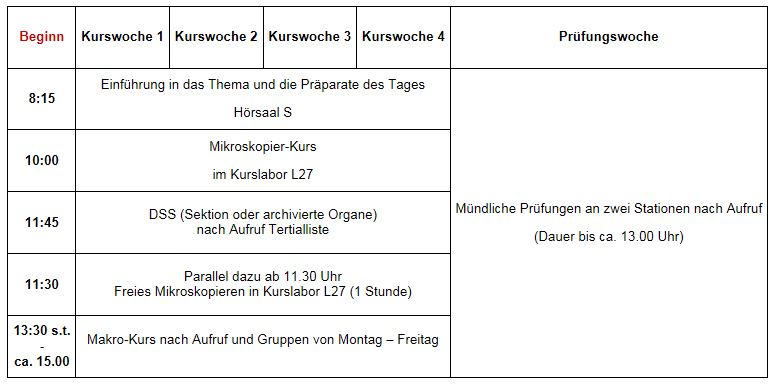
Basic structure of the tertial lessons
(not noted is the internship in the "PSS" section room, 6 students per day according to schedule and call)
The Institute of Pathology wishes you lots of fun and success!